Brinkmanship, the ability to take a country to the edge of war without plunging it into the abyss, was the cornerstone of cold war diplomacy. But in our different, more unstable times – in which the line between state and non-state actors has blurred, and weapons of war have diffused – the world this week finally tipped over the edge, and suddenly it is in freefall.
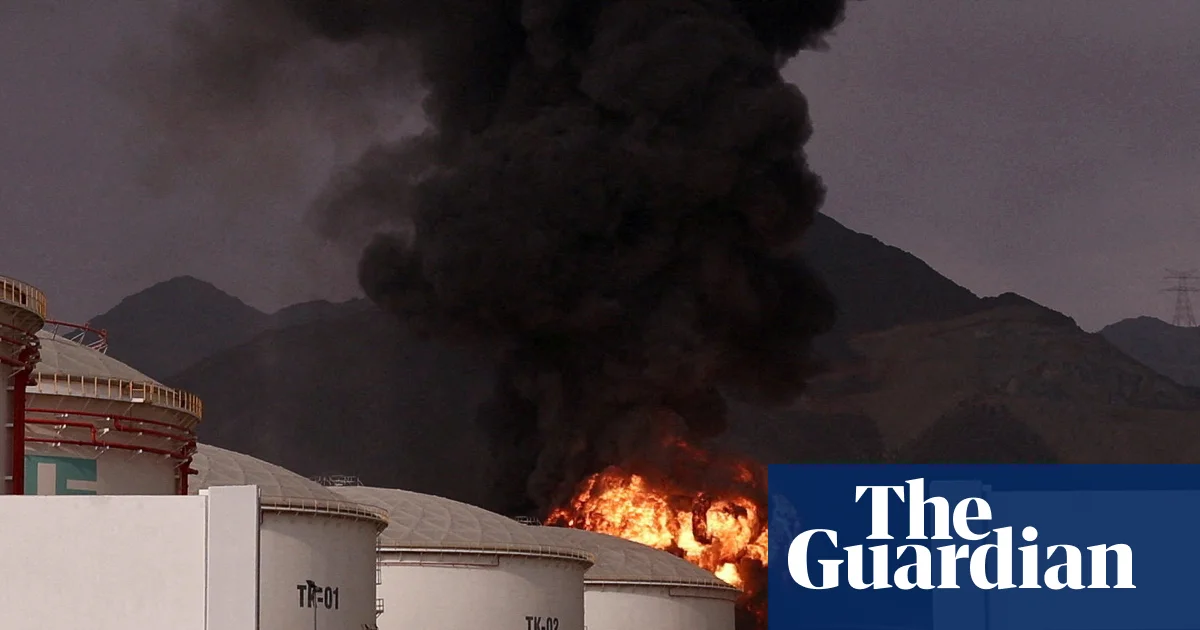
The first six days of the Iran war cost the US $12.7bn (£9.5bn), but now the Pentagon is seeking as much as $200bn in military funding. Oil at $125 a barrel is no longer an Iranian, or Russian, fantasy. The crown jewel of Qatar, Ras Laffan – the world’s largest liquefied natural gas plant – may not reopen fully for five years, at a cost of $20bn a year. Other combustible oil depots in the Gulf, from Bahrain to Abu Dhabi, are exposed to Iran’s low-cost drones. Then add the human cost of 18,000 civilians injured and more than 3,000 killed in Iran alone.
The regime in Tehran, fighting for its survival, had long warned that if it were attacked it would retaliate by targeting American bases in the region. Yet Donald Trump, the US president, seemed surprised when it did so. Inured to decades of isolation and condemnation, Ali Khamenei, the late supreme leader, said at the beginning of February: “The Americans should know that if they start a war, this time it will be a regional war.”
Iran also said a new phase of the conflict would begin if its energy facilities were attacked. Ali Larijani, the assassinated Iranian security chief, set this out explicitly to the Gulf states and tried to persuade them that their national interest did not lie in siding with Israel. But he was being given “a martyr’s funeral” on Wednesday as Iran struck Ras Laffan.
The Iranian regime has no compunction about escalating the war. Indeed, its willingness to do so is its greatest weapon. An Iranian official warned this week: “Other playing cards have been designed that will enter the fray at the right time.” This is probably a reference to the Gulf’s desalination plants, the centre of the region’s fragile ecosystem.
Iran’s leadership, with nothing to lose, benefits from an asymmetric advantage of fear. For instance, for Europeans such as Giorgia Meloni, the Italian prime minister, the chief concern is recession and a mass influx of refugees from a broken Iran. She says Europe should prepare to close its borders. Equally, sending naval ships to reopen the strait of Hormuz looks fraught with political danger for European leaders. Trump may now call for “a team effort” to ensure the safety of the strait, but Europe is being asked to escalate a war on which it was not consulted and whose consequences it predicted.
In the White House the US president is said to be “angrier than he has ever been”. He fumes at his European allies, whom he regards as dithering and ungrateful, and his Maga critics. He is furious with Tulsi Gabbard, his director of national intelligence, for testifying to Congress that Iran was not rebuilding its uranium enrichment facilities, and with JD Vance, the vice-president, whose silence speaks volumes.
Even his appeal among the populist European right is under strain. Tino Chrupalla, the co-leader of Germany’s Alternative für Deutschland, complained: “Trump started off as a peace president. He will end up as a president of war.”
Still worse, the US alliance with Israel, the rock on which the war was launched, is causing him trouble with the Gulf states and prising open the divergence in Israeli and US objectives. Trump backtracked on his claim that Israel had not consulted him about its strike on Iran’s South Pars gasfield, an attack the Gulf states had asked not to take place because it would lead to Iranian reprisals.
Trump said on Thursday: “I told [Benjamin Netanyahu] don’t do that. We get along great – it’s coordinated. But on occasion, he’ll do something and if I don’t like it, [I tell him] we’re not doing that.” But it was the second time in a week that Israel seemed to have a different approved target list to the US. Earlier in the war Israel bombed four major fuel storage depots surrounding Tehran, causing black rain to fall in the city.
Diplomacy seems to have come to a standstill. In the British embassy in Tehran, the only occupant is a dog, and he only has three legs. Around diplomatic lunch tables in London there is forlorn talk of off-ramps, but few can identify one that Trump might be willing to take.
How could the war end?
There are three options: a long and drawn out conflict ending with Iran’s capitulation; a unilateral declaration of victory by Trump; or an agreement, large or small, regional or bilateral, sweeping or narrow, that ends the fighting.
For Simon McDonald, a former permanent secretary of the Foreign Office, a US-Israeli victory should not be discounted. He told a House of Lords select committee: “From what I can see in Iran, the country that is achieving its objectives is Israel. Netanyahu has been personally obsessed with Iran all his life. He had a bust of Churchill in his office and this was his role model.
“Churchill was the only one in the 1930s that saw the threat from Nazi Germany and he felt saw the threat from Iran similarly. This is the culmination of a lifetime plan. It might work. There is a lot of doomy prognostication about what is happening in Iran. They [Israel] could achieve their objectives.”
In the second option, Trump could declare victory and simply walk away, arguing that he has destroyed, or diminished, Iran’s ability to threaten the region again. There have been moments when Trump appeared ready to take that step, when he claimed the destruction of Iran’s navy, nuclear programme, security apparatus and ballistic missile launchers was complete.
Israel, now lobbying for troops on the ground, would have no choice but to accept his judgment. The whereabouts of Iran’s highly enriched uranium would be unknown, the limits of US air power would be confirmed, and the strait of Hormuz, which at its narrowest is only about 21 miles wide, would continue to be a chokepoint for tanker traffic. Iran’s protesters could take their chances.
But that presupposes Iran is willing to go along with this pretence. Aslı Aydıntaşbaş, a fellow at the Brookings Institution thinktank in Washington, said of the regime in Tehran: “There has been a change in the regime, not a regime change, and that change has been for the worse, towards a harder, more nationalist Islamic Revolutionary Guard Corps that is operating within a devolved command structure.”
It is striking that reformists such as Mohammad Khatami, a former president of Iran, have argued that the assassination of Larijani has set back the chances of peace. “It is astonishing that those who come under brutal attack and assassination are precisely the ones who, in addition to their valiant defence of the nation’s and country’s essence, are capable and eager to bring about a dignified peace if such a path exists,” Khatami said.
The final option is de-escalation followed by peace. That peace could be one in which all sides are shown “the full ballet” in advance – a phrase sometimes used by Jonathan Powell, Britain’s national security adviser – or it could be achieved in a piecemeal way. Badr Albusaidi, Oman’s foreign minister, who mediated in eight rounds of talks between the US and Iran, wrote a piece in the Economist setting out a rational vision in which all sides in the region secure a substantive deal on nuclear transparency in the context of a regional non-aggression treaty.
But the Gulf is divided over which is the greatest threat: Israel or Iran. Iran’s preparedness to sacrifice the Gulf’s economies is helping it to lose that argument, even in Qatar and Turkey, the two countries most likely to persuade the Iranian leadership to negotiate. If there is any mood to review the value of US bases in the Gulf, and whether they have become a source of insecurity, it is not evident.
Prince Faisal bin Farhan, the Saudi foreign minister, said on Thursday that Iran had miscalculated if it believed the Gulf states were incapable of responding to its actions. “What little trust there was before has completely been shattered, and shattered on multiple levels,” he said.
Without trust, the destruction will only continue, and Iran will endure a Nowruz – new year – bereft of any semblance of renewal.