We may receive a commission on purchases made from links.
Makita is often seen by many as the single best major power tool brand on the market. Anyone who’s ever used the company’s tools can attest that they are sturdy, powerful, and offer some of the best build quality money can buy. Makita also has several exclusive technologies baked into its products that you can’t get with any other brand. Add all this up, and it’s easy to see why the blue and black tools are a popular choice among working pros and DIY enthusiasts alike. Unfortunately, Makita’s tools are also generally among the most expensive options you’ll find on the shelves of your local home improvement store.
Harbor Freight doesn’t quite share Makita’s reputation for prosumer-level quality. The discount retailer owns most of the brands that it sells, and these tools are better known for offering an extremely competitive price-to-performance ratio rather than competing in the upper echelons of quality. In fact, one of the company’s main strategies is to produce tools that are very similar to popular models made by premium brands (like Makita) and then sell them at a fraction of the price. This isn’t a secret, either. Harbor Freight openly invites its shoppers to compare these tools to the models made by rival brands on its website. This is particularly true of the retailer’s Hercules products, which serve as its primary premium power tool brand. Those who like Makita’s designs but can’t quite afford to spend Makita-level prices might be interested to see which Harbor Freight tools the company claims are similar, how much they cost, and what kinds of specs and features they offer.
Hercules 15 Amp 7 ¼-inch Circular Saw (HE72)
There are a lot of different kinds of power saws out there, but few can match the lightness and versatility of the circular saw. These are great for everything from DIY projects and cutting 2x4s to breaking down large sheet goods that don’t fit on a miter or table saw. The Makita 7 ¼-inch 15 Amp Corded Circular Saw (5007F) is a fantastic tool if you can afford the $174.00 price point. Its 15-amp motor is able to deliver up to 5,800 RPM, and it has a bevy of features that make it great for beveled and mitered cuts. It has a 4.8 out of 5 on the Home Depot site, so you know that users love it as well.
Harbor Freight compares this to the Hercules 15 Amp 7 ¼-inch Circular Saw (HE72), which it has listed for just $99.99. This is another corded saw with the same blade size and 15-amp ball-bearing motor. But that isn’t all. If we’re going by the spec sheet, these two have a lot in common. The tool also promises a top speed of 5,800 RPM, has a built-in dust ejection system, and has an impressive cutting capacity, promising 57-degree bevel capacity with detents at 22.5 degrees and 45 degrees.
This tool’s listing on the Harbor Freight site is also a 4.8 out of 5, with 96% of customers stating that they would recommend it. Several users have pointed out that the saw isn’t just powerful, but that it’s also well-balanced and has very little vibration. Users have also commented on the high quality of the materials used in its construction.
Hercules 3.5 Amp Variable Oscillating Multi-Tool (HE41)
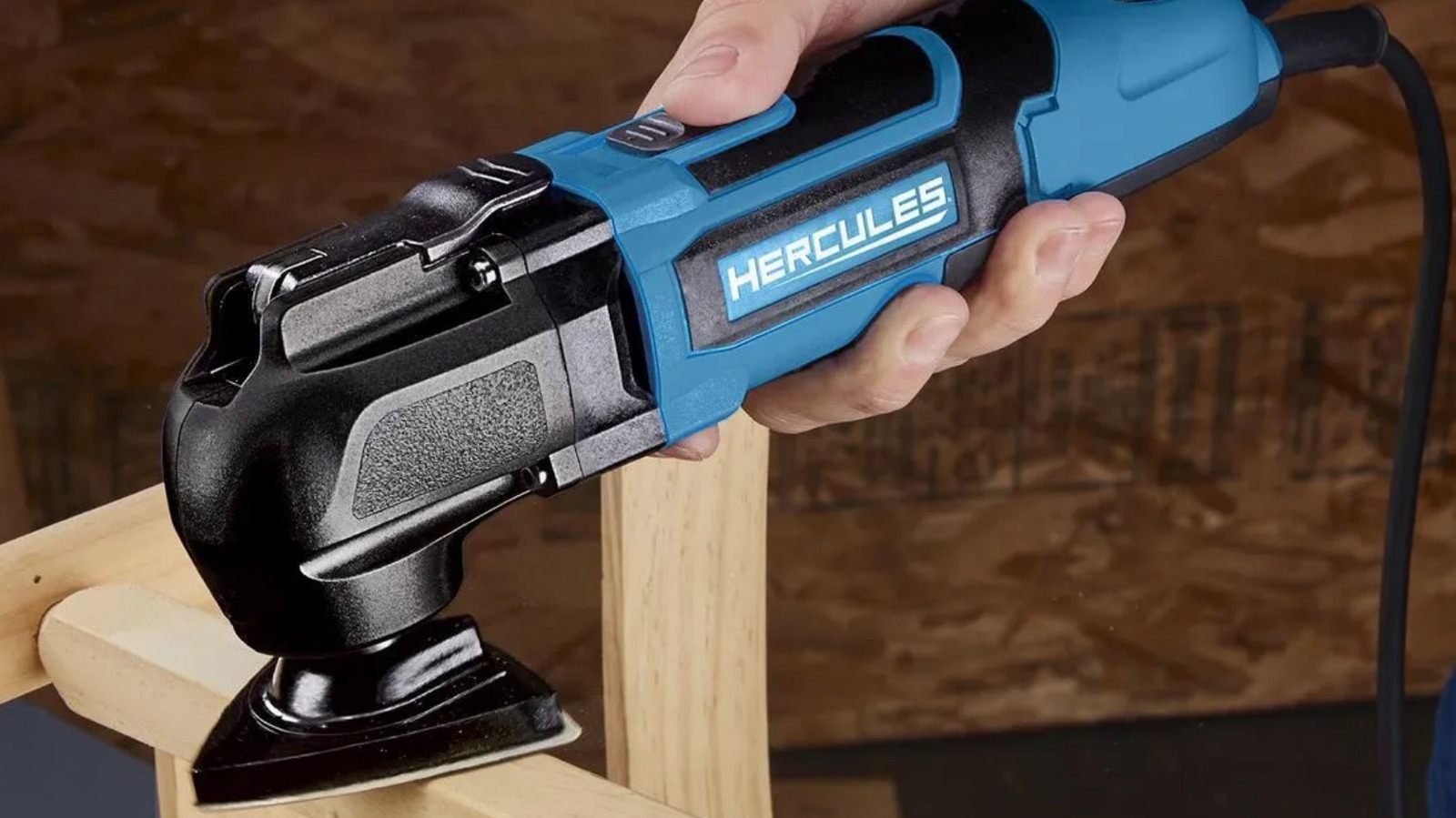
An oscillating multi-tool is a great addition to any collection. You can use it to plunge cut trim, flush cut nails, grind out grout, sand difficult to reach places, and just about a hundred other uses that you won’t think of until you own one. The Makita 3 Amp Corded Variable Speed Oscillating Multi-Tool (TM3010CX1) will run you about $209.00 at your local Home Depot. This tool can deliver 6,000-20,000 oscillations per minute (OPM), has a 3.2-degree oscillation angle, vibration absorption tech built-in, and promises to keep the buzzing under 80 dBa. It also comes with a hardshell carrying case, several sheets of sandpaper, and an adapter. Harbor Freight asks you to compare that to its Hercules 3.5 Amp Variable Oscillating Multi-Tool (HE41), which it sells for just $74.99. Admittedly, this doesn’t include the carrying case or any of the accessories, but it does boast a larger, 3.5-amp motor. It matches the Makita’s 20,000 OPM top speed, has a 3.3-degree oscillation angle, vibration control, and a soft-start motor.
This one has a 4.6 out of 5 on the Harbor Freight website with a 94% recommendation rate. There are consistent complaints about the tool getting really hot over extended periods of use (a common complaint with oscillating multi-tools), but customers otherwise appear very happy with its durability, power, and general build quality. They were particularly pleased by the utility of its toolless blade exchange system and variable speed control dial.
Hercules 12 Amp Variable-Speed Reciprocating Saw (HE75)
A quality reciprocating saw is another tool that belongs in just about every garage. You can use one of these for demo and construction work as well as a variety of landscaping jobs. It isn’t the most accurate tool in the world, but a good one can eat through just about anything.
The Makita 12 Amp Corded Reciprocating Saw (JR3051T) is a beast of a tool that promises a 1 3/16-inch stroke at a rate of up to 3,000 strokes per minute with an electronic speed control system. It has a variable-speed trigger and toolless blade changing. The only downside is that it costs $159.00. Harbor Freight carries a similar model: the Hercules 12 Amp Variable-Speed Reciprocating Saw (HE75). As you can no doubt tell from the title, these two tools share the same size motor and variable speed functionality. The Hercules performs just under the Makita here, with a 1 ⅛-inch stroke length and a max speed of 2,800 strokes per minute. It has a pivoting shoe that can be adjusted up to 30 degrees, a keyless blade changing system, and a special anti-vibration design, but the biggest upside to choosing this Hercules tool is that you can save nearly a third of the price by getting this one for just $109.99.
This saw has a 4.7 on the Harbor Freight site, with an impressive 97% of customers stating that they would recommend it to other buyers. Users said that it will cut through 2×4 like butter, but some of them also claimed that they used it on significantly harder substances, such as metal suspension bolts and blocks of solid ice.
Hercules 4 Amp ¼-inch Die Grinder (HE64)
If you do a lot of sanding, grinding, honing, and polishing, then you probably want to add a die grinder to your collection. These are most often associated with metalworking tasks as they are vital for deburring and smoothing welds, but they have a lot of great applications in restoration, woodworking, and automotive work as well.
One option you might consider is the Makita 3.5 Amp ¼-inch Die Grinder (GD0601). This corded tool can reach rotational speeds up to 25,000 RPM. It also promises heat resistance with prolonged use and has specially directed vents to direct hot exhaust away from the user. Harbor Freight counters this with the Hercules 4 Amp ¼-inch Die Grinder (HE64). This has a slightly larger motor while promising to meet that same 25,000 RPM speed. It also has similarly designed directional vents to help with heat dissipation. The Makita version is $169.00 while the Harbor Freight model is $79.99. It is worth noting, though, that the Hercules is a bit heavier, weighing 4.3 pounds to the Makita’s 3.7 pounds.
Even so, the Hercules Die Grinder has a 4.5 out of 5 on the Harbor Freight website with a 91% recommendation rate. Nearly all of the positive reviews commented that the tool had enough raw power to take on any project they threw it at. The two biggest complaints that the tool received was that the power switch is a bit finicky and that many users would have preferred if it had a variable speed dial or trigger to offer a bit more control.
Hercules 20V 2 ½-inch Variable-Speed Compact Band Saw (HCB790B)
Finally, we have the band saw. The continuous looping blade used in this tool is great for cutting all kind of objects with curves and irregular shapes, such as dowels, channels, or pipe. There are a lot of good ones out there, but the Makita 18V LXT Band Saw (XBP04Z) is a top pick for many fans of the brand. It retails for a hefty $379.18, though it’s worth noting that cost also includes the addition of a 32 ⅞-inch 18 TPI blade. This is a compact cordless tool that has a brushless motor and promises its variable speed blade is able to cut at a rate of up to 630 feet per minute (FPM). Harbor Freight has the Hercules 20V 2 ½-inch Variable-Speed Compact Band Saw (HCB790B). This has the same cutting capacity and variable speed capability, but it promises an ever-so-slightly faster maximum cuts speed at 635 FPM. Best of all, it goes for just $109.99–less than a third the price of the Makita.
It isn’t just affordable though, users really seem to like it as well. The Hercules 20V Band Saw boasts an impressive 4.9 out of 5 aggregated score on the Harbor Freight website, with an even more impressive 100% recommendation rate. Customers seem very happy with the tool’s power and performance. They’ve claimed to have used it to cut through thick walled pipes, square metal tubing, chain link, metal Unistrut channels, and other dense materials with ease. One even said that they cut through a a 3-inch metal fence post quickly and easily.
Our Methodology
Makita is well known for being one of the best construction-grade power tool brands on the market, but many of its tools may be a little to pricey for the average consumer. With that in mind, we thought that consumers might be interested in taking a closer look at the tools Harbor Freight offers that the company itself lists as being comparable to the more expensive Makita options.
In making this list, we started by taking a look at the tools that Harbor Freight itself compares to Makita-brand models. We chose the five most highly rated models we could find, and then took a look at how they compare. We broke down the differences in specifications, features, and price–highlighting areas where the Harbor Freight model may have been stronger or weaker than its Makita counterpoint. We then examined customer reviews on these Hercules tools with the aim to see what users thought about them in general, while also attempting to inform users of the tools’ biggest strengths and weaknesses. That way, any perspective buyers would be able to make an informed decision.