A lab-grown oesophagus that can restore swallowing has been created by British scientists in a breakthrough that could transform treatment for babies born with severe birth defects.
Researchers at Great Ormond Street Hospital and University College London developed a replacement section of the food pipe and used it in a transplant operation to repair damage in animals, allowing them to swallow normally.
The tissue was grown using the recipient’s own cells, meaning no anti-rejection drugs were needed – a major advantage, as these medications can leave patients vulnerable to infections.
Experts say the advance could one day help babies born with long-gap oesophageal atresia, a rare condition in which the food pipe does not properly connect to the stomach.
Around 180 babies are born with oesophageal atresia in the UK each year, with the most severe cases requiring multiple complex operations soon after birth. Without treatment, affected babies can be unable to swallow safely and are at risk of serious complications including choking and pneumonia.
Researchers hope the technique could eventually be tested in human patients, offering a less invasive alternative to current surgery.
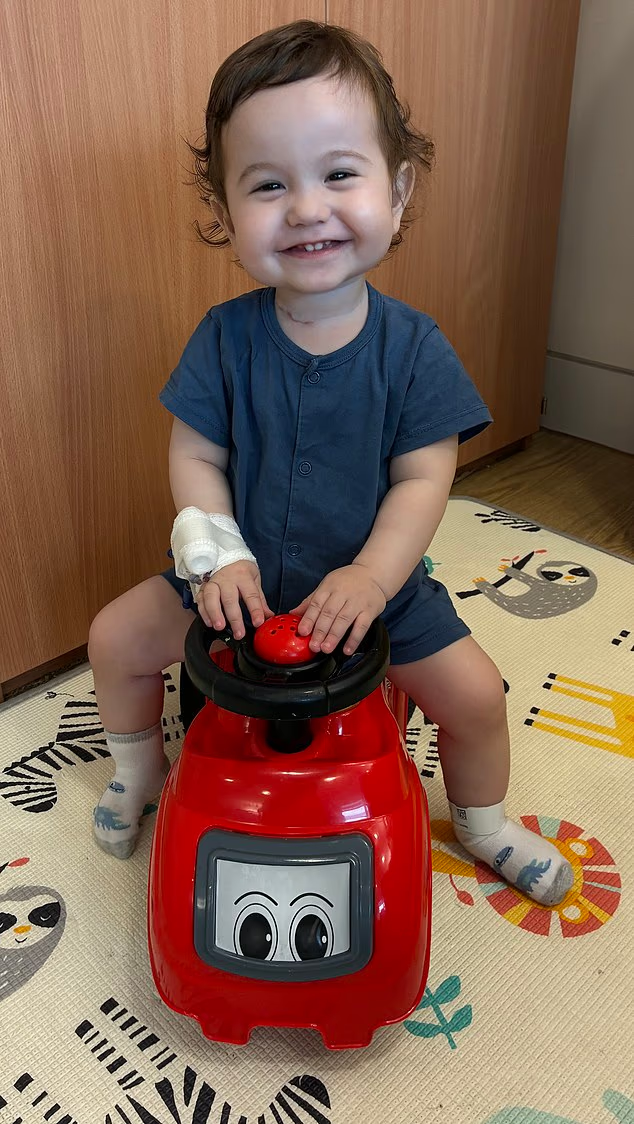
For families already living with the condition, the potential impact is huge. Two-year-old Casey McIntyre, from London, was born with part of his oesophagus missing and has already undergone multiple major operations.
Advances like this could one day mean babies like Casey avoid years of complex surgery and recovery.
Two-year-old Casey McIntyre was born with part of his oesophagus missing and has already undergone multiple major operations
Current treatments are highly invasive, often involving major surgery to reposition the stomach or sections of the intestine – complex procedures that can leave children facing lifelong health problems.
Complications can include breathing difficulties, digestive issues and a higher risk of cancer later in life.
In the study, published in Nature Biotechnology, scientists used a pig’s oesophagus – chosen because it closely resembles a human’s – and removed all its living cells, leaving behind a natural framework.
They then added muscle cells taken from the recipient animal.
After being grown in a special device for a week, the engineered tissue was implanted, where it integrated with the body.
All eight animals survived surgery, went on to eat normally and grew at a healthy rate.
They were monitored for six months, during which the lab-grown oesophagus developed muscles, nerves and blood vessels – and was able to contract and push food down to the stomach.
Lead researcher Paolo De Coppi said the work could revolutionise care within years.
He said: ‘For more than 50 years, pig heart valves have been used to extend and save the lives of patients with heart disease, and this technology is now commonplace in cardiac surgery.
‘More recently, xenotransplantation [transplanting animal organs into humans] has been explored as a potential solution to organ shortages.
‘In our work, we demonstrate that pig tissue, once stripped of all cellular material, can serve as a scaffold to engineer humanised tissue that is fully biocompatible.
‘I believe we are now standing at a similar new frontier in regenerative medicine.’
Dr Natalie Durkin, paediatric surgical registrar and lead author, said: ‘Each one of these steps represents a key milestone in being able to deliver this as a viable treatment option for children in the near future.’
Aoife Regan, GOSH Charity’s director of impact and charitable programmes, said: ‘We are thrilled to see the success of this research, which is offering more hope to children with a highly complex and rare condition that can significantly affect their quality of life.
‘Providing funding for key projects like this demonstrates the impact innovative research can have on those who need it most.’
The team believes personalised oesophagus transplants for children could be possible within five years. Cells could be taken during routine procedures and used to grow a tailor-made replacement that integrates with the body without the need for long-term anti-rejection drugs.
For families, the breakthrough offers hope of avoiding years of gruelling treatment.
Casey’s mother, Silviya, said: ‘We had several scans before Casey was born, so we knew he had issues with his oesophagus – but it was still very worrying to find out he was born with several centimetres missing.’

Casey’s mother Silviya said: ‘It’s been a long road. He’s had major operation after major operation.’ Casey is pictured in hospital

Casey is pictured with his parents, Sean and Silviya, on his second birthday. His father said: ‘The idea that one operation could fix this early in life would be life-changing’
‘He’s had major operation after major operation as we simply couldn’t get the gap to close using his own tissue.
‘The repeated surgeries have left him with some damage to his vocal cords, so he’s developing his speech and noise-making to catch up. Once he’s eating enough through his mouth, we’ll be able to take his tube out.’
His father, Sean, added: ‘People can never tell Casey has spent half of his life in hospital and hopefully he won’t remember, but the memories will never leave us.
‘We’ve had to learn things as new parents that we never considered would be part of our family life, from feeding him through a stomach tube to what to do if the hospital call with an urgent update in the middle of the night.
‘To look at him, he’s just amazing and we are very proud of him.
‘Whatever the team did for him was really a miracle, but the idea that there could be one operation early in your child’s life, that could transplant a working piece of oesophagus, and then we could move on would be life-changing.’
But some experts have urged caution.
Prof Dusko Ilic, Professor of Stem Cell Science at King’s College London, said there is no proof yet that the engineered organ can grow with a child.
‘The study represents a significant advance in engineering functional replacements for complex hollow organs, but the suggestion this approach offers a solution for children born without an oesophagus is premature.
‘Although the graft shows remodelling and functional integration over six months, it is implanted at a fixed length, and there is no evidence it can scale with growth.
‘Persistent fibrosis, stricture formation and the need for repeated interventions indicate it behaves as a remodelling scaffold rather than a dynamically growing tissue. Long-term studies are needed before claims of suitability for growing paediatric patients can be made.’
Researchers are now working to create longer grafts, improve blood supply and prepare for the first human trials. If successful, the technique could also pave the way for repairing other organs in the future.