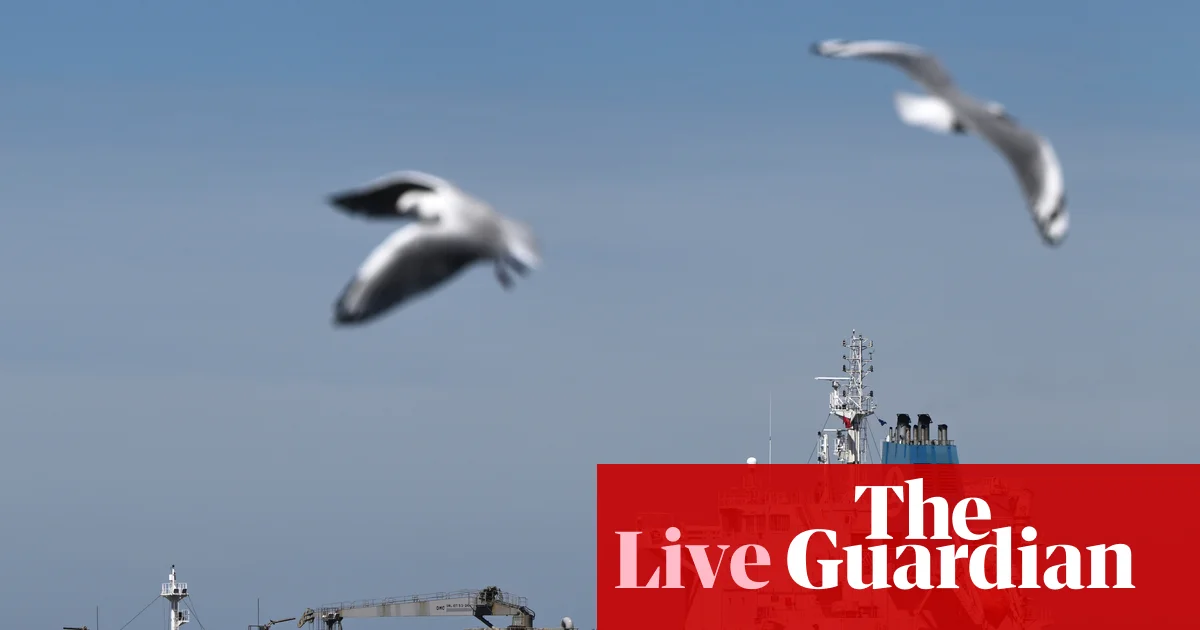
Six of 81 ships carrying fuel to Australia cancelled since start of Iran war, Bowen says
Chris Bowen said it was a challenging international situation, and while import ships were still arriving, some had been cancelled. The energy minister said:
We get, on average, around 81 boats a month delivering fuel to Australia. We’re aware of six boats that have been cancelled out of that 81, on average.
Some of those have already been replaced by the importers and refiners with other sources.
Key events
An 81-year old Japanese tourist, who was reported missing in Cradle Mountain National Park, has been found alive this morning, Tasmanian Police said.
A search operation commenced when the man was unable to be contacted around midnight on Saturday.
Members of the public, not involved in the search, located the man at about 7:45am Sunday morning.
Police reported that he had walked away from his accommodation during the night and became disorientated in the darkness.
The male was located with non life-threatening injuries and is being assessed by Ambulance Tasmania paramedics at the scene. Police would like to thank all assisting Tasmanian emergency services and members of the public in successfully locating the missing person.
Explainer: Could Australia ration fuel?
While fuel rationing is not on the cards just yet, according to the energy minister, Chris Bowen, federal and state governments have the power to ration supplies in an emergency.
If you’re wondering what that could look like, this explainer from Guardian Australia’s economics editor Patrick Commins provides some context:
Bowen shrugs off reports Australia’s top crude oil source could cut supply
Speaking on the ABC Insiders program, energy minister Chris Bowen acknowledged the flow of crude oil to some key importers had slowed, and had flow-on effects for their customers, including Australia.
My Guardian Australia colleagues reported on this issue on Friday, noting that Bowen had shrugged off reports that some countries may choose to prioritise local needs, ahead of exporting fuel to Australia.
They wrote:
Major sources of Australian oil, including Malaysia and South Korea, could cut their exports to prioritise local fuel needs, energy experts have warned, as Chris Bowen concedes some service stations are running out of stock. The energy minister said governments had “powers” to ration petrol if supplies were more severely disrupted.
Bowen shrugged off reports in the Australian Financial Review on Thursday that the Malaysian embassy said the country’s government would “prioritise our own needs, and only then we can look at whatever demand that we receive from overseas”. Malaysia is Australia’s top source of crude oil.
Read more here:
Australia not ‘contemplating’ fuel rationing but state and federal governments have powers, Bowen says
State governments also had fuel rationing powers, Chris Bowen said.
When I was a kid … in the 80s in Sydney, I remember petrol rationing was done by state governments – the state governments do have powers there.
Yes, the Commonwealth government, under the fuel emergency act, has powers.
We are not contemplating, at this point, needing to use any of those powers.
Of course, they’re there. And I think that can also give Australians reassurance that, yes, there are powers there, and there’s plans in place and contingency, prudent contingency planning for the worst.
Rationing under fuel emergency act only to be invoked in extreme shortage, Bowen says
The National Fuel Emergency Act 1984, which enables measures such as fuel rationing, had never been invoked, including during the first two Gulf wars and the Covid-19 pandemic, Chris Bowen said. The energy minister said:
It’s not designed to be invoked lightly. It really has powers primarily around defence and health, in the first instance, to ensure that those key areas are getting diesel that they need, but also other forms of fuel.
I would need to be satisfied that there’s a real shortage and that the powers under that act are useful.
I wouldn’t exercise those quite remarkable powers unless I had pretty strong advice that it was necessary in the circumstances, and obviously it’s something I would work through with the states.
‘Massive increase’ in fuel demand hitting regional areas hardest, Bowen says
Petrol stations were facing a huge spike in demand – a 100% increase in a few days, which Chris Bowen said was “understandable and expected”.
We’ve seen a massive increase in demand, accompanied by that increase in regional areas. Obviously, the regional areas are where the supply chain is the hardest to manage. It takes longer to get from Geelong and Brisbane to the various regional areas.
You’ve also got lots of rural suppliers, distributors and service stations working on very tight margins and not always able to access fuel that’s available.
Six cancelled fuel deliveries mainly from Asia, Bowen says
The six cancelled fuel deliveries were primarily from Asia, Chris Bowen said.
It’s a matter of the refineries seeing some supply problems with their crude oil, which is then impacting on their ability to deliver to their customers, including Australia, but not exclusively Australia.
I’ve always been clear, we’re in an uncertain environment.
Six of 81 ships carrying fuel to Australia cancelled since start of Iran war, Bowen says
Chris Bowen said it was a challenging international situation, and while import ships were still arriving, some had been cancelled. The energy minister said:
We get, on average, around 81 boats a month delivering fuel to Australia. We’re aware of six boats that have been cancelled out of that 81, on average.
Some of those have already been replaced by the importers and refiners with other sources.
Chris Bowen gives fuel crisis update
The energy minister, Chris Bowen, gave an update on the fuel crisis, telling the ABC Insiders program that petrol supply had increased to 38 days, with 30 days of diesel and jet fuel.
That indicates that while we’ve released more from the strategic reserve, the ships continue to arrive in good numbers, and both [of] our refineries are working absolute full pelt, and they’re both entirely 100% dedicated to Australian suppliers, not exports.
Federal government must ensure prosperity for all, Malinauskas says
The SA premier, Peter Malinauskas, has told Insiders that the federal government needed to get the economic settings right to ensure that people weren’t left behind as the economy grew.
I think the prime minister, and the entirety of the federal Labor team, are very conscious of the fact that you’re going to make sure that, first and foremost, the economic settings are right – to ensure that a growing economy doesn’t leave people behind and actually delivers a dividend for more people to have a degree of prosperity in their lives.
And that’s, of course, a very difficult thing to achieve, particularly in a global climate like the one that we have now
Triumphant Malinauskas says housing key to counter rise of protest parties
The re-elected South Australian premier, Peter Malinauskas, said mainstream parties needed to offer a clear policy agenda in response to the rise of parties like One Nation.
Appearing on ABC Insiders, he said:
If I was going to pick one area of policy that requires ongoing, sustained effort around the country, it is undoubtedly housing. I think that social compact that we have in Australia, where one family to the next can pass on to the idea of home ownership as an aspiration – I think that’s at risk.
For me, it’s all in on housing.
Good morning
Welcome to another Sunday Guardian live blog.
We’ll continue to bring you the latest on Tropical Cyclone Narelle, which crossed the Northern Territory coast early this morning as a severe category three system, and will continue moving west bringing rain and dangerous storm surges across the Top End.
We’ll also bring you all the wash-up from yesterday’s South Australian state election, and keep across the unfolding situation in Iran.
We’re expecting to hear from the energy minister, Chris Bowen, in TV interviews this morning for the latest on the fuel crisis, which the International Energy Agency has called the “largest supply disruption in the history of the global oil market”.
I’m Petra Stock, and I’ll be taking the blog through the day.
Tropical Cyclone Narelle makes landfall in Top End as category 3 system
Tropical cyclone Narelle has crossed the Northern Territory coast, bringing destructive winds up to 165km/h and intense rain, with the possibility of dangerous and life-threatening flash flooding, the Bureau of Meteorology has warned.
Narelle crossed about 4am local time as a severe category 3 system. It is now a category 2.
A warning is in place for communities between Milingimbi and Nathan River, extending westwards into the Top End, taking in Katherine, Bachelor, the Adelaide River, as well as the Daly River.
A BoM senior meteorologist, Jonathan How, said:
Within this severe weather warning zone, we will see 24-hour rainfall totals of between 180 [and] 230 millimetres, and some isolated locations could see more than 300mm, particularly to the north of Katherine, and this could produce dangerous and life-threatening flash flooding.
Narelle was forecast to weaken as it continued to move west on Sunday, but would still bring severe weather across parts of the territory already saturated by recent rains and flooding.
Major flood warnings were in place for the Katherine, Daly, Waterhouse and Georgina rivers and Eyre creek.