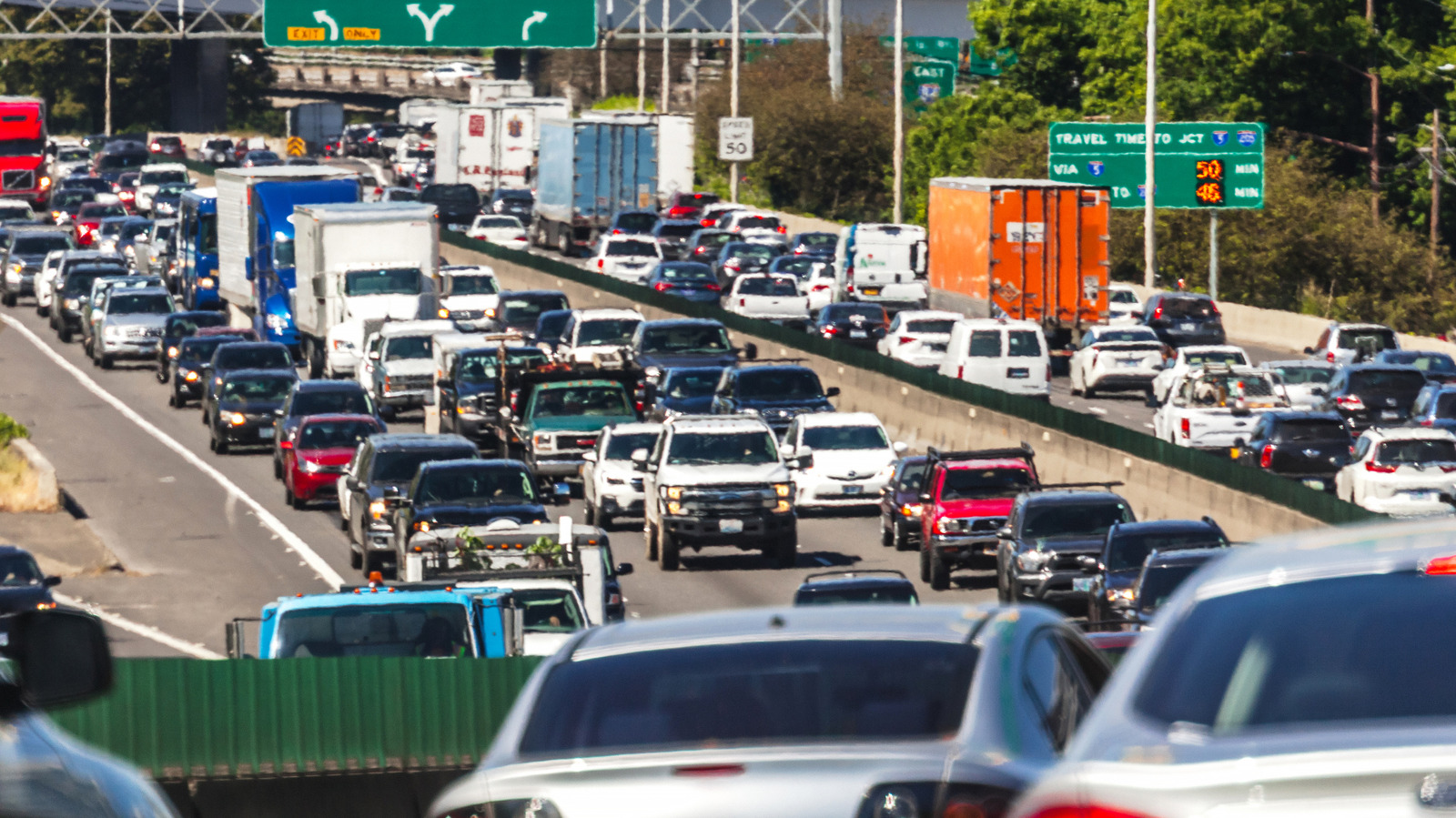
It’s not just in your head: Traffic congestion is getting worse across the United States, and it’s costing drivers as much time as it is money. Last year was the biggest year for car sales this decade so far with over 16 million new vehicles sold… But this country’s urban road networks just weren’t built for this many millions of cars. Coast to coast, drivers are struggling to keep up with an increasingly car-centric society.
According to the 2025 Global Traffic Scorecard from transportation analytics firm INRIX, the typical U.S. driver lost 49 hours to traffic congestion in 2025. That’s a six-hour increase over 2024 alone. Those lost hours shake out to an estimated $894 per driver in lost time for the year, resulting in a nationwide economic impact of over $85 billion. INRIX’s study says a handful of American cities are especially guilty of bad traffic. We’ve organized them all below. (Surprisingly, none are in the states U.S. drivers hate.)
Chicago is the most congested city in the country
According to the INRIX analysis, drivers in Chicago see worse traffic than commuters in any other American city. Drivers in the city lost an average of 112 hours to traffic in 2025. That’s more than double the national average and adds up to weeks of time spent sitting on clogged highways and crowded city streets.
The financial impact is just as staggering. INRIX estimates the typical Chicago driver lost more than $2,000 worth of time during the year because of these crazy traffic delays. Multiply all those losses by the estimated number of drivers in the metro area, Chicago traffic costs people roughly $7.5 billion a year.
Chicago’s place in the top spot is new for 2025. Last year, New York City had the distinct (dis)honor. INRIX says the reason for the traffic increase makes sense when you understand that Chicago’s one of the nation’s largest economic centers as well as a major transportation crossroads for rail, trucking and air travel.
New York City falls to second place
It might not be number one anymore, but New York City still ranks among one of the most congested metropolitan areas in the United States. The city placed second nationwide on INRIX’s list, and it’s because traffic actually got slightly better in 2025. (Or, at least, it didn’t get worse.) From 2024 to 2025, New York City had a 0% change in hours lost. It was an average of 102 hours spent in traffic last year, and it remains 102 this year. Compare that to Chicago’s jump from 102 to 112 year over year.
Transportation policy changes might be to thank. New York implemented the first cordon-based tolling program in the United States, which is a system that charges drivers for entering certain congested areas of the city. Further proof of policy in action: Of the five New York roads that ranked among INRIX’s busiest corridors in 2024, only one’s still on the list. Nevertheless, NYC had a 2025 cost-per-driver of $1,879 and a total cost of $9.7 billion for the city.
Philadelphia had the largest year-over-year jump
Coming in third, Philly recorded one of the largest increases in congestion among all the major US cities INRIX looked at. The metro area saw traffic delays jump by 31% compared to 2024. That rapid rise took them up two spots from their previous fifth-place ranking.
Philadelphia’s growing congestion is part of a larger trend in America. Many other large urban regions are seeing similar jumps thanks (at least in part) to widespread return-to-office orders. When a city’s road capacity remains relatively unchanged but actual number of cars on the road increases, those additional vehicles are naturally going to create heavier traffic. In Philly specifically, it’s a cost-per-driver of $1,860 and a $4.4 billion expense for all those drivers combined.
Oddly, Baltimore had a similar 31% spike in delays year-over-year, but its ranking didn’t move an inch. It remains in the same #13 spot for 2025 that it ended up in 2024.
Los Angeles traffic is bad, but not the country’s worst
Los Angeles has such a bad reputation for its heavy traffic and packed freeways, but it actually ranked fourth on INRIX’s list of the most congested US cities. Considering the region’s massive metropolitan footprint and its heavy reliance on cars, there’s obviously plenty of congestion out there on the roads. Millions of residents commute around the city every day, and its enormous web of highway networks is always getting overwhelmed during peak travel periods.
That said, Los Angeles has seen some stabilization in congestion levels in recent years. The INRIX report reveals that LA actually saw an improvement compared to 2024: 87 hours lost in traffic per driver per year in 2025, while 2024 saw 88. Not bad! All in all, LA drivers lose $1,602 sitting in traffic and a total of $8.6 billion annually for the city. They went from #3 to #4 year-over-year… maybe they can drop to #5 next year?
Boston drops to the fifth spot, but its traffic got worse
Rounding out the top five is Boston, a city that actually held the #4 spot in 2024. While that might sound like an improvement, Boston drivers certainly aren’t feeling it. Traffic got worse by 5% compared to last year, seeing 83 hours lost annually per driver compared to 79 hours lost in 2024. That’s like two whole work weeks! A whole pay period in traffic! INRIX did the math and found that Boston drivers lost $1,529 per person behind the wheel in 2025. That’s $2.9 billion for the entire city total.
A note on methodology: To come to these conclusions, INRIX first pinpointed what routes commuters relied on the most. From there, they looked at the time it took to commute on that route to and from each city’s major employment hubs. The total economic cost was calculated using hourly values of time from the US Federal Highway Administration’s Revised Departmental Guidance on Valuation of Travel Time for Economic Analysis. First published in 2016, INRIX also adjusted for inflation for accuracy. That got them $18.42 per hour in the US. And as far as timeline, they were working with numbers from Q4 2023 to Q3 2025.