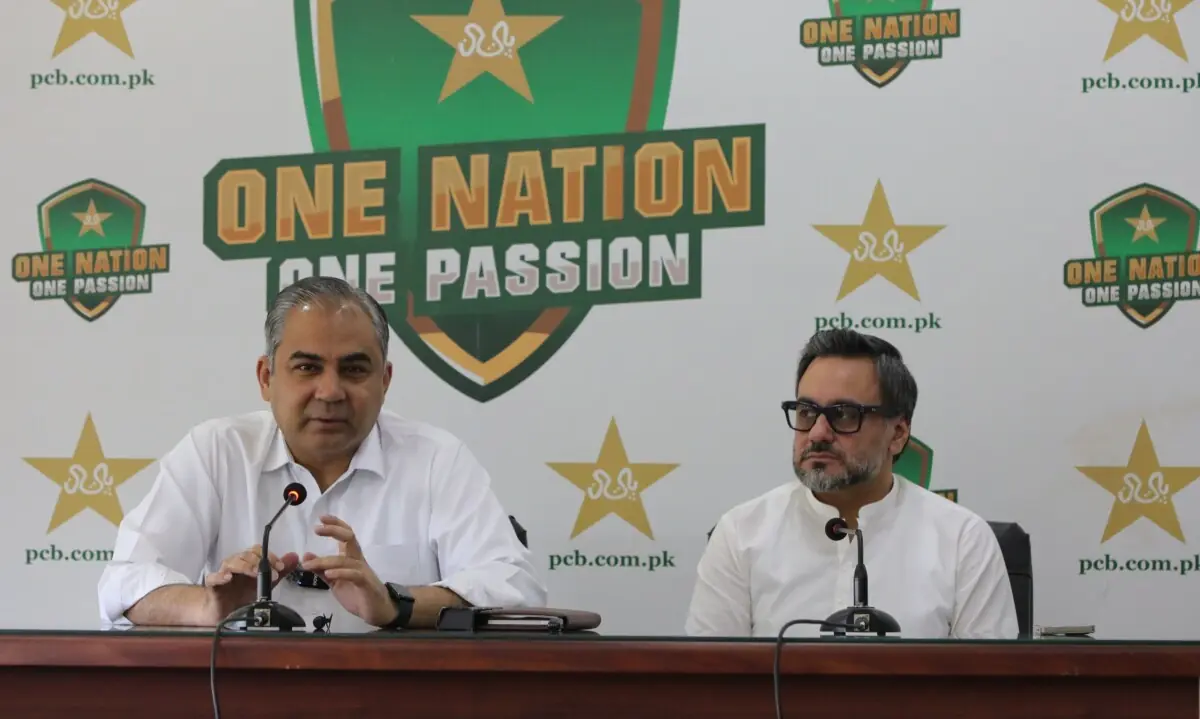
Pakistan Cricket Board (PCB) Chairman Mohsin Naqvi said on Sunday that the 11th edition of the Pakistan Super League (PSL) would go ahead sans spectators while matches would be held only in Karachi and Lahore in line with the government’s austerity drive.
The tournament, which is set to begin on March 26, will feature eight teams and 44 matches. It was initially scheduled to be held across six venues — Lahore, Karachi, Rawalpindi, Multan, Peshawar, and Faisalabad.
However, addressing a press conference in Lahore on Sunday, the PCB chairman said the board, after holding consultations with the government and security agencies, had decided that the tournament “will go ahead as scheduled [..] but a few difficult decisions had to be taken”.
Noting the government’s austerity drive, which was launched in the wake of the global fuel crisis triggered by the US-Israel’s war on Iran and aimed at fuel saving measures, the PCB chairman said, “On one hand, 25,000 to 30,000 people will be gathering at stadiums and on the other hand, we are telling people to restrict their movement.
“So until this crisis ends […] we will not allow crowds in the stadiums,” Naqvi said, adding that it was a “difficult decision” which had to be taken.
He further announced the cancellation of the PSL’s opening ceremony in line with the government’s efforts to minimise expenses.
He said that the “gate money” loss the franchises would face due to the absence of spectators would be “accommodated by the PCB”.
Naqvi also announced that matches would only be held in two cities — Lahore and Karachi. He said the decision was taken to “limit movement”, adding that the schedule would be announced soon.
He also took the opportunity to apologise to the fans in Peshawar, where matches were scheduled to be held. “I had made a promise but unfortunately because of the situation, we could not go ahead,” he said.
He added that those who had already bought tickets for the matches “will be given refunds within 72 hours”.
Naqvi said that the players would begin arriving “today and tomorrow”.
“We cannot postpone because we did not have any window to hold it later in the year,” the PCB chairman said, adding that “we must not go forward with a limited mindset”.
“Technically, it was up to the PCB to decide, but we have taken all the franchises into confidence,” Naqvi added.
In a later press release, the board said, “In consultation with the government of Pakistan, and in line with the officially announced national austerity and resource conservation measures, the PSL has introduced a revised operational plan for the 2026 edition of the tournament.”
It said that to support the efficient use of energy and public resources in light of the prevailing regional geopolitical situation, the number of host venues had been streamlined from six to two.
“Additionally, under the revised government standard operating procedures, matches will initially be held without spectators. This operational adjustment has been made purely in support of the broader national conservation effort and to ensure that the tournament is conducted in the most efficient and responsible manner,” it said.
“The league remains confident that the passion of its audience, combined with innovation in coverage, will make this edition one of the most widely watched in its history,” it said.
Two weeks ago, the government announced unprecedented austerity measures to cope with the fuel crisis triggered by the US-Israeli war on Iran after hiking petroleum products’ prices earlier this month.
The measures included a 50 per cent cut in fuel allowance for official vehicles and a four-day work week. It was also decided that 50pc of staff in the public sector would work from home; however, those providing essential services are exempt.
On Thursday, the government had appealed to the public to adopt fuel-conservation measures to “avert the risk of petroleum products’ supply getting affected in the coming days”.
A day later, Prime Minister Shehbaz Sharif said that he had rejected recommendations for further increasing the prices of petroleum products. However, he said he had instructed relevant ministries to devise a mechanism to ensure that the “relief” was restricted to only the deserving and needy.