Frankenstein is a classic. The 1818 novel written by Mary Shelley still sells tens of thousands of copies annually and is widely considered as the first major science-fiction novel. The Creature (often referred to as Frankenstein’s Monster) has also cemented itself as one of the most iconic and influential characters ever created.
Due to the immense success of the novel, there have since been endless adaptations of it. Spanning film, television, radio, podcasts, our culture holds a deep catalog of art based on the novel. This includes over 450 feature films, as early as 1915 with Joseph W. Smiley’s Life Without Soul and as late as 2025 with Guillermo Del Toro’s Frankenstein.
There was also a film featuring Frankenstein’s Monster released less than two weeks ago: Maggie Gyllenhaal’s The Bride!. Frankenstein and The Bride! were released less than six months apart from each other, and this has subsequently resulted in many comparisons being made between the two, though they are also drastically different in several notable regards.
The Bride! Isn’t Based On Mary Shelley’s Frankenstein Novel
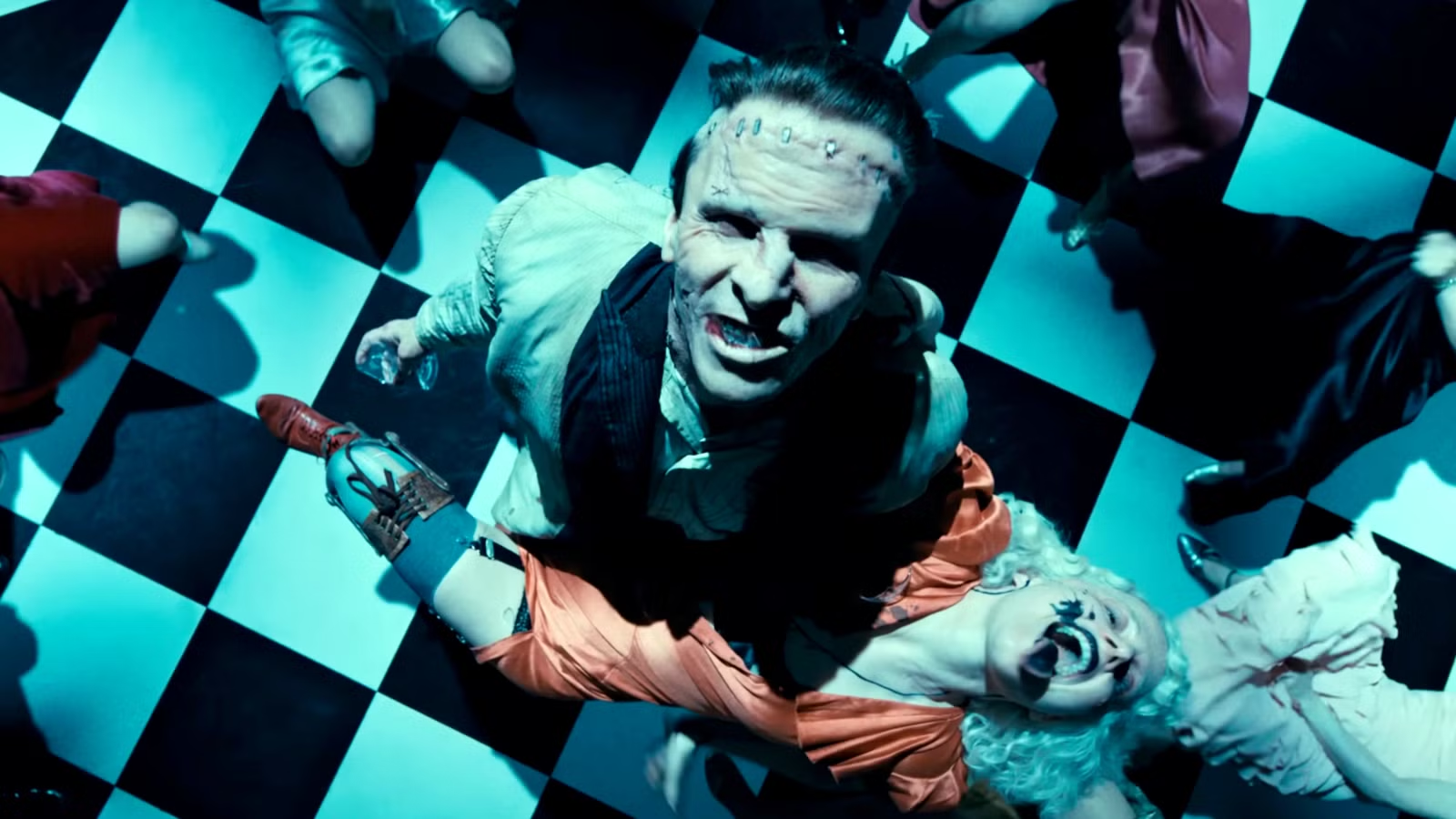
While The Bride! features the character of The Creature, known as Frank (Christian Bale), its biggest inspiration was actually the 1935 film, James Whale’s The Bride of Frankenstein. Mary Shelley, the original author of Frankenstein, had no affiliation with the creation of The Bride of Frankenstein; the film served as a sequel to Whale’s previous film, 1931’s Frankenstein.
Whale’s Frankenstein was also a rather unfaithful adaptation of Shelley’s novel, introducing new characters and changing the ending. Despite this, the film was greatly acclaimed and went on to become a massive financial success, making $12 million dollars at the box office on a $262,000 budget (equivalent to $256 million today) and spawning two sequels including The Bride of Frankenstein, which received similar financial and critical success.
Maggie Gyllenhaal’s The Bride!, however, hasn’t been so lucky. Since its release, it has divided critics (it currently holds a 57% rotten rating on Rotten Tomatoes) and struggled at the box office (opened to $13.6 million globally despite a budget of $80 million per IndieWire).
There’s No Dr. Frankenstein In The Bride!

In Mary Shelley’s original Frankenstein novel, Dr. Victor Frankenstein is the seminal character; a deeply ambitious scientist who sets out to create the titular monster. In Del Toro’s adaptation, Frankenstein (Oscar Isaac) is the focal point of much of the first half.
During this sector of the plot, Dr. Frankenstein is both on the run from The Creature (Jacob Elordi) and relaying the story of how he came to create it. The film, in its best moments, plays as a two-hander between Dr. Frankenstein and The Creature; they are in many ways an unlikely father and son dynamic.
In contrast, the events of The Bride! take place after the creation of The Creature. Dr. Frankenstein does not appear in the film. Instead, The Creature itself has since taken on the name of Frank.
The Bride! Has A Completely Different Protagonist Than Frankenstein

It’s up for debate whether Dr. Frankenstein or The Creature are the protagonists of Frankenstein. In the original novel, Frankenstein is the narrator. Readers are able to hear from the horse’s mouth how this Gothic tragedy unravels, and learn about the Dr. Frankenstein’s flaws, ambitions, and corrupting obsessions from the character themselves.
Despite this, many argue that The Creature is, at the very least, a co-protagonist to its creator; after all, it is the sympathetic, beating heart of the film. Our moral compass. We see this play out in Del Toro’s Frankenstein, in which both characters spend stretches of the film narrating their stories.
In The Bride!, we follow a completely different protagonist. Maggie Gyllenhaal’s film follows a woman, Ida, who is brought back from the dead by Frank, through the help of Dr. Cornelia Euphronious. She is subsequently renamed The Bride and begins a Bonnie and Clyde type partnership with Frank, with the film centering on a decidedly different overall narrative as a result.
Frankenstein Is A More Faithful Adaptation Than The Bride!

Many of the Frankenstein films have taken artistic liberties in their adaptation of the famous source material (Kenneth Branagh’s 1994 film was arguably the most faithful, albeit one of the most poorly received). So while Guillermo Del Toro’s Frankenstein is at times loose in its adaptation, it is far from out of the ordinary for a Frankenstein film.
Some of the differences in the film include: Dr. Frankenstein’s increased age and tenure as a surgeon; Elizabeth’s (Mia Goth) newly deepened relationship with Victor’s brother and The Creature; and the added resolution between The Creature and Victor at the end.
The Bride! completely reimagines The Bride of Frankenstein. Ida is resurrected by Dr. Cornelia Euphronious, then possessed by the ghost of Mary Shelley, who acts as a purgatorial narrator of sorts, for the film. Neither of these characters are present in The Bride of Frankenstein. To add to this, The Bride doesn’t even speak in the original film. The film is also set in a completely different century, which undeniably causes it to depart from the source material.
The Bride! & Frankenstein Have Completely Different Settings

The original Frankenstein novel takes place in late 18th century Europe. Particularly the arctic areas such as Switzerland and Germany. This is not dissimilar to The Bride of Frankenstein, which takes places in early 19th century Germany.
Guillermo Del Toro’s adaptation takes some liberties, placing the film during the Crimean War in mid-19th century Europe. Much like his adaptation of Pinocchio, which is reimagined in 1930s fascist Italy, political tensions allow for a strong emotional framework, and create effective stakes for the film.
The Bride! completely reimagines the world of Frankenstein in 1930s Chicago. The film involves movie theaters and detectives as opposed to ships and soldiers. So, while both take liberties in their settings, one is more transformative and jolting than the other.
The Bride! & Frankenstein Explore Very Different Themes

The main themes of the original Frankenstein novel include the dangers of unchecked ambition, the effects of social isolation, as well as the importance of the relationship between creators and their creations. Much of Del Toro’s film stays true to these themes, with it also providing a different outlook on them from Shelley, as Frankenstein‘s revised ending is more optimistic about the power of forgiveness amidst the creator’s abuse of their creation.
The Bride of Frankenstein primarily shines a light on the cruelty of humanity. The Bride rejects The Creature’s forced companionship, and in the process, the scientists behind the ordeal are made to look more savage than the monsters themselves.
The Bride! takes this glimpse of a premise and runs with it, anchoring it with a feminist spine. The Bride fights for her own autonomy and independence in the world she’s been rebirthed back into. This feminist reimagining is starkly different in its framing and thematic explorations to Del Toro’s Frankenstein.
FRANK Is Mortal In The Bride!

In the Frankenstein novel, though The Creature describes their desire to take their own life, their fate by the end is left ambiguous. This is the same for The Creature in Guillermo Del Toro’s Frankenstein, though throughout the film, their otherworldly regenerative abilities and remarks about not being able to die hint at the entity’s prospective immortality.
Conversely, in The Bride of Frankenstein, after The Creature is rejected by The Bride, it destroys the laboratory, killing Dr. Pretorius and The Bride, as well as itself. In The Bride!, Frank is similarly mortal, with the ending of The Bride! including the character being fatally shot by the police.
The Bride! And Frankenstein Have Very Different Styles

Maggie Gyllenhaal and Guillermo Del Toro bring very different styles to their films. Frankenstein, which just won three Oscars and was nominated for nine, is a very handsomely crafted, stunning technical achievement with striking imagery and rich colors. Its tone, naturally, proved to be a lot more serious and emotional, making it a sincere Gothic tragedy.
Maggie Gyllenhaal’s The Bride! is regarded as a lot more maximalist and gonzo in its filmmaking style. The film is more edgy, described as punk-infused, with considerably more sex and overly-stylized visuals. The film leans into being more of a blend of campy melodrama and 1930s noir, which is all tied together by a tragicomic Bonny and Clyde-esque plot that draws from the Frankenstein mythos.