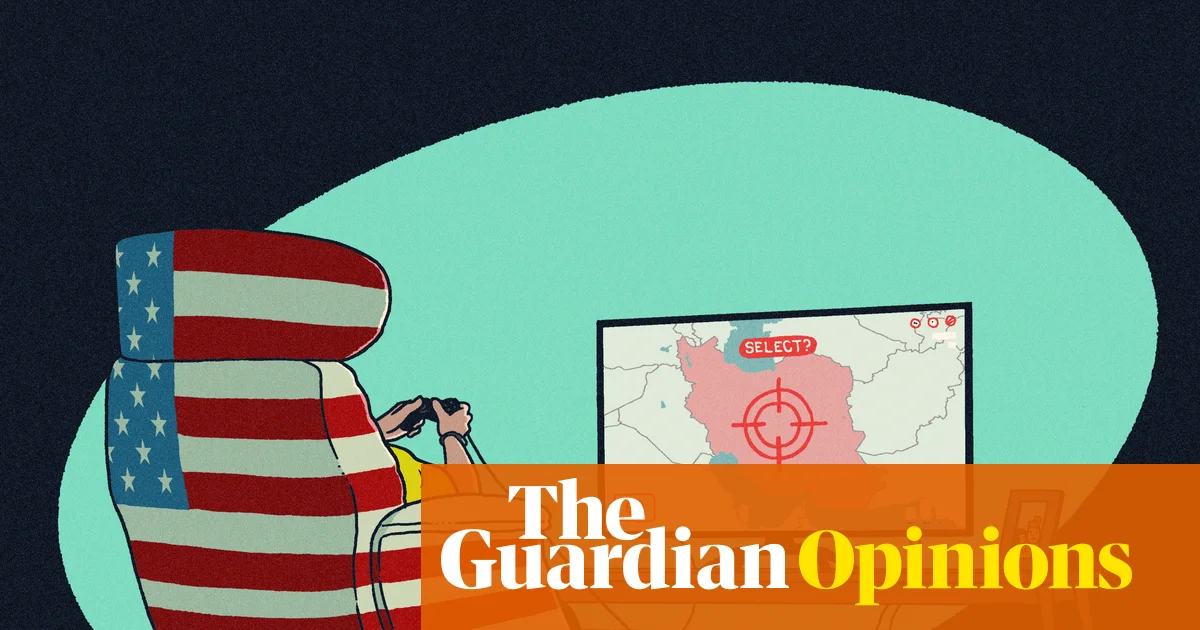
The war on Iran, even as it spreads and destabilises the Middle East and the global economy, is not real. This is how it is being portrayed by the Trump administration. The war is a video game, a spectator sport, a social media festival of dunking. The architects of this war have made a virtue out of stupidity, and have been supported in that by a stupefying information ecosystem. The conflict waged by the US feels like the first of its kind in the modern age: distinctly remote and profoundly ignorant.
A week into the war, the White House uploaded a clip on its social media channels featuring montages of Top Gun, Braveheart and Breaking Bad, with the caption “Justice the American way” – itself a repurposing of a Superman motto. In another, entitled Touchdown, NFL players tackle each other and upon contact, boom, footage of a strike explosion tagged “unclassified”. SpongeBob SquarePants also makes an appearance, asking, “Wanna see me do it again?”, and then, an explosion. In another, Operation Epic Fury is rendered as a Nintendo Wii game.
“We’re over here just grinding away on banger memes, dude,” a senior White House official told Politico. “There’s an entertainment factor to what we do.” It is pure Donald Trump and his Maga base, to whom everything is not just a game, but a competition. Politics at home and abroad is about scoring, winning and humiliating the other side. For that competition to be fun, it has to be portrayed in the most low-stakes way possible. And so the war is not about death, destruction, calamitous fallout economically and geopolitically, but about the boom, the score, the fist pump. “Wake up, Daddy’s home,” starts one clip. The Trump administration is like a gamer in a dark basement, downing beers, nursing deep insecurities, hectically self-soothing through flashes of colour and noise on a large screen. Maximum hit, minimum effort.
But apart from the sublimated masculine anxiety, the Trump machine’s rendering of this war serves a political purpose, removing the need for any complex narratives or justifications. Trump and his regime are incapable of coming up with any sophisticated reasoning for the war, because they are incapable of intellectually rising to the occasion. But also because the war floundered from the start. The original goal of creating the conditions for regime change was not achieved. Iran pummelled Gulf countries and Israel with drones and missiles, and shut the strait of Hormuz, blocking the passage of oil, gas and commodities, immediately spiking energy costs. What was supposed to be a quick win turned into a quagmire, and so it must all be simplified for viral dopamine into something triumphant.
Deepening the state of unreality is the remote nature of the conflict. Never before has a war with such devastating and wide-reaching consequences played out with such physical detachment. AI has been deployed with unprecedented scale. In a video posted by the Centcom commander for Operation Epic Fury in mid-March, Adm Brad Cooper summarised that in the more than 5,500 strikes on Iran, AI had played a crucial role. “Humans will always make final decisions on what to shoot and what not to shoot and when to shoot,” he said, “but advanced AI tools can turn processes that used to take hours and sometimes even days into seconds.”
This process is known, grimly, as “streamlining the kill chain”, reducing the effort to surveil, collect intelligence and then select a target. In this regard, the war is an actual video game, with yet another layer of human closeness to the details on the ground removed and outsourced to a code. There are no boots on the ground, no one seeing the whites of the eyes of those who are killed, no sense of the colossal incursion into the lives and lands of those on the other side of the bombs and missiles. There are few casualties on the American and Israeli side relative to the scale of the assault. The sort of stakes that were apparent when Iraq was invaded – of the face-to-face killing of civilians, their torture in places such as Abu Ghraib, and the death toll among American and European soldiers themselves – are absent. All there is, is a faceless enemy, and a measure of success or defeat that is only measurable in terms of boosts or injuries to the US’s ego.
The war also lands in an information ecosystem already primed for grotesque detachment. Long gone are the days when war was consumed exclusively through rolling coverage on CNN or the BBC, with a handful of correspondents and camera people on the ground beaming events to viewers, or newspaper reporters filing investigations. All events, from the mundane to the high-octane, are flattened into the feed. On Instagram, TikTok, X, you can toggle between recipes and influencers and those White House videos and the scenes of smoke rising from Tehran, Doha, Dubai. By reflexively scrolling, seeing but not absorbing, so many of us have been dulled by the sheer glut of life. As well as the flood of takes, shit-posting, AI slop fake footage and a million talking heads and podcasters on YouTube and streaming sites.
I have lost track of the number of “breaking news” posts and videos on the war on social media that upon closer inspection were entirely made up by authoritative-looking accounts farming for engagement. When the true and false jostle constantly in the content slipstream, nothing feels real. Entire businesses have been erected to benefit from this. The stakes on Polymarket, an online prediction platform that allows users to gamble on the outcomes of anything, including conflict, became so intricate and huge that earlier this month a journalist was sent death threats by users who ended up on the losing end of a bet as a result of his reporting.
It is enormously difficult amid such swirling forces to hold on to a sense of empathy, to follow a moral compass, to understand that thousands of innocent people are dying, their homes destroyed, their nations destabilised for a generation. And that we have a duty towards them that can be exercised through pressure on the architects of their suffering. This is the challenge of this war and, in fact, our entire age: to retain and insist on humanity in the face of those political leaders who benefit from effacing it, and those owners of platforms who profit from it.