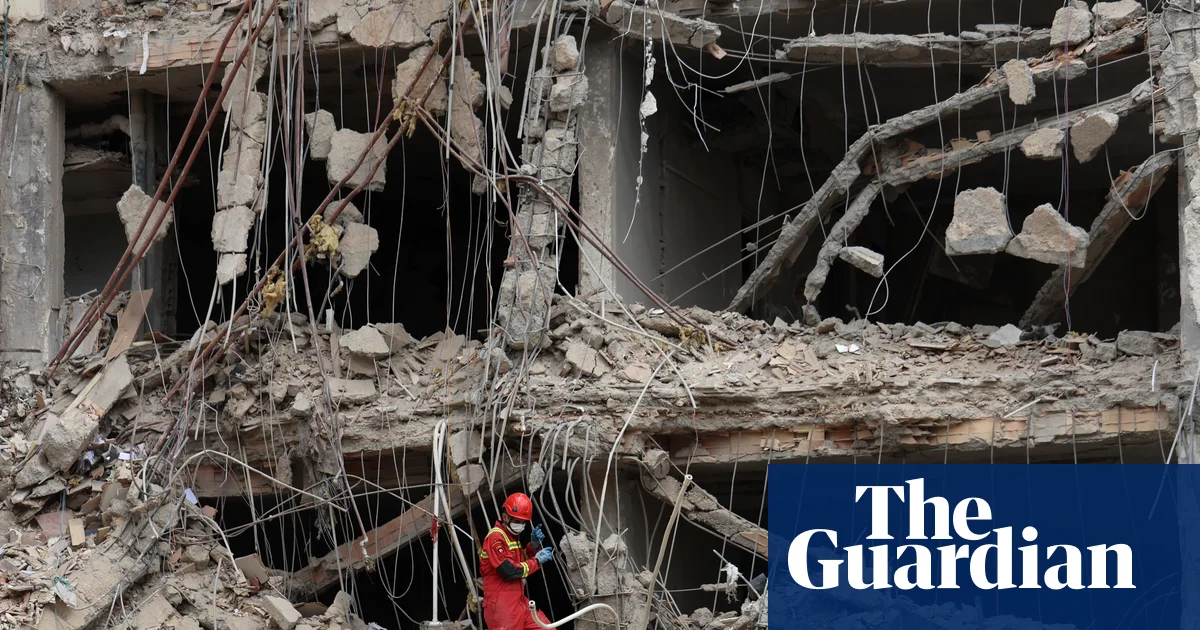
A wave of temporary relief, and some jubilation swept through Iran as Donald Trump announced he was postponing his attack on Iran’s energy infrastructure after he claimed he had productive conversations with Tehran, conversations Iran promptly denied ever having directly with him or through intermediaries.
That does not mean the diplomatic track was entirely silent. Turkey, through its foreign minister, Hakan Fidan, and Oman, via its foreign minister, Badr Albusaidi, who are both respected in Tehran and Washington, have been working the phones constantly.
But as ever with Trump, the threat that this is only Armageddon postponed leaves Iranians forced to live on the edge, for at least the rest of the week. It also strengthens those in Iran who have been arguing that his threat to cripple Iran’s power supplies was a distraction from his main strategic goal, which is to capture the strait of Hormuz.
Nevertheless the threat to Iran’spower supplies had been met with a mixture of defiance, anger and understandable fear as they contemplated the possibility of extended power outages, and made last-minute appeals for the rest of the world to urge Donald Trump to hold back from what may have been an impetuous half-considered threat.
One well-known Iranian reformist writer Ahmad Zeidabadi likened what might lie ahead to the apocalyptic novel Blindness by José Saramago in which the whole world gradually becomes blind.
The normally constrained Zeidabadi described Trump’s attack as “the greatest threat posed against our country or any other country in the world throughout history”.
He said: “If electricity to 90 million people were to stop, homes and streets would be plunged into darkness, the elderly and the disabled would be trapped in residential towers and water, gas, gasoline and diesel would become scarce, followed soon by no food, no hygiene and no transportation.
He went on: “If the people of America or other countries do not stop this savage being, the Middle East will instantly become an unimaginable hell and then a barren and uninhabitable land.” He described Trump as a mad and insane individual and yet “the main decision maker of the world’s greatest military power”. The sense that the US is in the grip of a deranged figure is quite common among Iranians.
In his daily diary, the son of Iran’s elected president, Masoud Pezeshkian, Yousef, justified what he described as the likely Iranian retaliation by saying: “When America attacks infrastructure, the consequences of this come back to you. You cannot say, ‘I will cut your electricity, but you must not cut mine’. Whatever we do sooner or later comes back to haunt us. This is the law of nature and the system of creation. This is the honour of the world.”
Reza Nasri, an international lawyer with strong links to the Ministry of Foreign Affairs warned if Trump follows through on his promise to attack Iran’s power plants, it will not be a war crime carried out in the chaos of battle, but something premeditated and announced in advance. He claimed the lack of congressional or judicial oversight showed something fundamentally wrong with American politics.
An energy expert widely quoted in Iranian media Mohammad Enayati, said Iran’s energy grid with a 100,000 megawatt capacity was a dispersed and broad target, making it difficult to knock out with a few airstrikes. The five largest Iranian power plants account for 10% of Iran’s electricity generation – by contrast, the five largest Israeli power plants provide 50% of Israel’s energy. The five Iranian power stations most likely to be attacked were widely listed in Iranian media.
He also claimed that due to the spring holiday, consumption was lower than normal, making it easier to keep the grid operating. The exodus from Tehran during the spring holiday is larger than normal, with heavy traffic on the roads out of Tehran. It is estimated more than 3 million Iranians have been internally displaced by the war.
The former Iranian ambassador to the UK Mohsen Baharvand in a telegram post said: “No honour or credibility is added to [a] super power if it attacks civilian facilities with advanced and destructive weapons and causes critical problems for a civilian nation.”
He said there was no need to prove, “the commission of war crimes when a world leader considers military operations and killing people as a kind of amusement or pleasure.”
Many Iranians will never forgive Trump for joking about the “fun” of a US submarine sinking an Iranian frigate Iris Dena off the coast of Sri Lanka killing more than 80 sailors, Baharvand said.
Baharvand wrote that with diplomacy, the strait of Hormuz could yet become “a card for peace”, a point for negotiation between the Gulf states.
Many Iranians, both civilians and diplomats, had been hoping Europe or the Gulf states could persuade Trump to hold back, but the Islamic Revolutionary Guards Corps spokesmen were unrelenting in spelling out they would retaliate by hitting the Gulf’s energy infrastructure and desalination plants, a step that could further wreck the Gulf economies, as well as cause an ecological and humanitarian crisis.
Iranian officials insisted they would respond even if there is only a tokenistic attack on a power station, but many Iranian commentators remain concerned by the growing reports that the US will send land forces to seize the strategically important Kharg island in the strait, the hub for Iran’s oil exports. A former parliament deputy speaker Ali Motahari believed the threat was a deception designed to divert attention from Trump’s real goal, which is to seize islands in the strait of Hormuz.
Iran’s defence council issued a statement warning: “Any enemy attempt to attack Iranian coasts or islands will naturally lead to the mining of all access routes and communication lines in the Persian Gulf and coasts with various naval mines including swimmer mines that can be deployed from the coast. In that case practically the entire Persian Gulf will experience a situation similar to the strait of Hormuz for extended periods and this time the entire Persian Gulf will effectively be blocked.”
It adds: “The memory of more than 1,000 mine clearers failing to clear a limited number of naval mines in the 1980s is still not forgotten. The only way for non-hostile countries to pass through the srait of Hormuz is in coordination with Iran.”
Iran continues to insist there is no truth in claims that it sent an intercontinental ballistic missile towards the British military base of Diego Garcia, a claim that led Israel to argue that Europe is threatened by Iran’s missile programme. British minister, Steve Reed, said on Sunday: “There is no specific assessment that the Iranians are targeting the UK or [that they] even could if they wanted to.”
Esmaeil Baqaei, the Iranian Foreign Ministry spokesperson, said it was significant that Mark Rutte, the Nato secretary general, had admitted the alliance cannot confirm that missiles targeting the UK base of Diego Garcia were intercontinental ballistic missiles dispatched by Iran. Many days after the incident, details of what actually occurred remain elusive.
Israeli thinktanks claimed Iran was down to only 25% or 120 of the 450 missile launchers it had at the start of the war.