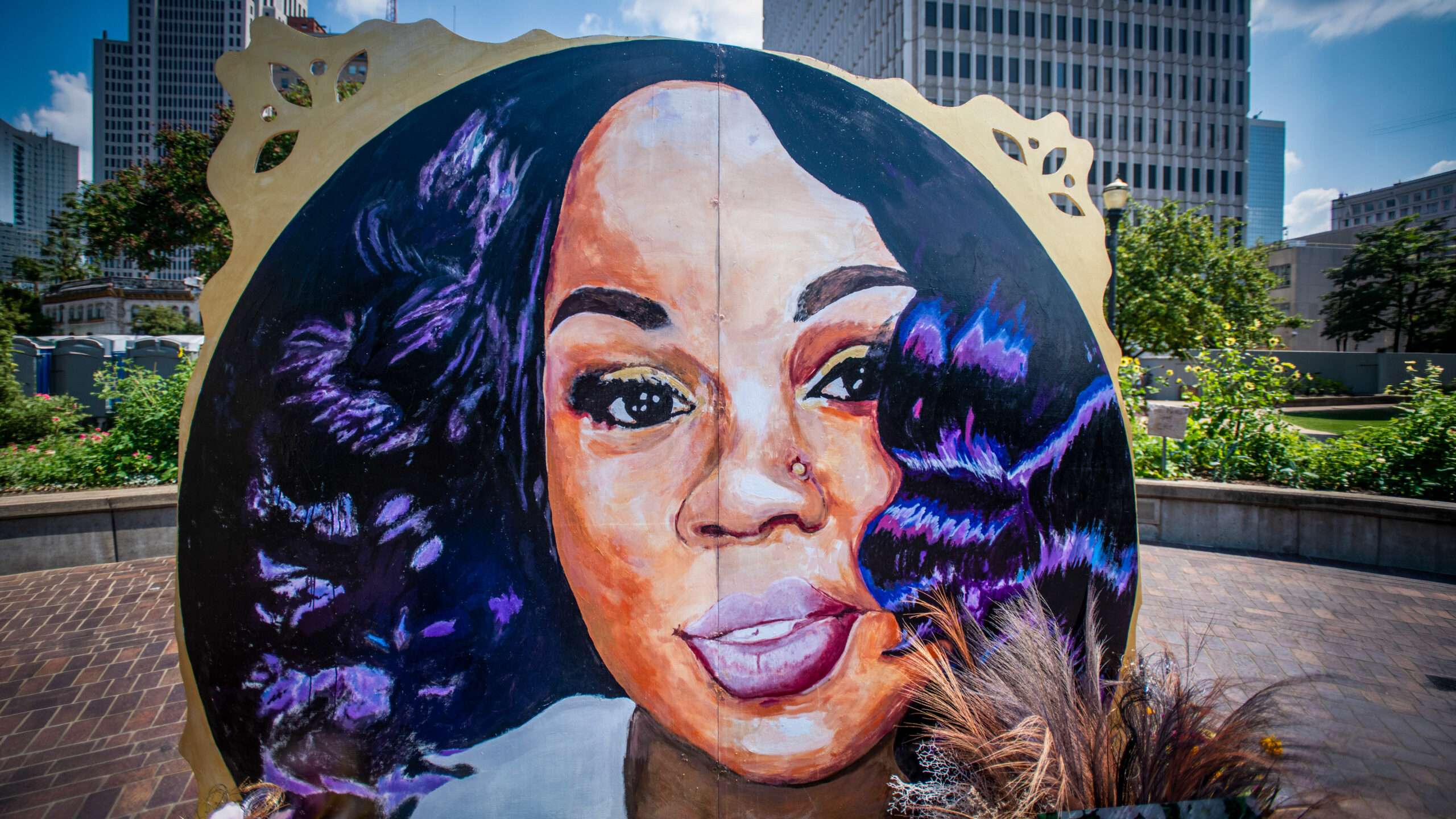
Louisville, Kentucky, Detective Joshua Jaynes lied when he applied for the March 2020 search warrant that resulted in Breonna Taylor’s death. Then he lied about his lies. Sgt. Kyle Meany, the supervisor who approved the warrant application, also tried to cover up its shortcomings. According to an August 2022 federal indictment, both officers knew that police did not have probable cause to search Taylor’s apartment.
Based on those allegations, the indictment charged Jaynes and Meany with violating 18 USC 242 by “willfully” depriving Taylor of her Fourth Amendment rights under color of law. It also charged them with conspiring to falsify a document and mislead federal investigators. But according to the Justice Department, which asked U.S. District Judge Charles R. Simpson III to dismiss those charges on Friday “in the interest of justice,” the indictment exemplified the Biden administration’s “inappropriate, weaponized federal overreach.”
Although that judgment is hard to fathom as a matter of law, it is consistent with President Donald Trump’s blasé attitude toward police abuses, which he sees as an acceptable cost of “STRONG & EFFECTIVE CRIME PREVENTION.” It is therefore not surprising that Trump’s Justice Department seems to view federal remedies for police abuses as unseemly meddling with local law enforcement. But abandoning those remedies undermines civil liberties by signaling that the Justice Department is no longer interested in pursuing charges against police officers who willfully violate Americans’ constitutional rights.
In her motion to dismiss the charges against Jaynes and Meany, Harmeet Dhillon, the assistant attorney general in charge of the Justice Department’s Civil Rights Division, does not say the defendants are not guilty of knowingly violating Taylor’s Fourth Amendment rights. Nor does Dhillon say they told the truth when they were asked about Jaynes’ warrant affidavit, which according to the 2022 indictment “contained false and misleading statements, omitted material information, relied on stale information, and was not supported by probable cause.” Dhillon’s silence on those crucial points suggests she simply does not view the officers’ conduct as sufficiently serious to warrant federal charges, which is alarming given the facts of the case.
Jaynes’ warrant affidavit, which he submitted to Jefferson County Circuit Judge Mary Shaw on March 12, 2020, implied that Taylor, a 26-year-old EMT and aspiring nurse, was involved in drug trafficking by her ex-boyfriend, Jamarcus Glover. But that allegation was based almost entirely on guilt by association: Taylor was still in touch with Glover, who no longer lived with her but continued to receive packages at her apartment after he moved out.
What was in those packages? According to Glover, who said he worried that the packages would be stolen if he had them delivered at his new address, they contained shoes and clothing he had ordered from Amazon. That is consistent with what Jaynes told internal investigators after Taylor’s death. In late January or early February 2020, according to Jaynes, Sgt. Jonathan Mattingly, one of the officers who would later execute the search warrant, “nonchalantly” told him “your guy [Glover] just gets Amazon or mail packages there.” Jaynes added: “I remember ‘Amazon’ resonating in my head. I just remember the word Amazon.”
According to the 2022 indictment, that conversation never happened. After the shooting, it says, Jaynes called Mattingly to “try to get [him] to say” he had “previously told” Jaynes that Glover “had received packages at Taylor’s apartment.” Per the indictment, Mattingly actually had told Jaynes “he had no information showing that [Glover] received packages at Taylor’s apartment,” and Mattingly reiterated that point during the phone call. But even if Mattingly had said something about Amazon shipments prior to the raid, it would not have indicated there was anything suspicious about the packages.
After the raid, Tony Gooden, a postal inspector in Louisville, told a local TV station that Louisville police had never consulted with his office about the packages Glover received at Taylor’s apartment. Gooden added that a different law enforcement agency, which he declined to identify, had asked about the packages in January 2020, when his office concluded “there’s no packages of interest going there.”
None of that was reflected in Jaynes’ affidavit. Instead, Jaynes falsely claimed he had “verified through a US Postal Inspector that Jamarcus Glover has been receiving packages” at Taylor’s apartment. He added that “affiant knows through training and experience that it is not uncommon for drug traffickers to receive mail packages at different locations to avoid detection from law enforcement.” Based on his “training and experience,” he said, he “believe[d]” that Glover “may be keeping narcotics and/or proceeds from the sale of narcotics” at Taylor’s apartment.
According to a superseding indictment filed in October 2024, Jaynes’ affidavit also “falsely claimed” that he had “observed” Glover’s car making “frequent trips” between Taylor’s apartment and the properties he allegedly used for drug trafficking. “In fact,” the indictment says, Jaynes and Meany “had only seen [Glover’s] car at Taylor’s home on one occasion, on January 16, 2020, nearly two months before they submitted the warrant affidavit to a judge.”
Glover later insisted that Taylor was not involved in his drug dealing. And contrary to Jaynes’ avowed expectation, the search of her apartment did not find drugs or drug money.
In December 2020, interim Louisville Police Chief Yvette Gentry fired Jaynes, saying he “lied when he swore ‘verified through a US Postal Inspector.'” Jaynes “did not have contact with a US Postal Inspector,” she noted. “Having an independent, third party verify information is powerful and compelling [evidence]. The inclusion of this in the affidavit as a direct verification was deceptive.”
Meanwhile, according to the 2022 indictment, Jaynes had lied about the actual source of this information in interviews with local and federal investigators, inventing a fictitious conversation with Mattingly. In “an official Investigative Letter,” on May 1, 2020, Jaynes and Detective Kelly Goodlett likewise claimed he had “verified through” Mattingly, “who contacted the postal service, that [Glover] had been receiving packages” at Taylor’s apartment.
The letter also included “the misleading claim that a detective ‘was able to verify through CLEAR, a law enforcement database, that as of February 20, 2020, [Glover] used” Taylor’s apartment “as his residence.” The indictment says Jaynes and Goodlett “both knew at the time that this statement was misleading” because Glover “did not live there” as of February.
When Meany signed off on Jaynes’ warrant application, according to the indictment, he knew “the affidavit contained false and misleading statements, omitted material
information, relied on stale information, and was not supported by probable cause.” Meany later “falsely told” an FBI agent that “a paragraph requesting authority
to make a no-knock entry at Taylor’s home was included” because the Louisville SWAT unit had requested it, which was not true.
The request for no-knock authorization was itself faulty because Jaynes did not supply the sort of evidence that the Supreme Court has said is necessary to dispense with the usual requirement that police knock and announce themselves before entering someone’s home. In 1997, the Court unanimously held that the Fourth Amendment does not allow a “blanket exception” to that rule for drug investigations. Rather, it said, police must “have a reasonable suspicion that knocking and announcing their presence, under the particular circumstances, would be dangerous or futile, or that it would inhibit the effective investigation of the crime by, for example, allowing the destruction of evidence.” While Jaynes made that general assertion in his affidavit, he did not include any evidence to back it up that was specific to Taylor.
Goodlett, who was accused of “conspiring with Jaynes to falsify the search warrant for Taylor’s home and to cover up their actions afterward,” pleaded guilty a few weeks after she was charged. She said Jaynes had never verified that Glover was receiving “suspicious packages” at Taylor’s apartment.
Violations of 18 USC 242 are ordinarily misdemeanors. But Jaynes and Meany were originally charged with felonies under that statute based on the argument that their violation of Taylor’s Fourth Amendment rights “involved the use of a dangerous weapon” and resulted in her death. Simpson rejected those enhancements in August 2024.
The fact that Jaynes and Meany knew the officers who executed the search warrant would be armed, Simpson said, was not enough to establish “use of a dangerous weapon.” And the deadly outcome of the raid, he added, did not stem directly from the defective warrant. Rather, it was “the late-night, surprise manner of entry” that precipitated the gunfire that killed Taylor. Even if the warrant had been valid, Simpson reasoned, the outcome would have been the same.
Simpson reiterated that point in August 2025 after federal prosecutors tried to strengthen their argument that Jaynes and Meany were legally responsible for Taylor’s death. Although he was “seriously troubled by the claimed falsehoods,” he wrote, prosecutors “cannot attribute Taylor’s death to the lack of a warrant supported by probable cause.” Rather, he said, that outcome was the result of “legal, lethal and tragic crossfire that was not initiated by police.”
That summary glossed over the recklessness of the officers who executed the warrant that Jaynes obtained. Despite their no-knock warrant, Mattingly and the two other plainclothes officers who approached Taylor’s apartment around 12:40 a.m. on March 13, 2020, banged on the door before smashing it open with a battering ram. They said they also announced themselves, but that claim was contradicted by nearly all of Taylor’s neighbors. Taylor’s boyfriend, Kenneth Walker, was in the bedroom with her at the time. He later said he heard no announcement and had no idea that the men breaking into the apartment were police officers. Alarmed by the banging and the ensuing crash, he grabbed a handgun and fired a single shot at the intruders, striking Mattingly in the thigh.
The three officers responded with a hail of 32 bullets, including six fired by Mattingly, 16 fired by Detective Myles Cosgrove, and 10 fired by Detective Brett Hankison, who was standing outside the apartment. Hankison fired blindly through a bedroom window and a sliding glass door, both of which were covered by blinds and curtains. Six of the rounds struck Taylor, who was unarmed and standing near Walker in a dark hallway. Investigators later concluded that Cosgrove had fired the bullet that killed Taylor.
Walker called his mother and 911 about the break-in that night. “Somebody kicked in the door and shot my girlfriend,” he told a police dispatcher. He initially was charged with attempted murder of a police officer, but local prosecutors dropped that charge two months later, implicitly conceding that he had a strong self-defense claim. An investigation by Kentucky Attorney General Daniel Cameron concluded that Mattingly and Cosgrove also had fired in self-defense, a judgment that reflects the dangerously chaotic situation the officers created by breaking into the apartment in the middle of the night.
The only officer to face state criminal charges was Hankison, who was fired three months after the raid because of his reckless shooting. He was charged with three counts of wanton endangerment that September, based on rounds that entered a neighboring apartment, but acquitted by a state jury in March 2022.
Taylor’s family, which sued the city of Louisville the month after the raid, announced a $12 million settlement in September 2020. Three months later, on the same day Gentry dismissed Jaynes, she also canned Cosgrove, saying he had fired “in three distinctly different directions,” which indicated he “did not identify a target” and instead “fired in a manner consistent with suppressive fire, which is in direct contradiction to our training, values and policy.”
After his state acquittal, Hankison was charged under 18 USC 242 based on his reckless use of deadly force. His federal prosecution ended with a mistrial in November 2023 because the jury could not reach a verdict. A year later, another federal jury convicted Hankison of willfully violating Taylor’s Fourth Amendment rights. Because the charge “involved the use of a dangerous weapon and an attempt to kill,” he faced a maximum sentence of life. In July 2025, he was sentenced to 33 months in federal prison.
As Reason‘s Autumn Billings noted, that sentence was much shorter than the one recommended by the U.S. Probation Office, which suggested a range of 11 to 14 years. But Hankison’s punishment was much more severe than the penalty favored by the Justice Department, which “asked U.S. District Judge Rebecca Grady Jennings to sentence Hankison to just one day in prison and three years of supervised release.”
In addition to Hankison’s federal mistrial, Dhillon noted his state acquittal. But the state case involved different elements, since it did not entail willful violation of constitutional rights. It also involved different victims: Taylor’s neighbors, as opposed to Taylor herself.
One wonders how Dhillon would have handled Hankison’s case if he had not been convicted before she took office. Her decision to drop the charges against Jaynes and Meany provides a clue.
“Neither of these officers was present during the shooting, and a district court has already repeatedly dismissed the most serious charges as completely unsupportable,” a Justice Department spokesperson noted on Friday. But those observations hardly justify giving a pass to the detective whose dishonesty played a crucial role in Taylor’s senseless death.
Simpson was right that Taylor’s death did not flow inexorably from the warrant that Jaynes obtained. It is nevertheless true that Taylor would not have died in a hail of gunfire but for Jaynes’ fraudulent and misleading affidavit, which Meany approved. That reality underlines the potentially grave consequences of letting police officers make shit up to manufacture probable cause—a danger that does not seem to trouble the main Justice Department official charged with protecting Americans’ civil rights.