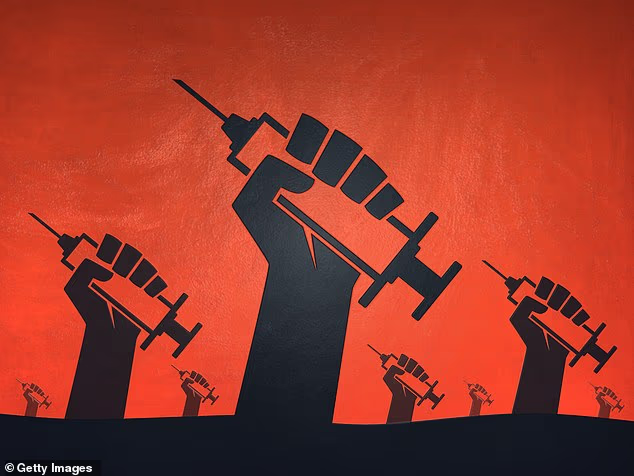
The news of two teenagers dying of meningitis B in the outbreak that started in Kent is tragic. And the awful thing is they might well have survived if they’d been vaccinated.
The meningitis B vaccine doesn’t offer complete protection. But it does reduce the risk of getting the infection – and if you do get meningitis, it reduces the risk of dying, as well as the severity of illness and complications such as loss of limbs, brain damage and hearing loss.
And what makes this so uncomfortable is that we already have this vaccine and have been giving it to babies since 2015 – but the NHS made a decision (based on cost) not to vaccinate children born before this rollout.
So any child over 12 is not protected against meningitis B (menB), unless their parents have paid for them to have the jab privately.
This brings us to a much bigger, more uncomfortable, question: how much is a life worth?
It sounds like the sort of question you’d expect in a philosophy seminar, but in reality it is what determines the care that is available on the NHS. In the UK, that decision largely sits with NICE – the National Institute for Health and Care Excellence.
At its simplest, NICE does two things. First, it asks the basics: does this treatment, test or vaccine work; how well does it work – and is it safe?
But then, that more brutal question: is it worth the cost?
The meningitis B vaccine doesn’t offer complete protection, but it does reduce the risk of getting the infection

We have been giving the jab to babies since 2015 – but the NHS made a decision, based on cost, not to vaccinate children born before this rollout
To answer that, NICE uses something called a QALY, or quality-adjusted life year. In simple terms, one QALY is one extra year of life in good health.
NICE then works out how much it costs to gain one of those years. If it costs more than around £30,000 for one patient for one year of good health, that treatment or test often isn’t funded. So, in effect, we have quietly decided the price of a year of healthy existence.
On one level, that’s entirely reasonable. The NHS does not have unlimited money and, if you don’t make those decisions, the system doesn’t work.
But like most things that work well on paper, it becomes more complicated when you’re trying to help individual patients.
A few years ago, towards the end of a shift in A&E, I treated a teenager who had a fever, a headache, and was vomiting. But there was something about him that made me pause. He wasn’t quite right – not confused, but just not engaging in the way you’d expect.
An hour later he developed a rash and soon became critically ill with sepsis caused by menB. He was given antibiotics quickly but still required weeks of intensive care treatment and, ultimately, one of his legs had to be amputated below his knee, as the blood flow to his extremities was affected – which happens all too frequently in meningococcal septicaemia.
Vaccinating him would have made sense on a clinical basis, as it would have prevented this illness, but it wasn’t deemed cost-effective by the NHS because of how rare menB is in teenagers – one or two cases per 100,000 every year.

I chose to pay for the chickenpox vaccine for my children (at £200 each), writes Professor Galloway (posed by model)
Yet his care ended up costing hundreds of thousands of pounds. He was lucky, he survived; others, like we saw last week, have not.
And this is where the neat logic of cost-effectiveness begins to feel uncomfortable.
When what might possibly happen involves life-changing disability or death, especially in young people, then the calculation that NICE does when deciding whether to fund a treatment becomes ethically almost impossible.
That is exactly the tension that charities such as Meningitis Now have been highlighting: they are campaigning for the menB vaccination to be made available more widely to those at risk.
They also argue that access to the jab should not depend on your ability to pay. At over £200 privately for a full course, it is simply not affordable for many families.
The NHS works on cost-effectiveness. But as a doctor I want to know if something is clinically effective. If it is – and the benefits outweigh the risks – I can discuss with my patients whether to cover the cost if the NHS won’t.
In the case of the menB jab, I’d recommend parents of 15- to 24-year-olds pay for the vaccine as this group is most at risk, particularly in the first year of university, when young people are suddenly living and partying together, kissing and sharing vapes – the ideal conditions for meningococcal bacteria to spread.
We see this same ethical dilemma in cancer care, or autoimmune conditions such as rheumatoid arthritis, where drugs that are clearly beneficial are restricted because their cost per QALY is too high.

Julia Halpin, who runs the Being Well private pharmacy in Hove, East Sussex, says: ‘Increasingly, our patients want to take charge of their own health – and that means wanting to access medicines or services that aren’t available on the NHS’
We also see it with the new weight-loss jabs, which are proving to be highly effective but are tightly limited on the NHS.
The key point is this: as an individual, do you want to do what is optimum for your health (if you can afford it) – or accept the care that the NHS deems cost-effective at a population level? Understanding this, there are some other vaccines I would consider paying for.
Take the shingles vaccine: the NHS offers it to those turning 65, or aged 70 to 79, because that’s where it’s most cost-effective.
Outside those groups, the vaccine still works perfectly well, and can prevent a nasty infection – which in the worst cases can lead to long-term nerve pain and vision loss. And emerging evidence suggests the shingles vaccine may reduce your risk of dementia.
So I personally will get the shingles vaccine when I turn 50 next year (the age it’s licensed for), rather than waiting.
It’s £500 for the two doses needed – I’m lucky enough to be able to afford to make that choice. Similarly, I chose to pay for the chickenpox vaccine for my children (at £200 each).
In many countries it’s long been part of the routine childhood vaccination schedule, but in the UK that was only introduced this year. The reasoning is again cost-effectiveness – most cases are, thankfully, mild. But as I’ve seen in my work, it sometimes causes severe complications.
It was a rational decision for the NHS to restrict it, but equally it was a rational decision for me to vaccinate my little ones.
NICE’s decisions aren’t set in stone. If the menB outbreak continues to widen, then it becomes cost-effective for the NHS to vaccinate – and its position will change.
However, this latest outbreak has helped expose something the NHS has always done but rarely explained well: the difference between what is clinically effective and what is cost-effective.
More and more people are now stepping outside the NHS in order to reduce their own personal risks in ways the NHS system simply cannot fund at the necessary scale. You see it in the growing numbers paying privately for flu vaccines and for Covid boosters (I recommend getting both, particularly to reduce the individual risk of long Covid).
It’s no surprise to hear pharmacies report they are running out of stocks of the menB vaccine, as people have been alerted to the risks.
My colleague Julia Halpin, who runs the Being Well private pharmacy in Hove, East Sussex, told me this is part of a clear shift. ‘Increasingly, our patients want to take charge of their own health – and that means wanting to access medicines or services that aren’t available on the NHS,’ she said.
Which brings us back to the more difficult question: if NICE decides something is not cost-effective, how much am I prepared to pay?
Much of preventative health care, including getting a vaccination, is like taking out an insurance policy.
And if we can start asking ourselves about the clinical effectiveness of healthcare – and not just accept the NHS’s cost-effectiveness decisions – it will help us each make the right choice for ourselves and our families.