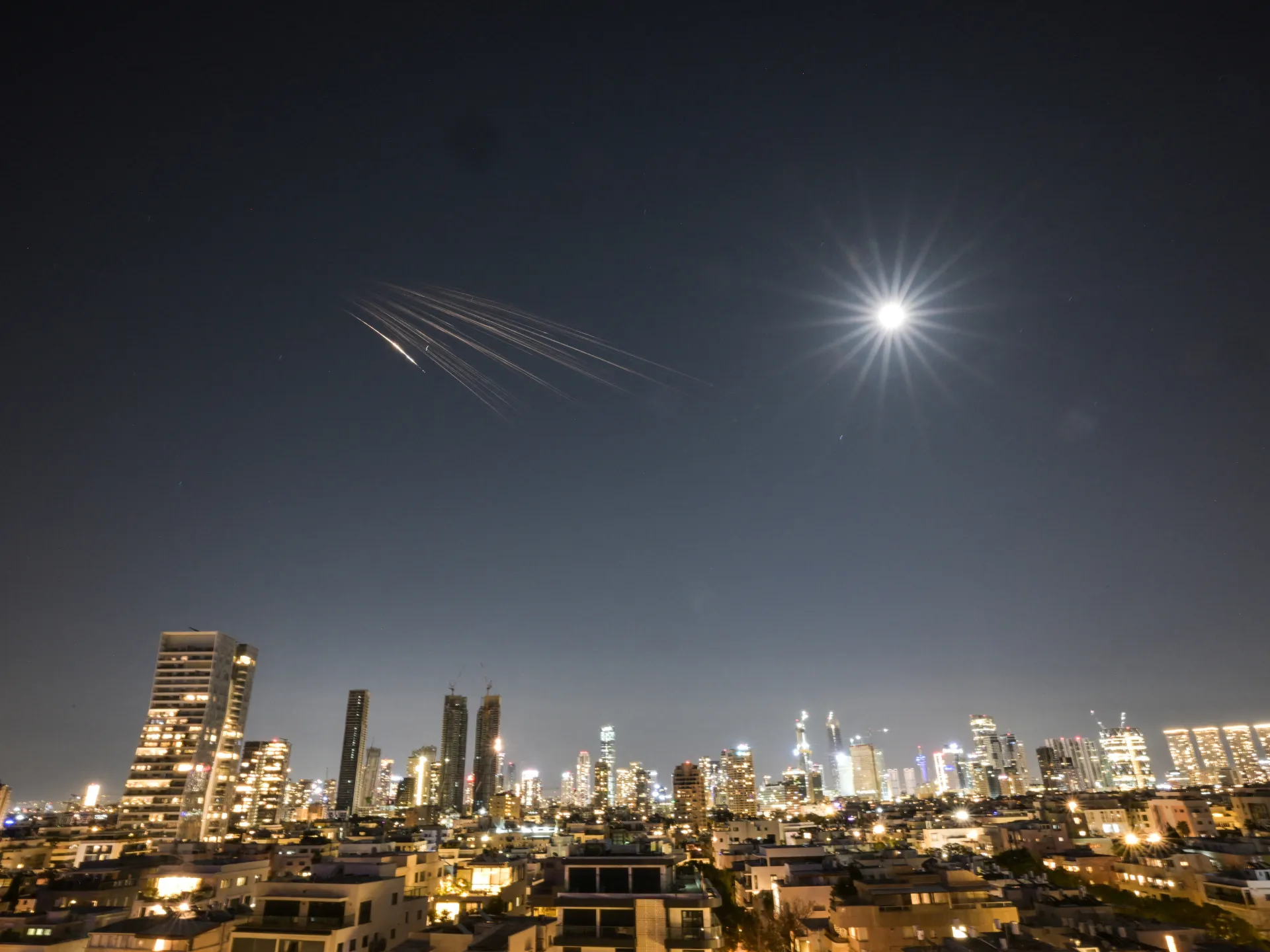
Hours after Israel’s assassination of Iranian security chief Ali Larijani on March 17, a little more than two weeks into their war, Iran fired a series of deadly cluster missiles at central Israel in what its Islamic Revolutionary Guard Corps (IRGC) described as “revenge” for his death.
The overnight attack deployed multiple-warhead missiles that can better evade defence systems and killed two people in the Ramat Gan area near Tel Aviv.
Falling shrapnel injured several other people and caused significant property damage, including at a Tel Aviv train station, according to Israeli media reports.
Al Jazeera’s Nida Ibrahim reported at the time that the two people killed, a couple in their 70s, had a safe room in their home but were unable to reach it in time, raising concerns that Israel’s air raid sirens were not sounding quickly enough for people to react.
But the use of cluster munitions has triggered broader alarm in Israel than any one incident – in a twist of fate for a country that has itself been accused of using these dangerous weapons.
“Each kind of warhead the Iranians have also uses a cluster warhead,” Uzi Rubin, founding director of Israel’s missile defence programme and a senior fellow at the Jerusalem Institute for Strategy and Security, told the US news agency Media Line.
Here is what we know about the use of cluster munitions:
What is a cluster munition or warhead?
Instead of a single explosive payload, a cluster warhead disperses multiple bomblets and has the potential for inflicting much wider damage and destruction than conventional warheads.
Cluster mechanisms can be used with any missiles designed to carry large payloads, such as ballistic and long-range missiles.
“The tip of the missile, instead of containing a big barrel of explosives, contains a mechanism which holds onto a lot of small bombs. And when the missile approaches the target, it opens its skin, it peels off and it spins around and the bomblets are released and released into space and fall on the ground,” Rubin told Media Line.
He explained that Iranian cluster warheads may contain 20 to 30 or 70 to 80 bomblets, depending on the type of missile.
Iran reportedly also used cluster munitions in the 12-day war with Israel in June, and Israel has been accused of using them in the past.
What missiles capable of carrying cluster mechanisms does Iran have?
Yes. Defence analysts have described Iran’s missile programme as the Middle East’s largest and most varied.
Developed over decades, it contains ballistic and cruise missiles and is designed to give Tehran airpower despite its lack of a modern air force.
Indeed, Iran’s ballistic missile programme was central to US demands during negotiations that were ongoing when Israel and the US launched their war on Iran on February 28.
Iran has both short- and medium-range missile systems and longer-range surface-to-air and antiship cruise missiles.
Details about Iran’s munitions are sketchy, but it is believed that the country’s medium- and long-range systems include the Shahab-3, Emad, Ghadr-1, the Khorramshahr variants and Sejjil. They also have newer designs like Kheibar Shekan and Haj Qassem.
Iran’s surface-to-air and antiship cruise missiles include the Soumar, Ya-Ali and the Quds variants, Hoveyzeh, Paveh and Ra’ad.
Its longest-reaching ballistic missile, the Soumar, has a range of 2,000km to 2,500km (1,243 to 1,553 miles). However, it was reported that two Iranian missiles were fired late on Thursday or early on Friday on Diego Garcia, the site of a joint US-United Kingdom military base in the Indian Ocean that is 4,000km (2,485 miles) from Iran. The UK said the attack failed, and an Iranian official denied firing the missile.
Former Iranian Supreme Leader Ali Khamenei previously limited Iranian missile ranges to 2,200km (1,367 miles) but removed that limit after Israel’s 12-day war. The US joined Israel in that war as well, carrying out one day of attacks on Iran’s three main nuclear facilities.
Has Iran successfully struck locations in Israel?
Yes. Overall, more than 4,500 people have been wounded in Israel since the start of the current war, according to the Ministry of Health.
On Tuesday, it was reported that Iranian missiles had hit several areas of Tel Aviv, causing major damage to buildings and at least four casualties.
On Saturday, Iranian missiles struck the Israeli towns of Arad and Dimona, close to a nuclear research centre. Iran said this was a response to an Israeli attack on its Natanz nuclear facility in Isfahan province.
At least 180 people were wounded in Saturday’s attack, and hundreds of people were evacuated from the towns.
Why are cluster munitions making an impact now?
Analysts said it is rare for the Israeli public to feel the effects of a war like it has over the past three weeks.
An Israeli military spokesman said Israel’s air defence systems failed to intercept some of the Iranian missiles that hit Arad and Dimona despite being activated on Saturday. He added that Iran’s weaponry was not “special or unfamiliar” and an investigation was under way.
It is thought that the reason Iranian missiles are making such an impact is because of the use of cluster mechanisms, which make missiles much harder to intercept.
To stop a ballistic missile equipped with cluster bomblets, it must be intercepted before the payload opens and releases its submunitions. After the payload opens midflight, the missile goes from a single point of attack to multiple points, making it difficult to stop.
Are cluster munitions legal and why are they so dangerous?
Cluster munitions are not banned internationally, but 111 countries, including most European nations and NATO members, are parties to the 2008 Convention on Cluster Munitions prohibiting their use.
The US is not a party to that agreement, however, arguing that they should be allowed to be used against military targets. Israel and Iran are not signatories to the convention either.
During the 12-day war in June, Amnesty International called Iran’s use of cluster munitions “a flagrant violation of international humanitarian law”, referring to the Convention.
Cluster munitions are particularly dangerous for civilian populations because they disperse multiple bombs over wide areas, according to human rights advocacy groups.
The United Nations reported that civilians accounted for 93 per cent of global casualties from cluster munitions in 2023, citing the Cluster Munition Monitor 2024 by the Cluster Munition Coalition, an international civil society group.
Not all bomblets dispersed from cluster weapons detonate on impact. The unexploded bombs, known as duds, can remain embedded in the ground for years, posing a serious danger to civilians, most notably children.
Patrick Fruchet, a landmine clearance expert, told Al Jazeera in 2023 that explosive remnants of war – bombs that “fail to go bang” when launched – are a major risk in conflict areas.
Fruchet said the main concern with cluster munitions is their failure rate and their “twitchy” qualities, which make unexploded devices vulnerable to detonation when handled.
“You see a lot of children coming upon novel-looking devices and being attracted to them because they’re unusual, … and there’s a tendency to pick them up,” he said.
The duds can still detonate decades after they are dropped. “There’s no reason to believe that they ever really become inert, that they ever become harmless,” Fruchet said. “These things are made to an industrial standard. They’re often stored for a long time.”
Who else has used cluster bombs?
Russia-Ukraine war
In 2023, then-US President Joe Biden’s administration attracted criticism when it authorised the transfer of cluster munitions to Ukraine despite the objections of rights advocates.
Neither Ukraine nor Russia is a party to the international convention against their use.
The US argued at the time that US-made cluster bombs were safer than the ones Russia was already using in the war.
“We recognise that cluster munitions create a risk of civilian harm from unexploded ordnance,” US National Security Adviser Jake Sullivan told reporters at the time.
“This is why we’ve deferred the decision for as long as we could, but there is also a massive risk of civilian harm if Russian troops and tanks roll over Ukrainian positions and take more Ukrainian territory and subjugate more Ukrainian civilians.”
Biden later told US media that it was a “very difficult decision” on his part, adding that the “Ukrainians are running out of ammunition”.
The weapons made up part of a tranche of US military assistance to Ukraine that year that also included armoured vehicles and antiarmour weapons.
Sarah Yager, the Washington, DC, director at Human Rights Watch, called the US move “devastating”.
“They are absolutely awful for civilians,” Yager told Al Jazeera in a television interview in 2023. “I think when legislators and policymakers here in the United States see the photos coming back of children with missing limbs, parents injured, killed by our own American cluster munitions, there’s going to be a real awakening to the humanitarian disaster that this is.”
Israeli invasions of Lebanon
Israel has also been accused of using cluster bombs in Lebanon – most recently in 2025.
In November last year, evidence that Israel had been using cluster munitions in Lebanon since its invasion in 2023 was raised in the UK Parliament.
In their motion raised in Parliament, MPs cited “evidence showing Israel’s largest arms company, Elbit Systems, was one of the manufacturers of the cluster munitions used in Israel’s recent assault on Lebanon”.
They expressed alarm that Elbit Systems was continuing to operate factories in the UK and called on the government to implement measures to prevent companies operating in the UK from supporting violations of international law and to close down all Elbit Systems factories.
During Israel’s occupation of southern Lebanon in 2006, the United Nations warned that up to 1 million unexploded cluster bombs were lying on the ground there.
Chris Clark, the UN’s demining official in Lebanon at the time, said: “The situation in south Lebanon now as a result of 34 days of bombing is that there is extensive unexploded ordnance lying all over the place.”
At the time, Al Jazeera reported that Lebanese houses, gardens, farms and streets had been peppered with the munitions.
In 2007, the Israeli army appeared to confirm the use of cluster munitions in Lebanon when, after an investigation, it said its chief investigator, Major General Gershon HaCohen, determined: “It was clear that the majority of the cluster munitions were fired at open and uninhabited areas, areas from which Hezbollah forces operated and in which no civilians were present.”
The Israeli army said cluster bombs had been fired at residential areas only “as an immediate defence response to rocket attacks by Hezbollah”.
“The use of this weaponry was legal once it was determined that, in order to prevent rocket fire onto Israel, its use was a concrete military necessity,” an army statement said.
Sudan
In 2015, Human Rights Watch reported evidence that Sudan had used cluster bombs on civilian areas of Southern Kordofan’s Nuba Mountains in February and March.
“The evidence that Sudan’s army has used cluster bombs in Southern Kordofan shows the government’s total disregard for its own people and civilian life,” Daniel Bekele, Africa director at Human Rights Watch, said at the time.