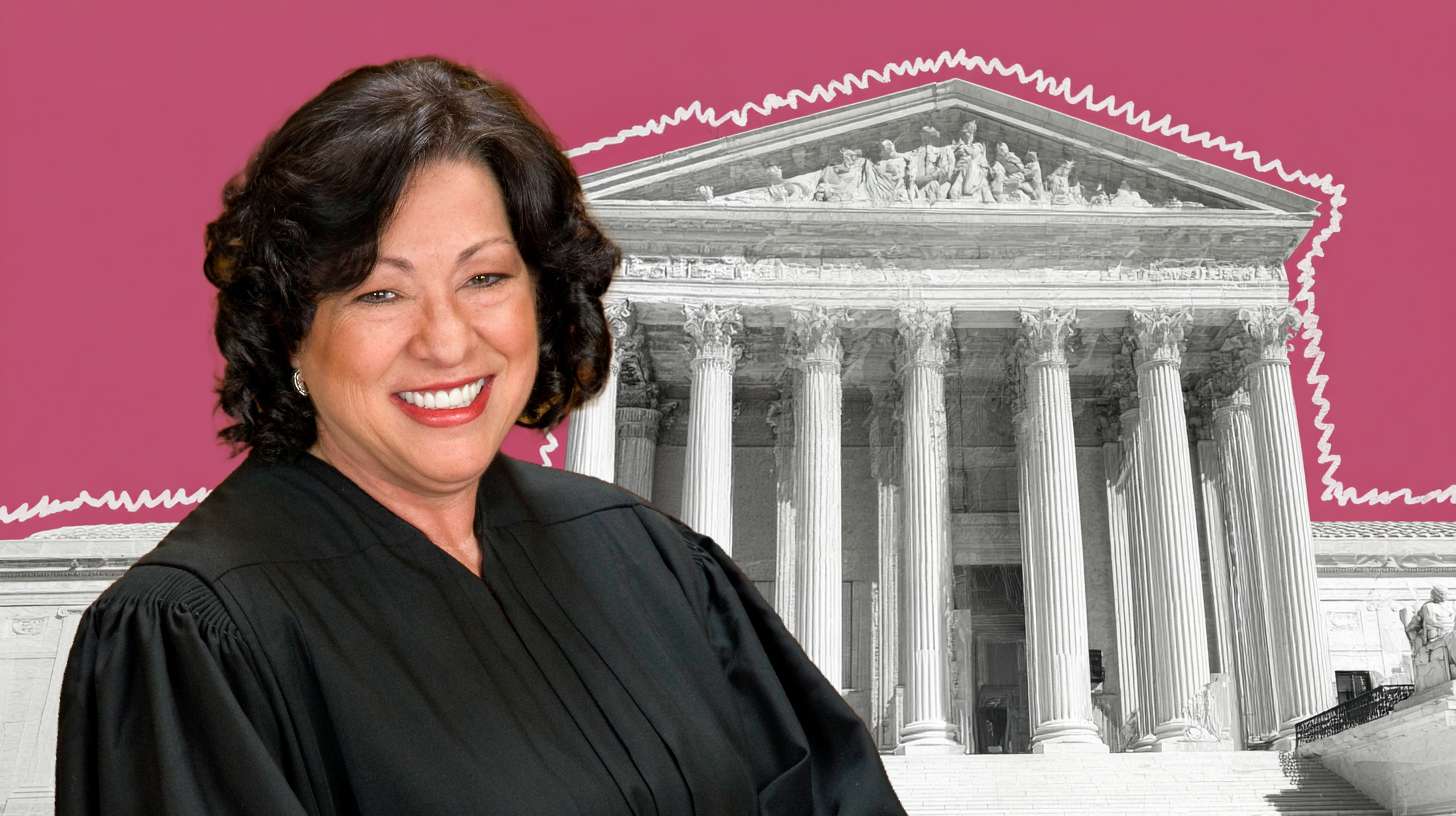
The Supreme Court yesterday rejected a petition from Priscilla Villarreal, the independent Texas journalist who was arrested on felony charges in 2017 for asking a Laredo police officer to confirm information about a fatal car accident and a public suicide. The decision against hearing Villarreal v. Alaniz provoked a 15-page dissent from Justice Sonia Sotomayor, who explains why anyone who values freedom of the press should be alarmed by the way Laredo officials treated Villarreal.
Although “it should be obvious” that Villarreal’s arrest “violated the First Amendment,” Sotomayor writes, the U.S. Court of Appeals for the 5th Circuit held that the local officials responsible for it were shielded by qualified immunity, a doctrine that bars federal civil rights claims unless they allege violations of “clearly established” law. As a result, “Villarreal is left without a remedy,” Sotomayor notes. “The Court today makes a grave error by declining to hear this case.”
The Foundation for Individual Rights and Expression (FIRE), which represented Villarreal, notes that Laredo cops “arrested Priscilla for asking police questions—something reporters do every day, and something the First Amendment squarely protects.” The denial of her petition, FIRE says in a press release, “shines more light on the need for the Court to revisit how qualified immunity applies in free speech cases.”
This was Villarreal’s second trip to the Supreme Court. The first time around, the justices vacated an earlier 5th Circuit ruling against her and remanded the case for further consideration in light of Gonzalez v. Trevino, a 2024 decision that made it easier for victims of retaliatory arrests to substantiate their First Amendment claims. Despite that instruction, the 5th Circuit reached the same result last year.
Even if District Attorney Isidro Alaniz and Laredo police engineered Villarreal’s arrest to punish her for constitutionally protected speech, Judge Edith Jones said in the majority opinion, “it is easily shown” that they would be protected by qualified immunity. That conclusion hinged on the fact that the arrest preceded the Supreme Court’s 2019 ruling in Nieves v. Bartlett, which recognized an exception to the general rule that probable cause for an arrest defeats a retaliation claim.
That rule, the Court said in Nieves, “should not apply when a plaintiff presents objective evidence that he was arrested when otherwise similarly situated individuals not engaged in the same sort of protected speech had not been.” Gonzalez v. Trevino elaborated on that point, saying such a showing does not require “very specific comparator evidence” indicating that “identifiable people” engaged in similar conduct but were not arrested.
Those principles seemed highly relevant to Villarreal’s case, since she was arrested under an obscure, ambiguous, and rarely enforced Texas law aimed at “misuse of official information”—a law that Laredo police had never invoked before. The charges were ultimately dismissed by a judge who deemed the underlying statute unconstitutionally vague. But given the timing of Villarreal’s arrest, Jones said, none of that mattered. “At the time Villarreal submitted herself to the police based on arrest warrants,” she wrote, “‘every reasonable officer’ could have believed that what he or she was doing was perfectly legal, or put otherwise, none of the defendants, including the police and attorneys who drafted the warrant affidavits, ‘knowingly violate[d]’ Villarreal’s constitutional rights.”
The 5th Circuit did not revisit its prior determination, in a 2024 opinion also written by Jones, that arresting a journalist for asking questions was not obviously unconstitutional. That astonishing conclusion provoked four vigorous dissents written or joined by seven judges.
For good reason, Sotomayor notes. Villarreal “is a reporter who was arrested for doing something journalists do every day: posing questions to a public official,” she writes. “Specifically, Villarreal twice texted with a police officer to corroborate information Villarreal already knew about events that had occurred within her community. That officer voluntarily provided the information Villarreal sought, and Villarreal published those facts, consistent with her role as a journalist.”
Six months later, Sotomayor notes, “Villarreal was arrested for asking those questions. Making matters worse, Villarreal alleges that the arrest followed a months-long effort by a police department and district attorney’s office to retaliate against her because they disliked much of her reporting on their activities. Of course, that reporting was often critical of them.” The vindictive nature of the charges against Villarreal was pretty clear from what happened after she turned herself in: Police officers “surrounded her, laughed at her, took pictures with their cell phones, and ‘otherwise show[ed] their animus toward Villarreal with an intent to humiliate and embarrass her.'”
As Sotomayor sees it, these allegations preclude qualified immunity. That doctrine, she notes, aims to ensure that government officials have “fair warning that their conduct violated the Constitution,” which does not necessarily require precedents involving closely similar facts. As the Supreme Court recognized in the 2018 case District of Columbia v. Wesby, “there can be the rare ‘obvious case,’ where the unlawfulness of the officer’s conduct is sufficiently clear even though existing precedent does not address similar circumstances.”
Villarreal’s case fits that description, Sotomayor says: “Even absent a factually similar precedent, the contours of Villarreal’s First Amendment rights were sufficiently clear to place the unlawfulness of the officials’ alleged conduct ‘beyond debate.'” She notes the long line of Supreme Court cases recognizing a First Amendment right to gather information, including “information not available to members of the general public.”
Villarreal’s arrest “was a blatant First Amendment violation,” Sotomayor writes. “No reasonable officer would have thought that he could have arrested Villarreal, consistent with the Constitution, for asking the questions she asked. Such an arrest is plainly inconsistent with basic First Amendment principles. It is also inconsistent with how officers (including the officers in this very county) are trained to interact, and have historically interacted, with the press.”
On that last point, Sotomayor cites a brief from several journalists (including me) noting that police officers are commonly trained to deal with the press and understand that asking questions is part of a reporter’s job. Although that much may seem obvious, the need for such a reminder was apparent given Jones’ apparent ignorance of how journalism works. Jones implied that Villarreal’s reporting, which she published on a locally popular Facebook page, was somehow illegitimate because she relied on “backchannel police sources.” Given Villarreal’s supposedly sneaky methods, Jones said in 2024, it was “inappropriate” to portray her as “a martyr for the sake of journalism.”
Sotomayor, by contrast, has no trouble seeing the principle at stake here, which she says is so clear that any reasonable official would have recognized it. “Although there is not a direct, factually analogous precedent confronting this situation,” she writes, “that is unsurprising and, more importantly, irrelevant given just how [obviously] unconstitutional the officials’ conduct here was.”
The 5th Circuit thought Laredo officials “reasonably believed that they had probable cause to arrest Villarreal,” Sotomayor notes. “Not so. Just [as] an individual cannot be convicted of a crime for engaging in First Amendment activity, it is axiomatic that a probable cause determination cannot be based on such protected activity either….It necessarily follows that when an arrest is based on protected First Amendment activity, that activity cannot constitute probable cause and support adverse police action. All reasonable officers know this.”
The Supreme Court should have intervened because “the Fifth Circuit’s position undermines important bedrock constitutional protections,” Sotomayor writes. “Under its view, police officers may arrest journalists for core First Amendment activity so long as they can point to a statute that the activity violated and that no high state court had previously invalidated, whether facially or as applied. This rule creates a perverse scheme in which officials can arrest someone for protected activity, decline to appeal a trial court’s decision declaring the statute unconstitutional (as the county did here), and use qualified immunity to avoid liability by citing back to that statute.”
In Nieves, Justice Neil Gorsuch highlighted the danger posed by such legal creativity. “Criminal laws have grown so exuberantly and come to cover so much previously innocent conduct that almost anyone can be arrested for something,” he wrote in a partially concurring opinion. “If the state could use these laws not for their intended purposes but to silence those who voice unpopular ideas, little would be left of our First Amendment liberties, and little would separate us from the tyrannies of the past or the malignant fiefdoms of our own age.”