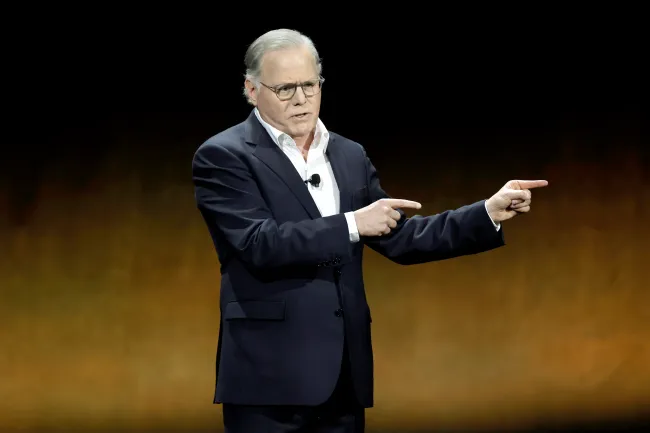
David Zaslav is leaving Hollywood as both villain and hero.
Days after selling Warner Bros. Discovery to Paramount, he cashed out more than $114 million in stock — a move that, with layoffs looming, many saw as a final insult.
Inside the industry, it cemented his role as the villain.
On Wall Street, Zaslav was a “hero.” His four-year tenure was dedicated to preparing WBD for a sale, a process he brilliantly orchestrated by getting Paramount to pay $31 a share, when it had been trading under $10 for most of 2025. From a stockholder’s perspective, Zaslav was the “hero.”
That’s what success looks like now. Sure, Zaslav will leave without the respect of employees or peers, after hollowing out one of Hollywood’s most storied studios. Wall Street shrugs at the loss of another major studio as nostalgia for a bygone era.

But two things can be true: Warner Bros. still has enormously valuable assets. And, Warner Bros. has been systematically prevented from reaching its full potential by successive owners.
As the studio is absorbed into Paramount — IP folded in, HBO reduced to a tile, workforce and production carved up in billions of dollars of “synergies” — one question lingers: Who was actually stewarding Warner Bros.?
Zaslav was the steward of shareholders. They secured his loyalty with a $246.6 million compensation package in 2022, then promised a golden parachute worth as much as $887 million if he and his team delivered the deal. By that measure, he succeeded. The Ellisons overpaid. Shareholders got paid. The C-suite’s $1.5 billion-plus in compensation was, from the board’s perspective, money well spent.
WBD investors were never interested in recruiting a visionary leadership team to finally bring Warners back to health, so that it could be worth $31 dollars a share on its own. They wanted a reality TV henchmen, who built a business on cutting every cost imaginable (and some that people hadn’t yet imagined, a true pioneer), to fatten up the turkey for Thanksgiving. It’s a strategy that worked. Which raises a harder question: Who, exactly, acted in the long-term interest of the business?
I’m not talking about a “for the good of the art form” effort. But who had the entrepreneurial and business sense to see an asset, suffering from years of neglect, that could be rebuilt to the point it was actually worth what Paramount paid for it?
Where were those in Hollywood with the capital, influence, and relationships to make the case for the untapped value of Warners? Where were there industry leaders who pride themselves on living in the legendary homes of men like Jack Warner because they see themselves as heirs to Hollywood’s legacy, but couldn’t — or wouldn’t — intervene to stop another destructive round of consolidation? Anyone?
Zaslav isn’t the problem. He’s the outcome.
His success — and the backlash to it — is the product of a system that rewards short-term financial engineering over long-term business building. Warner Bros.’ final chapter is just the clearest example of a shift that has been underway for decades: the rise of an executive class whose incentives are no longer tied to the long-term health of the industry they run.
Zaslav’s most tangible accomplishment was reducing WBD’s debt to $37 billion, down from $58 billion — itself a legacy of AT&T’s disastrous ownership. Like AOL before it, AT&T brought a thesis about its own industry and imposed it on a business it didn’t understand. Warner Bros. wasn’t treated as a company to be built, but became the imperfect tool to solve an existential crisis its owners faced in their own industries. Like today’s WBD stockholders pulling Zavlav’s strings, Warners —and the film/TV business in general– was viewed as a means to an end.
That pattern now runs across Hollywood.
Exhibitors view movies as the things that lure customers to walk past concession stands. Innovation focuses on novelty popcorn buckets, not the theatrical experience. Agencies prioritize private equity returns over talent. Streaming strategies have been shaped as much by financial optics as by product thinking. The industry’s core businesses are managed as inputs to someone else’s balance sheet.
The result is an industry that failed to execute on its most obvious evolution: streaming. After successfully navigating every previous technological shift — satellites, cable, VHS, DVD, digital — Hollywood stumbled on the one it saw coming. Warner Bros., battered by years of misaligned ownership, is a case study in that failure. After AOL left the studio reeling from a culture class with its internet overloads and skiddish about internet distribution, resulting in unsuccessful half-measures. Enter AT&T, laser-focused on a streaming platform to save its telecommunications business, swinging the pendulum too far in the other direction, and taking a sledgehammer to the pillars of the movie studio’s business.
Today, HBO Max – with an incredibly valuable library and the best and most wide-ranging content – accounts for just 1.2 percent of total U.S. TV viewing.

Compare that to Netflix. Sarandos is also an extremely well-paid studio boss of a publicly traded company, but one whose focus remains on the company’s long-term health. When its stock collapsed in 2011 after the DVD split, the company’s strategy remained on building a durable business. More than any single decision, Netflix benefited from incentives aligned with its future, not a near-term exit.
That’s what Hollywood has lost.
Hollywood chieftains of yesteryear were never an admirable crew. They were brutal, abusive, treated talent horribly, and were cutthroat in the aim of profit. They were far less interested in the art of motion pictures than today’s gatekeepers.
Here’s the difference: Their fates, their success, their fortune, their professional motivation were inseparable from the industry’s health. They didn’t develop talent out of altruism, run theaters to preserve the artistic integrity of the viewing experience, or make movies in LA to save their neighbors’ jobs.
They needed the system to work because they were embedded in it. Today’s decision-makers are not. The real power sits with private equity, Wall Street, and tech — institutions designed to extract value, not sustain ecosystems.
Which is how you end up here.
Zaslav walks away a hero to shareholders and a villain to Hollywood. Both are right. And neither matters.
The loss of Warners will be immeasurable. With the Ellisons, we have oligarchs buying up media, debt, the lack of a track record, questionable hires, and, yes, politics.
But at least Paramount-Warners is a family business again. For better or worse, the Ellisons’ legacy and the combined studio’s future are intertwined. In 10-20 years, the health of the combined companies and their TV and film business will be the measuring stick by which both Hollywood, Wall Street, and David Ellison himself judge his success. Gulp.