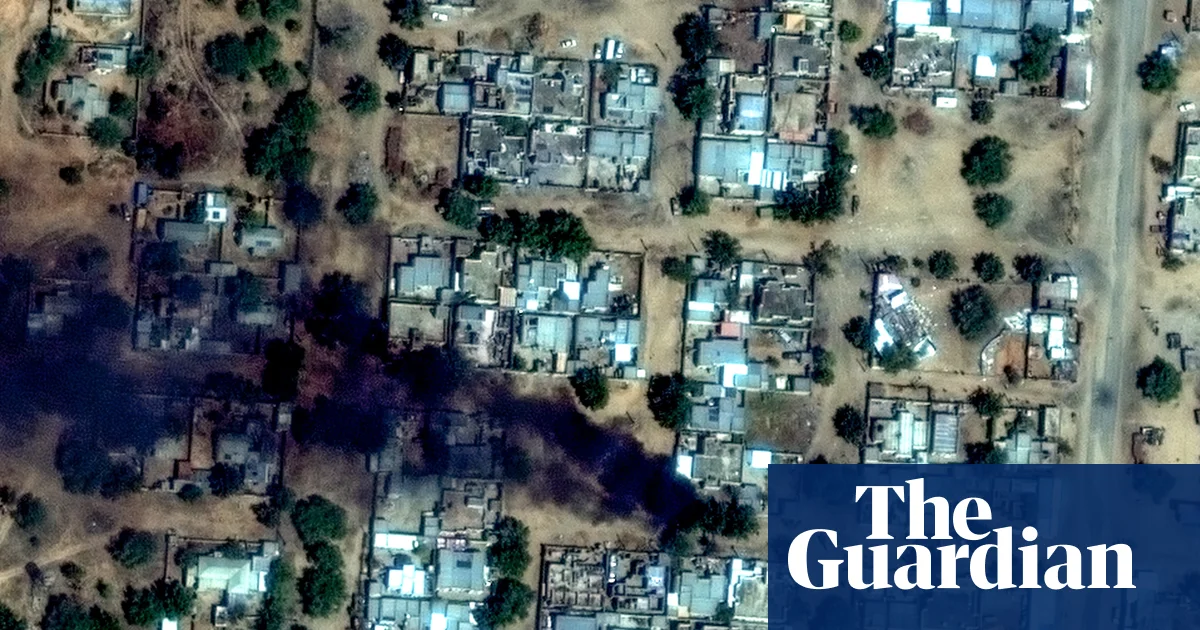
To frame El Fasher within the timeworn narrative of collective international failure avoids the darker truth.
Decisions were taken that ensured help never came. Both the US and UK suppressed or sidelined warnings that would have helped avoid the slaughter.
Central to the UK’s approach was the Joint Analysis of Conflict and Stability (Jacs), conceived to assess whether genocide was likely and, if so, intervene suitably.
The UK’s own intelligence, sources confirm, said the RSF wanted to “eliminate” the city’s non-Arab population.
Yet no attempt was made to update Jacs throughout the 18-month siege. The most recent Jacs assessment for Sudan is dated 2019: four years before the current war began.
It typified an attitude, said experts, that cost lives. “The UK’s approach was a death sentence to the people of El Fasher. Their lives were not seen as important as others,” said a parliamentarian.
Were El Fasher’s residents viewed as expendable? In July 2023, after an ethnic slaughter in nearby Geneina, western intelligence agencies suggested El Fasher would face worse.
The UK mission to the UN security council asked Nathaniel Raymond, executive director of the Yale Humanitarian Research Lab, what could be done.
Raymond advocated urgently deploying a UN monitoring force around El Fasher. “If we don’t, these people will die. I begged them.”
Nothing happened. The US similarly seemed in no rush to help. Requests for “kinetic intervention” to protect El Fasher were rejected.
The US state department blocked intelligence assessments relating to El Fasher that would have triggered an intervention to prevent genocide.
Investigators assembled compelling publicly unavailable evidence that the attack on Geneina was an ethnic rampage: El Fasher was next.
State department officials blocked the assessment. Sections of the report were requested to be deleted.
“There was an intelligence assessment that would have triggered a mass atrocity and genocide determination. That effort was stopped,” said the source. They believe the warning was stifled to protect a US mutual defence agreement with the UAE.
A US state department spokesperson said they do not comment on “alleged intelligence reports”.
The UK was similarly downplaying Darfur as a concern. Weeks after US officials blocked its assessment, the UK government revised its view of the 2003-05 Darfur genocide.
A confidential briefing for MPs, circulated last December, stated that when Sudan’s war began, Darfur was formally classed as genocide.
But when the Islamic State’s targeting of Iraq’s Yazidi minority was added to the UK’s official list in August 2023, Darfur was removed.
“It silently – inexplicably – removed the Darfur genocide,” stated the briefing.
It wasn’t the first sign Darfur had been deprioritised. As fighting spread across the region in 2023, a parliamentary report warned of genocide. Submitted to Downing Street it received no formal response. “We were indignant, outraged,” said one of the authors.
Yet the UK was El Fasher’s great hope. Not only Sudan’s penholder at the UN security council, it had international responsibility for civilian protection.
By summer 2024 – with El Fasher’s siege eight weeks old – London was suitably anxious about the deteriorating situation. An expert panel met government officials, warning El Fasher’s fall would mean genocide.
London appeared queasy over intervention. “They kept saying: ‘You have to be absolutely sure,’” said Raymond.
It felt like gaslighting. “I expressed my frustration with the UK government. They made it seem that we were crying wolf,” he added.
Also present was prominent analyst Kholood Khair. She told ministers that calling out the UAE could avert genocide.
They refused. “They were effectively saying: ‘We believe that saving lives is an imperative, but do we believe it enough?’”
In June 2024, a meeting of the UK’s Cobra emergency committee was secretly convened on El Fasher.
Raymond briefed those attending beforehand. “Cobra was told there would be a genocidal massacre: the RSF’s intent was to complete the liquidation of El Fasher.”
Soon after, the UN security council adopted a resolution demanding the RSF halt its siege.
But nothing changed. “Consequences? Zero,” said a diplomat. The resolution did not reference the UAE.
“The silence sent a signal to the killers. For the RSF and UAE, it offered consent for what would follow,” said Khair.
The security council never delivered another resolution on El Fasher. Sanctions were not proposed against the UAE despite a UN arms embargo on Darfur.
Yet sources say US internal weapons assessments – shared with the UK – confirm El Fasher was routinely attacked with UAE-supplied weaponry.
Weeks before the siege began, the UK’s then Africa minister, Andrew Mitchell, met the president of Chad and discreetly urged him to stop the UAE smuggling weapons into neighbouring Darfur.
Mitchell confirmed that even then – March 2024 – he possessed “incontrovertible proof” that the Emiratis were arming the RSF.
Yet his government, likewise the current, seemingly chose not to act. “It was quickly clear the Starmer government did not want to piss off the Emiratis,” said a US source.
A UAE official “categorically rejected allegations” that they supplied weaponry to the RSF “whether directly or indirectly”.
The Foreign, Commonwealth and Development Office said it was “absolutely clear” that external support to Sudan’s warring parties “must stop immediately”.
Atrocities meanwhile, mounted. Ibrahim’s hospital was repeatedly shelled: one drone strike killed more than 70.
As increasingly heavy weaponry was tracked to El Fasher, the UAE denied involvement.
In April 2025, UN member states urged Raymond to publicly present evidence of RSF atrocities and weapons systems around El Fasher to the security council.
“But Emirati pressure prevented me. Member state missions told me the Emiratis would not allow me to brief the security council.”
Darfur’s governor, Minni Minnawi, had similar frustrations. On at least 30 occasions Minnawi warned UK, US or UN officials that without intervention tens of thousands would die inside El Fasher. “I was asking them to press the Emirates to stop.”
Minnawi particularly targeted the UK, arguing its approach “encouraged” the RSF.
The US had issues – its entire Darfur team, sources said, was wiped out by the USAID cuts while senior state department officials were briefed to stop US president Donald Trump meddling in Sudan.
“Keep Darfur off the president’s desk,” said a diplomatic source, adding that keeping the UAE on side over Gaza was a priority.
As El Fasher’s demise approached, Minnawi engaged in frantic, futile diplomacy. Trump’s Africa envoy, Massad Boulous, never picked up the phone.
Two days before El Fasher’s fall, hope emerged. Boulous met UAE, Saudi and Egyptian officials in Washington.
Attempts, however, to discuss El Fasher were vetoed – the UAE, sources said, threatened to storm out if the city was mentioned.
“They expressly said: ‘We will not talk about this. We will leave,’” they said.
Within hours, El Fasher trembled beneath a bombardment from AH4 howitzers, allegedly provided by the UAE.
At 1:44pm on 25 October 2025 – less than 12 hours before the El Fasher massacres began – Boulous tweeted his gratitude for the UAE’s “commitment to ending the suffering of the Sudanese people”.