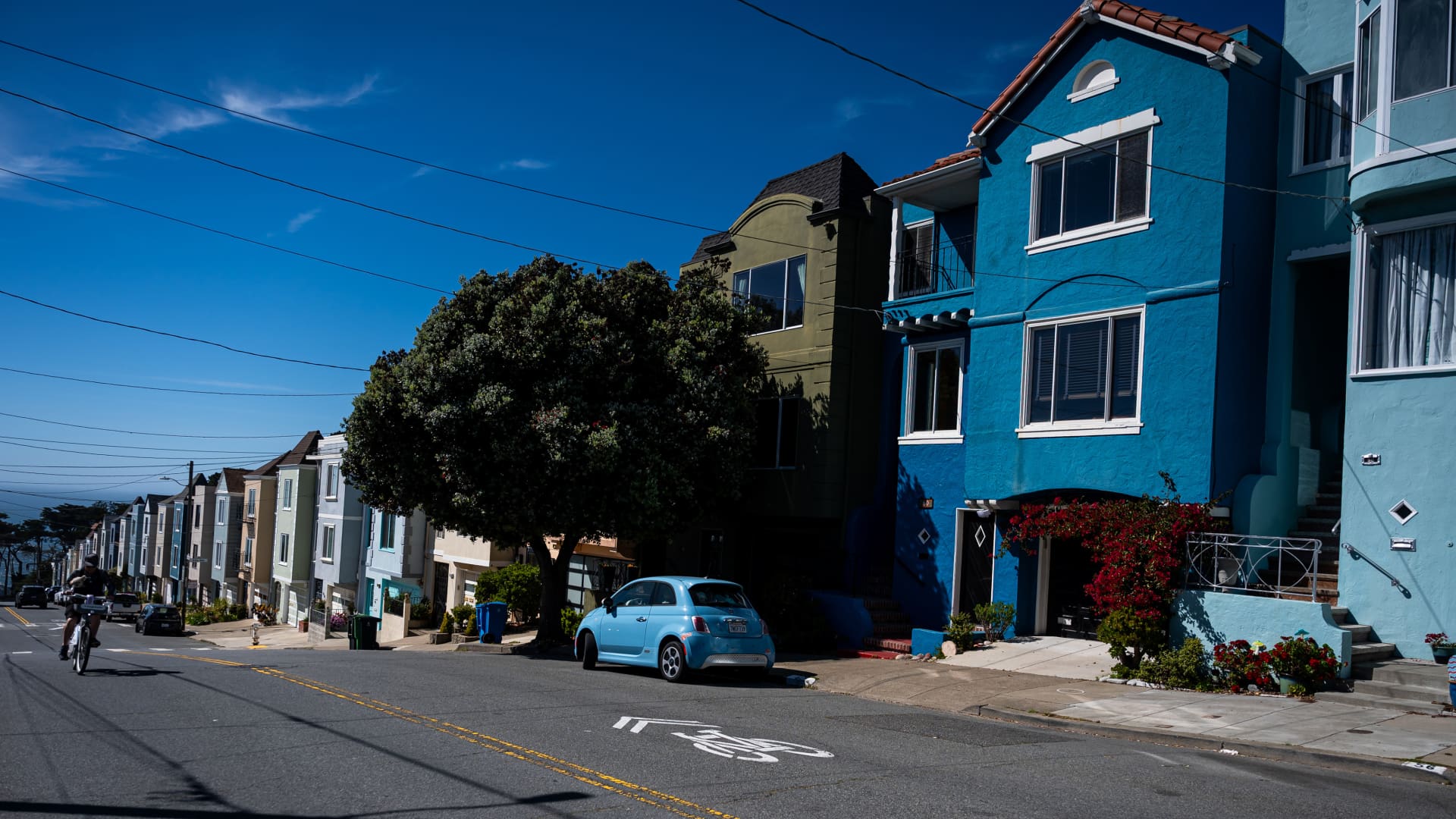
Homes in San Francisco, California, US, on Monday, March 23, 2026.
David Paul Morris | Bloomberg | Getty Images
The immediate impact of the war with Iran on the U.S. housing market has been a sharp rise in mortgage rates. One day before the strikes began, the average rate on the 30-year fixed loan was 5.99%, according to Mortgage News Daily. It is now hovering around 6.5%.
Higher rates have curtailed what was expected to be an improvement in affordability. Not only were mortgage rates falling before the war, but home price gains were shrinking and the supply of houses for sale was rising. All of those favored buyers, who had been up against a tight and pricey market.
As interest rates rose last week, applications for a mortgage to buy a home dropped 5% from the previous week, according to the Mortgage Bankers Association. But it’s not just mortgage rates.
Zillow had forecast a 4.3% gain in sales of existing homes this year, compared with last year.
“While that of course would not be a strong market, it would represent a market that had turned a corner, with 2026 acting as a ‘reset’ year,” wrote Mischa Fisher, Zillow’s chief economist, in a report Tuesday. “However, new uncertainty has emerged via energy prices and inflation concerns, adding fresh complexity to our outlook.”
Fisher used the increase in mortgage rates, due to increased concerns over inflation and the “potential for a slight uptick in the unemployment rate given reduced consumer spending power resulting from higher prices.”
Modeling those, he forecast that if the current scenario only lasted through the end of April, home sales would still rise 3.48% this year compared with last year. If it ended July 1, sales that gain would drop to 2.33%. If it ended Sept. 1, the gain would be 1.21%. Finally, if mortgage rates stayed 50 basis points higher than their original path and unemployment also rose by 20 bps for the rest of 2026, Fisher forecasts a decline of 0.73%.
The effects, however, are already hitting the new construction market. After reporting disappointing quarterly earnings Tuesday, KB Home lowered its full-year forecast.
“Consumers have been faced with a variety of challenges over the past two years, and the conflict in the Middle East that began at the end of February has added another layer of uncertainty,” said KB Home Chairman Jeff Mezger on a call with analysts. “Against this backdrop, and taking into consideration that our net orders in the first quarter were below the level we needed to hold our prior full-year delivery guidance, we are lowering our range for the year.”
Builders now have a very high supply of homes for sale, and inventory on the existing side is rising as well, albeit more in the South and West than in the Northeast and Midwest.
Even before the war began, buyers were canceling contracts at the highest rate since 2017, according to a count by Redfin. Roughly 1 in 7 homes, or 13.7% of homes that went under contract in February, were canceled, up from 12.8% a year earlier. Buyers are suddenly holding the upper hand, with more than 600,000 more sellers than buyers in the market, according to Redfin. That is a near-record gap, although it varies widely market to market.
“As the housing market approaches the ‘best time to sell’ season, it sits in a precarious position, caught between long-term improvements and sudden short-term instability,” wrote Jake Krimmel, senior economist at Realtor.com in a weekly report.