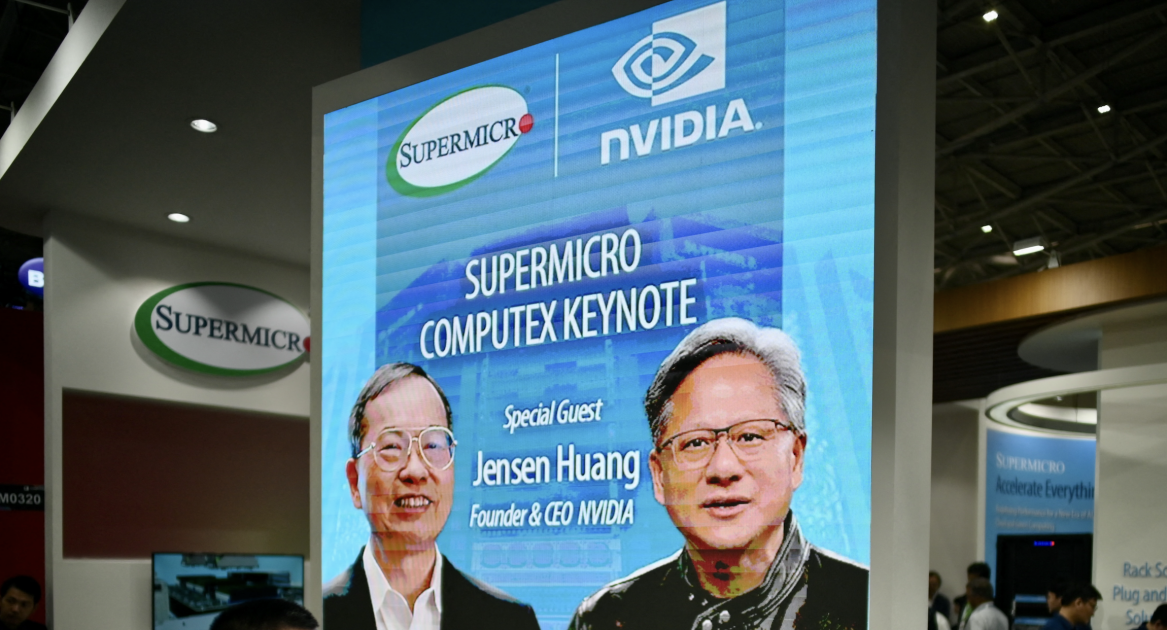
The US has disclosed a new Nvidia chip-smuggling case that also seems to involve San Jose-based server manufacturer Supermicro. It comes days after a Supermicro co-founder was arrested in a separate investigation, but in this instance, it looks like Nvidia and Supermicro played a role in foiling the attempted smuggling.
The Justice Department today announced it had charged three suspects, one Chinese national from Hong Kong and two US citizens, for trying to smuggle the export-controlled chips to China using pass-through companies in Thailand. The 56-year-old Chinese national, Stanley Yi Zheng, allegedly began conspiring with Americans Matthew Kelly and Tommy Shad English about smuggling the chips to China in May 2023.
The DOJ did not name Nvidia or Supermicro in the announcement or the criminal complaint. But the 41-page criminal complaint references the trio attempting to smuggle hundreds of Nvidia A100 and H100 chips. The official announcement of the charges also includes screenshots of messages the suspects sent that also mention the enterprise GPUs.
(Credit: DOJ)
In addition, the criminal complaint says the three suspects attempted to buy the Nvidia GPUs from a “computer hardware and services company” based in San Jose. A screenshot shows that Zheng allegedly sent a purchase order for 232 server units of a model dubbed “SYS-821GE-TNHR,” a Supermicro product that supports Nvidia H100 and H200 GPUs. The total cost of the purchase order was nearly $62 million.

(Credit: DOJ)
The complaint adds that a tipster notified federal investigators about the scheme in January 2024. Last month, federal agents seized the phone and laptop of US suspect Matthew Kelly when he returned to the US from Italy, giving them a way to view WhatsApp messages between the three suspects.
Nvidia and Supermicro didn’t immediately respond to a request for comment. But the complaint indicates that federal officials contacted both companies during the investigation. It also suggests that employees from Nvidia and Supermicro noticed something was off with the order requests and canceled them early in 2024. A second attempt was made to buy the chips in April 2024, but that too “ultimately was unsuccessful,” according to federal investigators.

Get Our Best Stories!
Your Daily Dose of Our Top Tech News

Thanks for signing up!
Your subscription has been confirmed. Keep an eye on your inbox!
“China is an embargoed country restricted by the US government. US companies are restricted from selling to businesses or end users headquartered in China,” Supermicro, identified as “Company-1” appears to have told the suspects at one point. All three suspects are now in US custody.
The case emerges amid growing concerns that China continues to find ways to obtain cutting-edge AI chips despite US export controls. The investigation involving Supermicro co-founder Wally Liaw focused on the company selling $2.5 billion worth of servers to another pass-through company in Southeast Asia, which then sent the units to China. Liaw was arrested last week, but not before he was spotted posing for a picture with Nvidia CEO Jensen Huang.
Recommended by Our Editors
In response to that case, Nvidia told PCMag: “Strict compliance is a top priority for Nvidia. We continue to work closely with our customers and the government on compliance programs as export regulations have expanded. Unlawful diversion of controlled US computers to China is a losing proposition across the board—Nvidia does not provide any service or support for such systems, and the enforcement mechanisms are rigorous and effective.”
Still, two US senators, Jim Banks (R-Ind.) and Elizabeth Warren (D-Mass.) have called on the Commerce Department to suspend Nvidia’s export licenses to ship the advanced GPUs to Asian markets over fears the hardware will be rerouted to mainland China. “I want a freeze to Nvidia’s export licenses until it takes our national security seriously,” Sen. Warren tweeted.
UPDATE: Nvidia told PCMag about the newest GPU smuggling case: “The complaint shows that our due diligence process works well. Despite several efforts, the would-be smugglers failed to clear our diligence process and did not receive GPUs from us.”
About Our Expert

Michael Kan
Senior Reporter
Experience
I’ve been a journalist for over 15 years. I got my start as a schools and cities reporter in Kansas City and joined PCMag in 2017, where I cover satellite internet services, cybersecurity, PC hardware, and more. I’m currently based in San Francisco, but previously spent over five years in China, covering the country’s technology sector.
Since 2020, I’ve covered the launch and explosive growth of SpaceX’s Starlink satellite internet service, writing 600+ stories on availability and feature launches, but also the regulatory battles over the expansion of satellite constellations, fights with rival providers like AST SpaceMobile and Amazon, and the effort to expand into satellite-based mobile service. I’ve combed through FCC filings for the latest news and driven to remote corners of California to test Starlink’s cellular service.
I also cover cyber threats, from ransomware gangs to the emergence of AI-based malware. Earlier this year, the FTC forced Avast to pay consumers $16.5 million for secretly harvesting and selling their personal information to third-party clients, as revealed in my joint investigation with Motherboard.
I also cover the PC graphics card market. Pandemic-era shortages led me to camp out in front of a Best Buy to get an RTX 3000. I’m now following how President Trump’s tariffs will affect the industry. I’m always eager to learn more, so please jump in the comments with feedback and send me tips.