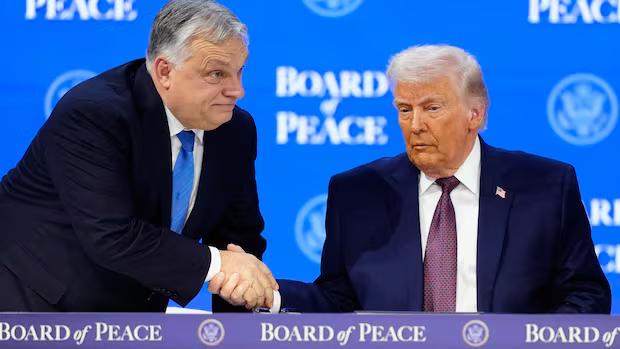
U.S. President Donald Trump wants it be known that Hungarians should re-elect Viktor Orban, in case it wasn’t already abundantly clear.
“I was proud to ENDORSE Viktor for Re-Election in 2022, and am honored to do so again,” Trump said in a Truth Social post on Tuesday night.
In truth, Trump has backed Orban at least twice before already this year. He also lavished praise on Orban’s bid for a sixth term as Hungary’s prime minister on TruthSocial last month, and on Sunday he sent a video message to the Hungarian version of the Conservative Political Action Conference.
U.S. Secretary of State Marco Rubio travelled to Budapest in February and publicly backed Orban. That visit earned a rebuke from Democratic Sen. Ruben Gallego, who pointed out that Rubio, in his previous role as a senator, signed a 2019 bipartisan congressional letter expressing concerns that Hungary was on a downward trajectory away from democratic government.
If that weren’t enough, Vice-President JD Vance — who has lectured Western European countries about the perceived shortcomings of their free speech provisions — will travel to Hungary to visit Orban, who was once called a “free press predator” by Reporters Without Borders.
Mutual admiration societies
As the Republican party swung farther right from the presidencies of George W. Bush to Trump, conservatives have become enamored with the Hungarian prime minister. Orban received a warm welcome at CPAC in 2022 and events hosted by American think-tanks. The Heritage Foundation, instrumental in developing the Project 2025 blueprint for a Trump return to the presidency, has praised Orban, “under whose leadership in Hungary on immigration, family policy, and the importance of the nation-state is a model for conservative governance.”
Under Trump’s second administration, the U.S. could be seen as emulating Hungary in overt displays of Christianity from government podiums, and an antipathy to immigration from Muslim-majority countries, though Republicans haven’t been as blunt as Orban’s declaration at CPAC in Dallas that “we do not want to become peoples of mixed race.”
Some analysts have also detected, in Trump’s second term with his outspoken Federal Communications Chair Brendan Carr, an Orban-like attempt to cow and influence private media companies.
Trump, in Tuesday’s post, also said that Orban works hard to “grow the economy” and “create jobs,” though under his stewardship, Hungary has perennially been among the poorer performers in the European Union. Eurostat, the European Commission’s statistical office, placed Hungary’s real GDP growth in 2025 as third-last in the EU.
While Trump has bemoaned anything he thinks smacks of “election inteference” on the domestic front — a very broad list that includes a recent Ontario government ad criticizing U.S. tariffs — he has a history dating back to his first term of making his preferences known in foreign elections from Brazil to Israel to Poland. He went a step farther last fall with Argentina, seemingly indicating that a multibillion dollar currency swap to shore up the peso was dependent on their midterm results.
Whether the U.S. cheerleading for Orban this time will hold any sway, or backfire, is yet to be seen.
Trump’s threats to make Canada another U.S. state, together with a leadership change from Justin Trudeau to Mark Carney, revived the fortunes of the Liberal Party in last year’s election, and weeks later, some thought that Trump’s hectoring of allies did no favours for Australia’s conservatives, with the Labor Party in that country exceeding pre-campaign expectations for a majority government victory.
The result of this week’s election in Denmark is not yet clear, but Trump’s threats to take over its semiautonomous territory Greenland were so existential that right-of-centre candidates backed away from previous praise of the U.S. president — none more profanely than a member of the Danish People’s Party in Brussels — and focused instead of pressing domestic issues.

Orban’s team has also soliticited testimonials from friendly voices across the world. The leaders of Israel, Italy and Argentina — as well as actor Rob Schneider, of Deuce Bigalow: Male Gigolo fame — sang his praises in an early campaign video.
Rumours of Orban’s downfall have been exaggerated in other elections since he returned to power in 2010 — he was also PM from 1998 to 2002 — as his popularity has been buttressed in campaigns by a barrage of friendly state media coverage and favourable changes to the electoral system.
But polling this year has consistenlly shown Orban to be facing an uphill battle against challenger Peter Magyar of the Tisza party.
Hungarians are not being asked to back a politician at the opposite end of the political spectrum, with Magyar considered centre-right. Until two years ago, Magyar was affiliated with Orban’s Fidesz Party.

Hungarian Prime Minister Viktor Orban has accused Ukraine of waging an ‘oil blockade’ against his country by delaying the reopening of a vital pipeline that supplies Russian oil — the Soviet-era Druzhba pipeline. CBC’s Briar Stewart breaks down the hostile situation.
While in power, Orban has often whipped up support by accusing Budapest-born George Soros of encouraging Muslim immigration and undermining Christianity in Hungary, through the Soros-led Open Society Foundation funding of activist groups and, for a time, a university led by former Canadian politician Michael Ignatieff. It has been an ironic development, since before he swung hard to the right, Orban as a young man received a grant from a pre-OSF Soros organization to study at Oxford University in England.
But Soros, 95, has retreated from public life, and Open Society has a smaller footprint under his son that it had just a few years ago.
If any one person can be said to fit the role of a post-Soros foreign bogeyman this campaign, it is arguably President Volodymyr Zelenskyy from neighbouring Ukraine. Both at the EU and NATO, Orban has often been a minority voice in opposing financial and military support for Ukraine since it was invaded by Russia, led by Orban ally Vladimir Putin.
Last week, Orban infuriated many in the EU by blocking a 90 billion euro aid package ($143 billion Cdn) for Kyiv.
Orban has pushed back on claims his government hasn’t been receptive to Ukraine refugees of the four-year war, and tensions between the countries have been exacerbated this year after a crucial pipeline in Ukraine was damaged in January and hasn’t been fixed, preventing Hungary from accessing Russian oil. For good measure, Hungary recently temporarily seized millions in Ukraine assets.
The campaign between Orban and Magyar has reportedly been bitter, and the challenger accused the administration of “outright treason” after the Washington Post reported last week, citing a European security official, that Orban’s foreign minister had made regular calls during breaks at EU meetings for years to brief his Russian counterpart, Sergei Lavrov.
The minister, Peter Szijjarto, dismissed the report with a familiar-sounding two-word response: “fake news.”