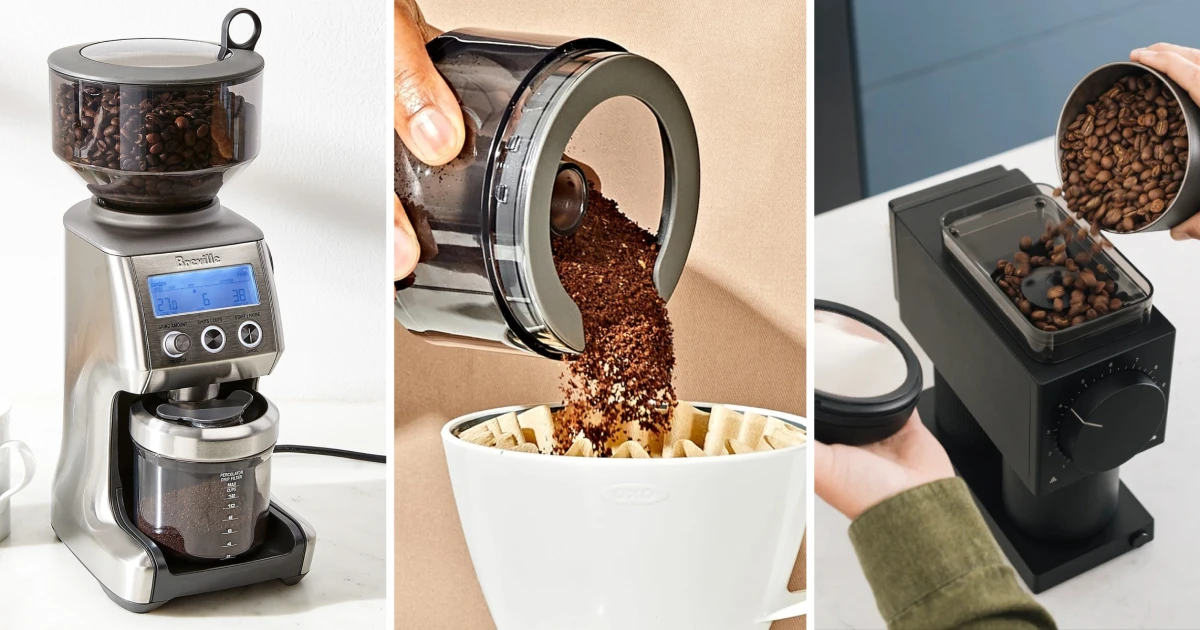
One thing that many coffee drinkers don’t realize is that a quality brew comes down to more than just the beans. Though your beans can certainly be the difference between a swoon-worthy sip and something you’d rather spit out, the equipment you use to prep that cup of joe can also impact how it turns out, especially when it comes to the grinder.
Coffee grinders are used for brewing all types of beverages, including drip coffee, cold brew and espresso. “A grinder is literally the most important piece of coffee brewing equipment you can buy,” says Jiyoon Han, a certified Q grader coffee sommelier of Bean & Bean Coffee. “I can brew great coffee in just a mason jar with a filter if I have a good grinder.”
So whether you want to make your drinks at home or in the office, you’ll need quality tools. To find the best coffee grinders, we spoke with coffee experts to learn more about the different types of appliances. They also shared their favorite grinders for every type of brew.
What are the types of coffee grinders?
Before we get to our picks it’s important to note the types of coffee grinders first: the two main options are blade and burr. Burr grinders use burrs or “discs” to break down the beans and are much more commonly recommended by experts because they grind coffee into more uniform pieces in many types of textures. Blade grinders don’t have the level of customization (more or all of this below).
The main types of burr grinders are flat and conical burrs. Flat burrs use flat discs to grind coffee while conical ones use a cone-shaped mechanism. We included a mix of both types of burr grinders below.
The best coffee grinders of 2026
Below, we rounded up our experts’ recommendations for the best coffee grinders, and all (except one) are burr grinders.
Best coffee grinder under $200

The Baratza Encore is a highly-rated conical burr grinder that customers praise for having a wide range of grind settings. John Holmquist, customer experience manager at Seattle Coffee Gear, also recommends this pick, saying that it’s a ”great option for households that use multiple brew methods.”
The first 20 settings are meant for brewing espresso, while the settings 21 to 40 are best for brewing coffee, including for drip and pour over. To adjust the grind settings, all you have to do is twist the hopper on the top. It also has a 10.6-ounce capacity, an on and off switch on the side and a pulse button on the front.
Best blade coffee grinder

If you don’t care much about having multiple grind settings, this blade grinder from Bodum is a great option, and it’s affordable. Around the size of a drinking glass, the grinder has a compartment on the top to grind the coffee (up to 60 grams). You just press the button on the top to pulse and grind until it reaches the texture you prefer.
Best single-dose coffee grinder

A popular conical burr coffee grinder, the Fellow Ode Gen 2 is a powerful appliance with capacity of 100 grams. It’s meant for making brewed coffee, including pour over, French, press, cold brew and drip, and it has low noise, according to the brand. It has a 1-meter-long power cord and it isn’t as tall as the previous model, making it easier to fit in a small kitchen.
Holmquist, recommends this option and says that it’s a great option for people who enjoy making different types of coffee, as opposed to just espresso or drip.
Best minimalist coffee grinder

Fellow has a great lineup of coffee appliances, including the Fellow Opus, which is a conical burr grinder that has more than 40 adjustable grind settings. You can measure your grind by using the dosing lid, which allows you to prepare up to 12 cups of brewed coffee, according to Fellow.
Coffee grinder with the most grind settings

The Baratza Virtuoso has 40 grind settings for different types of espresso and coffee beverages. It grinds up to 2 grams per second, according to the brand, and has a capacity of 10 ounces. It also has an LED light making it easy to see the grind setting and an LCD display on the front, plus a dial that allows you to choose the grind size.
Best smart coffee grinder
This grinder from Breville has more than 50 grind settings and a capacity of 18 ounces. It has a screen on the front to display the grind setting, grind time, the type of coffee you’re brewing and the amount. It also has a button to start and stop the grind process and it allows you to select shots of espresso or cups of drip coffee. You simply adjust the grind size with the dial on the side.
Best affordable burr grinder

This option from Cuisinart is a smart choice if you want a conical burr grinder but don’t want to spend a ton of money. It has an 8-ounce capacity and it has a dial on the top that allows you to adjust the grind size and select between 18 settings, which include fine, medium and coarse. It also makes grounds for up to 18 servings of coffee (5 ounces each), according to the brand.
Best small burr coffee grinder

While many conical burr coffee grinders are very tall or wide, this option from Oxo is small and has the power of a traditional conical burr appliance. It holds up to 50 grams of coffee and you can adjust the setting by twisting the top to the desired amount. It’s the ideal size for small apartment kitchens or anyone with limited counter space.
Best coffee grinder worth the splurge

This coffee grinder comes recommended by Han, who says that while it is on the more expensive side, it is a “top-tier option” because of its Turbo burrs, which are flat burrs that create consistent and uniform grinds.
The burrs are made for brewing espresso and pour over, so it makes super smooth grinds and they also prevent the buildup of coffee fines (tiny residual pieces of ground coffee that buildup around the spout, according to the brand). The lid is also magnetic, preventing spills, and it has more than 30 grind settings, perfect for espresso or pour over.
How we chose the best coffee grinders
There are a lot of important features to consider when buying a coffee grinder to ensure your coffee comes out great, according to Han. These include size, effort required, price, noise level, the type of coffee in question and the type of burr. Below, are some of the factors experts, including Han, recommend we keep in mind when making this list:
- Grinder type: “The first thing to understand about coffee grinders is the difference between blade and burr systems,” says Holmquist. He also says that since blade grinders don’t allow you to adjust the grind and make uniform pieces, they don’t always make the best coffee. “If you’re really looking to bring out the best in the coffee beans, taste the different flavor profiles and brew well-extracted coffee, a burr grinder is the move,” he says. With this in mind, the majority of coffee grinders we included above are conical burr grinders (more on this below).
- Size: The size of a coffee grinder matters since some home kitchens can accommodate only a smaller-sized manual grinder. Some coffee grinders have large compartments for the grounds while others are small for single dosing, in other words, they make enough for one serving, according to our experts. We included coffee grinders of all sizes above.
- Price: Blade grinders are usually inexpensive and conical and flat burr grinders are more expensive. “Entry-level espresso grinders typically cost between $200 and $400, and more advanced grinders with more features, insulation to keep grind noise low, and higher-quality build materials can exceed $500,” says Holmquist. All of the grinders above range in price from $75 to $250.
- Noise: All coffee grinders will make some level of noise, though it varies. “If you’re an early riser who wants to brew your first espresso in the morning without disturbing the rest of the household, you may want to consider a quieter grinder,” says Holmquist.
- Speed: Fancier, pricier coffee grinders will grind coffee more quickly, which offers more convenience in terms of time and also limits the amount of time you’ll have to listen to the noise the grinder makes.
- Adjustability: Some grinders have different features to adjust the weight and grind size. “If you want to really ‘dial in your brew,’ you want a good amount of options for grind size and clear lines marking your adjustments,’’ explains Han. “This will help you move around more easily between particle sizes.” For example, if you want to make cold brew, you’ll need a coarse grind — but if you also like to make pour-overs, you’ll then need a finer grind. Some grinders also have options for grinding based on time or weight. “In other words, the grinder will give you a set amount of coffee per grind,” Han says. “Grinding by weight is ideal in many ways, whether you choose to buy a scale and weigh the beans ahead of time or you decide to splurge and buy a grinder with a built-in scale.”
- Hopper size: Different grinders allow you to input different amounts of beans in the hopper, the container where the beans are held before being ground. Hoppers can hold anywhere from 30 grams to 1 pound of beans. “This is something to keep in mind,” says Han. “If you choose the hand grinder route and consistently brew a chemex for three people, you are probably going to have to reload it three times.”
- Single dosing: Another thing that’s important to consider is single dosing: If you single-dose your coffee (or weigh out the amount of beans you need every morning), you’ll want a single-dosing grinder to avoid aged coffee that’s sat in a hopper for days on end
Types of coffee grinders to shop
There are two primary types of grinders on the market: blade grinders and burr grinders.
Blade grinders
While they’re much more affordable than burr grinders, blade grinders create non-uniform pieces of coffee that lead to bad extraction or unpredictable taste, according to Holmquist. This is why most coffee experts recommend burr grinders instead for grinding your own coffee at home.
Burr grinders
Burr grinders work much like pepper mills in that you have two metal “burrs” (or discs) that spin when grinding, allowing the beans to break down into even pieces as they pass through, explains Han. The pieces end up being more uniform in size and shape, therefore helping with an even extraction. “Basically, this means each piece of coffee is able to give you the same amount of the same kinds of flavors,” she says. “The result [is] a much better and more consistent cup. Burr grinders are the best for consistent, yummy coffee.”
Flat burr grinders
“Flat burrs use two plate-like surfaces stacked on top of each other, while conical burrs use a smaller cone-shaped burr nested inside a larger funnel-shaped one,” says Holmquist. “Both [flat and conical grinders] produce consistent results, so don’t stress too much about which configuration is right for you.”
Conical burr grinder
In a conical burr grinder, meanwhile, the burrs are mounted vertically. These are more common and also work relatively well, especially for espresso, explains Han. “They are often less expensive both in the initial purchase as well as when you need the burrs replaced, which will eventually need to happen,” she says.
Frequently asked questions
The best coffee grinder to buy depends on the type of coffee you enjoy, such as drip coffee or espresso. Most coffee grinders have a conical or flat burr, both of which our experts recommend, as opposed to blade grinders which produce inconsistent grinds.
There are many coffee grinders available that are great for single-dose brewing, but a top option is the Fellow Ode grinder, which allows you to grind small portions of coffee at a time, which preserves the flavor of your coffee over time (as opposed to grinding a lot of coffee and having it sit for days).
Meet our coffee experts
At NBC Select, we work with experts who have specialized knowledge and authority based on relevant training and/or experience. We also take steps to ensure all expert advice and recommendations are made independently and without undisclosed financial conflicts of interest.
- Jiyoon Han is a certified Q grader coffee sommelier of Bean & Bean Coffee.
- John Holmquist is a customer experience manager at Seattle Coffee Gear.
Why trust NBC Select?
Lauren Levy is a former contributing writer at NBC Select, who interviewed multiple coffee experts for this story.
Cory Fernandez is a commerce editor at NBC Select. He updated this article with additional reporting.
Catch up on NBC Select’s in-depth coverage of tech and tools, wellness and more, and follow us on Facebook, Instagram, Twitter and TikTok to stay up to date.