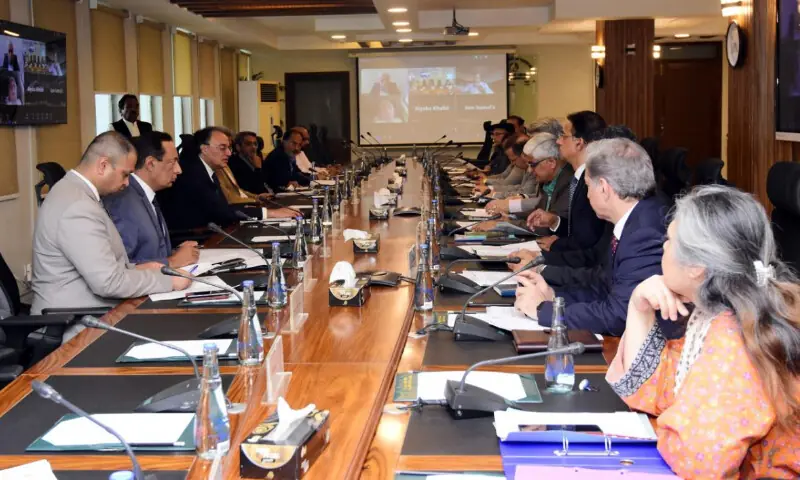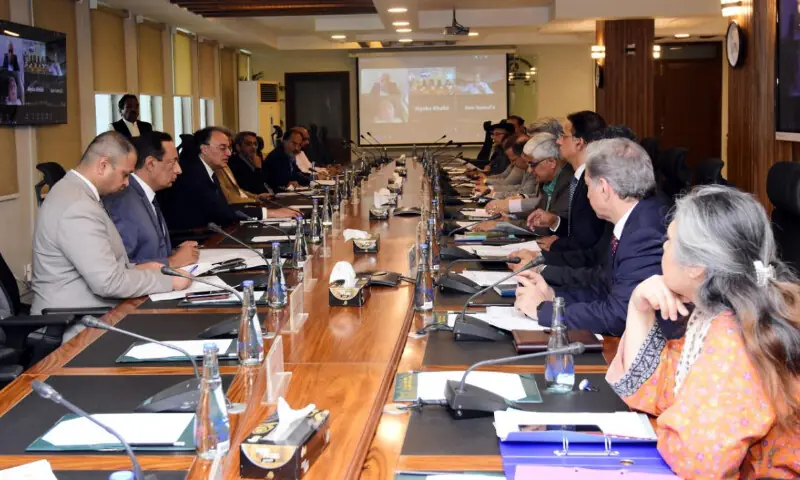
ISLAMABAD: The Economic Coordination Committee (ECC) on Thursday approved a Rs100 billion supplementary grant for the prime minister’s austerity fund created to finance the petroleum pricing subsidy.
Finance Minister Muhammad Aurangzeb presided over the ECC meeting, which approved a summary submitted by the Ministry of Finance, seeking a Technical Supplementary Grant (TSG) of Rs100bn for onward transfer to the austerity fund.
“The committee was informed that, in light of evolving developments in the Gulf region and their potential impact on international petroleum prices, the prime minister had directed the mobilisation of Public Sector Development Programme (PSDP) resources to meet price differential requirements on petroleum products and to cushion consumers from price volatility,” an official statement said.
During the discussion, the ECC noted that the proposed allocation was being met through rationalisation and surrender of PSDP funds by various ministries and divisions, as coordinated by the Ministry of Planning, Development and Special Initiatives in consultation with Principal Accounting Officers of the ministries concerned, it added.
It was emphasised that the reallocation exercise had been undertaken to minimise disruption to priority and well-performing projects while creating the required fiscal space.
“The committee also took note that initial surrenders have already been received and the remaining adjustments were being finalised to meet the overall requirement. It was noted that PSDP had already been cut by Rs100bn to Rs900bn for the purpose,” the statement said.
The government has already notified the crowdfunding of the opening of the Prime Minister’s Austerity Fund 2026 to mitigate the impact of the extraordinary spike in diesel and petrol prices due to the war in the Gulf region.
All proceeds on account of the said fund would be received at all branches of the State Bank of Pakistan (SBP), all treasuries and branches of the National Bank of Pakistan and all other scheduled banks.
The finance ministry has notified that the said fund would receive “donations from both domestic and international donors and contributions from abroad, which will be received at all the branches mentioned above where such branches exist”.
In other foreign countries, contributions would be received at Pakistan missions and remitted to the SBP, which would prescribe the necessary procedure for its accounting, the notification said.
“For this purpose, ten separate individual funds head of account, including special deposit fund, relief funds and Prime Minister’s Austerity Fund 2026, besides Prime Minister’s Austerity Funds for Punjab, Sindh, Khyber Pakhtunkhwa, Balochistan, Azad Jammu and Kashmir, Gilgit-Baltistan and the state-owned enterprises.”
“Accounts of the fund will be maintained by the accountant general of Pakistan revenues, Islamabad, the concerned accountant generals and the Head of state-owned enterprises. The fund will be administered by the Ministry of Finance,” the notification said.
Meanwhile, the ECC also approved the procurement of up to one million tonnes of wheat and directed that the procurement should be done through a transparent and competitive process to be executed by the private sector, the statement said.
It added that the Ministry of National Food Security and Research had sought procurement of three million tonnes of wheat for federal strategic reserves under the Interim National Wheat Policy (INWP) 2025-26 through private-sector participation.
The meeting was briefed about the current supply and demand outlook, including production estimates, evolving weather conditions, and existing public and private stock positions. Projections suggested improved crop conditions but uncertainties remain, warranting a cautious and calibrated approach to maintaining adequate reserves, the statement said.
Furthermore, the ECC discussed the need to balance market stability, farmer support, and fiscal considerations, while avoiding premature interventions that could distort market signals or create uncertainty, it said.
“The committee also highlighted the importance of distinguishing between strategic and commercial reserves, ensuring that procurement decisions are aligned with actual requirements and do not impose unnecessary fiscal or storage burdens.
“Therefore, it decided procurement of only 1m tonnes and directed that key elements, including financial implications, pricing benchmarks, and operational modalities, be further refined in consultation with the Finance Division before finalisation,” the statement said
The committee emphasised that procurement levels and financial commitments should remain flexible and responsive to updated crop assessments and market conditions, it concluded.