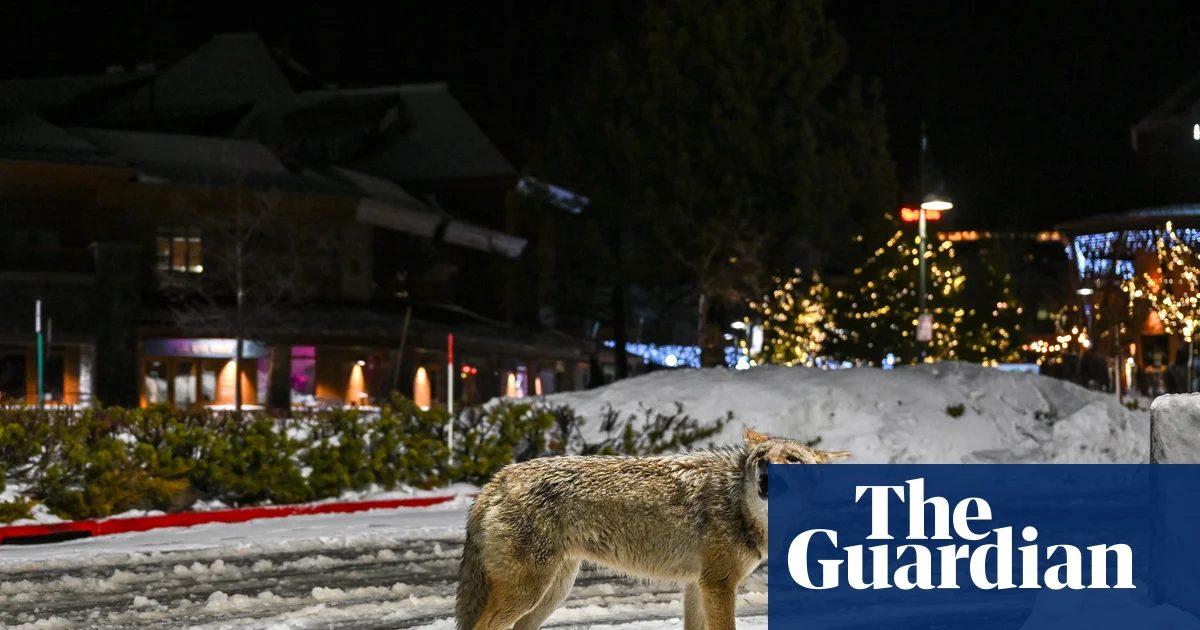
Anyone who has lived long enough in a city can tell you – with time, you just stop noticing strange new things. A unicycling bagpiper. A person changing clothes on the subway. Murals that transform streets into tart.
Coyotes in cities seem to be bolder as well and less afraid of new experiences. That’s according to a new study that researchers conducted at more than a dozen sites across the US, comparing urban and rural coyotes’ reaction to new stimuli.
The results were consistent: urban animals didn’t flinch when facing new objects. “Urban coyotes nationwide take more risks compared to those coyotes in rural areas,” says Javier Monzón, a biologist at Pepperdine University in Malibu, California, who coauthored the study. “That doesn’t mean that they are more aggressive, it just means that they’re less afraid of unfamiliar stimuli.”
The study was the first to look at the issue of urban and rural coyotes over such a wide area – 623 stations at 16 pairs of sites around the country. While coyotes have been living in the western US for thousands of years, in the past decades they have rapidly expanded into the rest of the continent due to lack of predators and an abundance of food.
It was also a way to ask a broader question about urban wildlife in general – because coyotes are everywhere, Monzón says. “One of the cool things about coyotes is that they’re sort of ubiquitous,” he says. “So it really was a good study system to explore whether urban wildlife behaves in a different way from their rural counterparts.”
The researchers set up camera trap stations, with remote cameras triggered by any warm‑bodied animal moving in front of it. At half of those sites, they built structures with four posts and some string – a novel object that was unfamiliar to the coyotes. Inside the little structure, they placed a heaping teaspoon of meat bait and a tab of scent to attract the animals. The western urban coyotes spent about 4 seconds more near the bait area than their rural counterparts. The researchers said the behavioral gap is likely a product of less fear of harassment in cities, where recreational hunting is typically prohibited and coyotes face fewer direct threats from humans. Their findings were published in the journal Scientific Reports in December 2025.
Niamh Quinn, a wildlife ecologist with the University of California Division of Agriculture and Natural Resources, says the results don’t surprise her. “Coyotes are ridiculously adaptable,” she says. “They just conduct their daily business of being coyotes among us, and really don’t pay that much attention to us anymore.”
Coyote populations are surging in cities across the US. A 2016 study found coyotes present in 96 out of 105 cities surveyed. But many communities are struggling to figure out new ways to deal with predators in their neighborhoods, given concerns about confrontations with people, children and pets. In 2019, a study by the National Park Service found that 20% of urban coyotes’ diets are made up of cats.
Monzón says that the new study’s results may help cities manage their behavior better: while the gap between urban and rural coyotes was more pronounced in western cities, the findings were consistent across all cities. That means management techniques that work well in one place are probably going to work in another.
Quinn says the biggest research question to her is whether hazing – making coyotes uncomfortable around humans – actually works. It involves being big, bold and loud – using actions like shouting, waving arms, or using noisemakers – until the animal completely leaves the area. And it’s not clear at all if it’s effective, she says. Sometimes it comes down to the individual. “You could haze a coyote and it could just look at you, and if it had a middle finger, it would essentially raise it,” she says. “Or you could haze a coyote and it could put its tail between its legs and not look back.”
To test this, Quinn is trying to catch coyotes, collar them and haze half of them and then measure how their use of space changes afterward – basically, see if they start behaving more like rural coyotes.
Cities seem to have an effect on other species too. When Monzón is driving around Los Angeles, he sees ravens sitting on the side of the busy road – seemingly unfazed by cars just whizzing by. He also notices squirrels or birds that tend to be less afraid of people, and it makes him wonder. With the coyotes, there’s still an open question: “What we don’t know is if this change is due to habituation,” he says, “or if it’s due to evolution, like a genetic adaptation, to be bolder.”