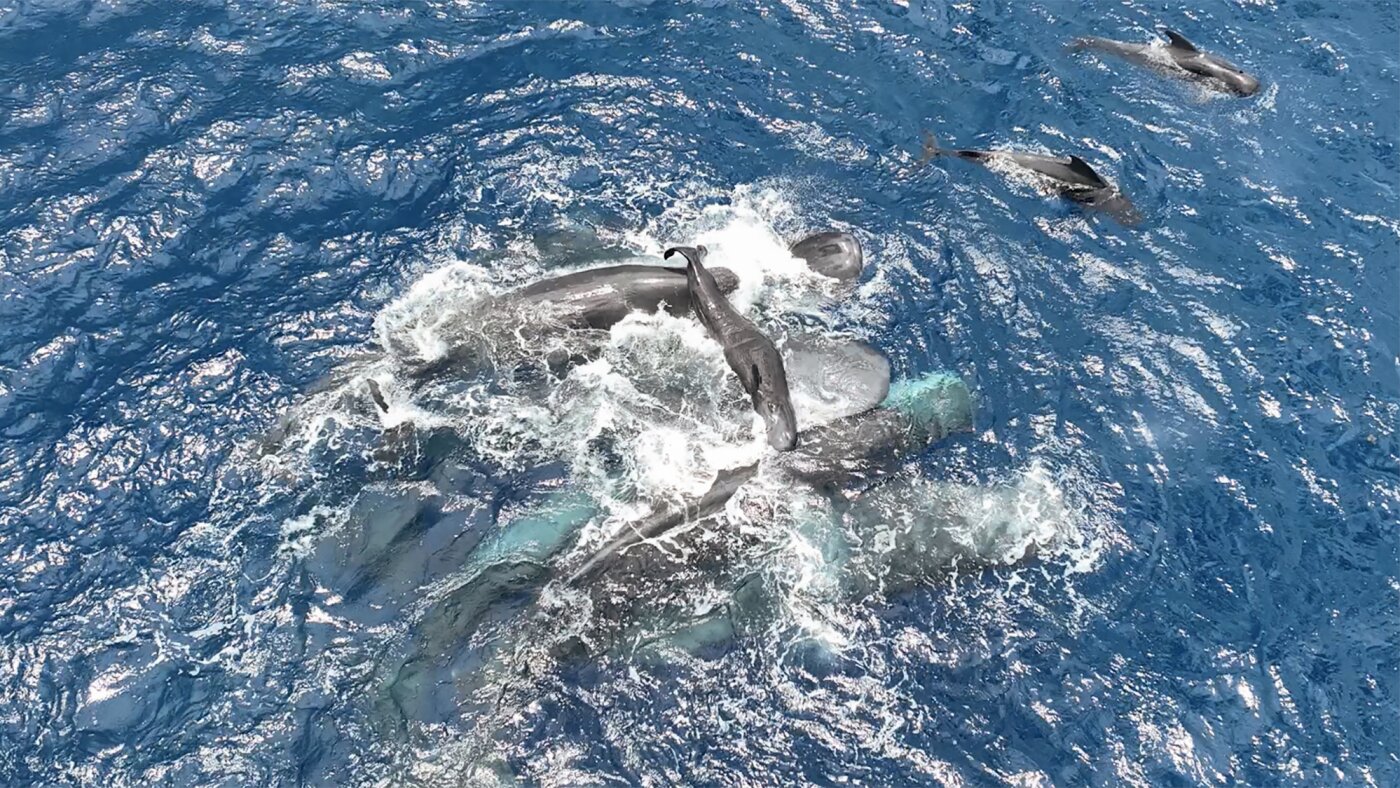
A group of sperm whales, including nonrelatives, work to keep a newborn calf afloat in the hours after its birth.
Project CETI
hide caption
toggle caption
Project CETI
The researchers knew something was off. It was July 2023, and they were on a boat in the Caribbean Sea, tracking a sperm whale, when they came across a larger group: 11 whales, bunched together near the surface. Only they weren’t as active or social as marine biologist Shane Gero had come to expect.
“They were just laying there calmly,” he said.

The researchers launched two aerial drones and started filming.
About an hour later, the calm was shattered. The whales started roiling and a sudden gush of blood reddened the water.
“To be honest, I thought that predators had attacked,” Gero said. “And I was like, ‘Oh no. This is going to be a horrible, terrible, no-good, very bad day.”
Instead, it would turn out to be one of the most rewarding days of his life. What they were witnessing — and what the drones had been recording — was the birth of a sperm whale.

“We captured laboring and the moment that the fluke emerged from the mom,” Gero said (whales are born tail-first).
They used underwater microphones to record the whales clicking to each other beneath the water — their communication is the focus of Gero’s work as lead biologist for Project CETI, a nonprofit whale research group. They saw the birth. And they watched for hours as different individuals, even whales with no genetic relationship to the mom, helped lift the newborn calf to the surface for breaths.
The events of that day are now detailed in a pair of studies, published in the journals Science and Scientific Reports. Together, they give the most detailed chronicling of a sperm whale birth to date. And they show a remarkably coordinated and cooperative effort to help both mom and calf.
Using the video footage, machine learning and years of field observations, the scientists were able to identify the birth mother as a sperm whale named Rounder.

A gush of blood seeps into the water as Rounder, a sperm whale, starts to give birth.
Project CETI
hide caption
toggle caption
Project CETI
Sperm whales live in matrilineal groups: grandmothers, mothers and daughters. Females stick together, while males set out on their own in their mid-teens. Rounder’s group, Unit A, included two distinct matrilines that don’t typically spend a lot of time in close proximity. Roughly half of the whales present during the birth were not directly related to her.
But the videos show that didn’t prevent the nonfamily members from helping. Newborn whales are negatively buoyant, Gero said. They don’t have the fully developed, oil-filled sack organ in their nose that helps adult sperm whales rise to the surface. So without effort, newborns will sink. For the first three hours after the calf was born, every whale present took a turn keeping it afloat.
“The behaviors that we’re seeing — in supporting the mom, in supporting the newborn — reflect a complex cooperative society that can’t just be explained by ‘Oh, you’re related,'” Gero said. “There’s something richer there — in which they live in a society where the expectation is ‘I will help you so you will help me.'”

Philippa Brakes, a behavioral ecologist at the University of Exeter and research fellow with the wildlife charity Whale and Dolphin Conservation, who was not involved in the new studies, said the findings suggest a layering of cultural and innate behaviors in the whales.
“An analogy for humans might be that some of us like sushi, others like fries — but when it comes to helping people in extremis, most of us would respond to someone who was giving birth in the street,” she said.
Gero said his team will continue searching through the data collected during the birth to get a better sense of the social dynamics and to answer other outstanding questions. But he said there’s a broader takeaway, applicable to humans, from what they’ve already found.
“We succeed by overcoming obstacles by working together. In spite of the fact that we’re different and unrelated,” he said. “And that’s a pretty important message, I think, these days.”