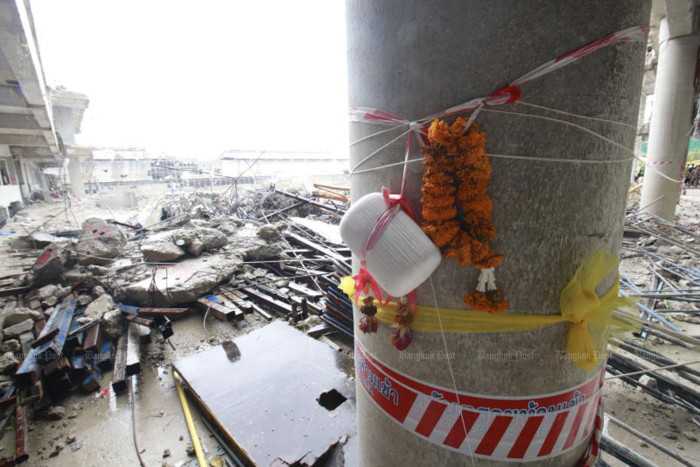
Accountability gaps persist after tragedy
One year after the collapse of the State Audit Office’s (SAO) new headquarters in Bangkok’s Chatuchak district on March 28, 2025, Thailand is still searching for answers — not only about what caused the building to fall, but also about the deeper systemic failures the disaster exposed.
The 2.1-billion-baht complex, intended to embody the integrity of the country’s top watchdog, instead became a symbol of public outrage and institutional failure.
The structure gave way after tremors from an earthquake in Myanmar were amplified by Bangkok’s soft soil, killing 93 people and leaving three missing.
For many observers, the physical destruction has come to mirror a collapse of public confidence in the SAO and in the broader system of state construction oversight.
Public anger has remained strong. Criticism has repeatedly resurfaced online, fuelled by the agency’s limited updates and a promotional music video released after the tragedy that many viewed as insensitive.
The ruins have also become a focal point for broader concerns about corruption, procurement practices, and safety standards in state-funded projects.
Despite the scale of the disaster, the full official investigation report has yet to be released.
“It has been a year, and the investigation report has not been fully disclosed. There is a lack of clear, detailed accountability,” Mana Nimitmongkol, chairman of the Anti-Corruption Organisation of Thailand (ACT), told the Bangkok Post. He said the ACT has repeatedly urged the government to publish the complete findings, warning that withholding details only deepens public suspicion.
Authorities have identified three groups under scrutiny: nominee business operators allegedly acting as fronts for foreign capital; private-sector figures, including designers, engineers and contractors, suspected of substandard work and possible document forgery; and state officials under investigation for procurement irregularities.
In a recent statement, the ACT said investigations have uncovered additional issues, including the alleged misuse of engineers’ and architects’ signatures and the use of Thai “nominee” firms by foreign investors to bid on megaprojects. Such practices, it warned, can drive aggressive underbidding, excessive subcontracting and compromised safety.
Procurement rules that prioritise the lowest bid over quality have also come under renewed scrutiny, alongside a pattern of costly but poorly planned government construction projects left unfinished or underused. The disaster has further revived concerns over emergency preparedness.
Mr Mana said the case illustrates how accountability can blur within complex bureaucratic structures. Project approvals spanned multiple administrations, while layers of subcontracting diluted responsibility and weakened oversight.
Corruption risks, he warned, can emerge at every stage.
While a foreign firm has been implicated, Mr Mana stressed the issue is not about nationality but about systemic weaknesses.
He called for urgent reforms, including full disclosure of the investigation, stronger safety standards, greater procurement transparency and stricter enforcement of professional ethics.