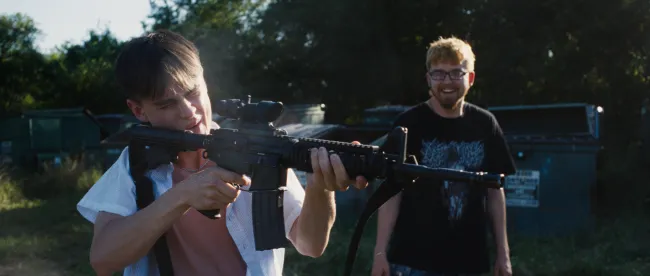
Vainglorious edgelords, internet trolls, social media addicts, and school-shooting obsessives populate the wounded world of the new film “Our Hero, Balthazar” — a world that is unmistakably our own.
It’s directed and co-written by Oscar Boyson, a co-founder of the Safdies’ former Elara Pictures and a producer on a number of their early films. Despite all this timeliness and pedigree, though, and a cast led by Gen Z superstars Jaeden Martell and Asa Butterfield, this pitch-black, thrillingly toxic comedy only landed at Tribeca Festival last year after being rejected by both Sundance and SXSW.
It’s co-written by former HuffPost journalist-turned-screenwriter Ricky Camilleri; he and Boyson both hail from New York, and it’s in the city’s high rises and private schools where “Our Hero, Balthazar” begins.

Martell (the “It” movies, “Knives Out”) plays a latchkey trust fund kid with a perverse gift for making himself cry on command for his social media followers. His fascination with school shootings — going as far as playing video footage of one for a female classmate he’s wooing — leads him to troubled Texan teen Solomon (Butterfield), angsty and with access to firearms and fantasies of using them.
“Is Balthy a hero? Is Solomon a murderer? Or are they both just hopeless casualties of an epidemic of over-interneted incel-adjacents who’ve turned being online at all these days into a pervasive existential risk?,” I wrote in my 2025 review of the film. The stellar indie cast also includes Jennifer Ehle, Anna Baryshnikov, Noah Centineo, Becky Ann Baker, and Avan Jogia.
At a moment where just talking about school shootings in our art still feels like touching a cultural third rail, it’s unsurprising even to the filmmakers that “Our Hero, Balthazar” faced repeated festival rejection before premiering at Tribeca in summer 2025. (Elliot Tuttle’s similarly provocative indie “Blue Film” from last year, about the dynamic between a pedophile teacher and the former-student-turned-camboy he once desired, was also shut out of the same festivals, suggesting this is no anomaly in fear-filled times.)
“Sundance and SXSW both passed,” Boyson told IndieWire. “I think that is such a damn shame, because this movie would have slayed at Sundance. Everybody goes to Sundance looking to bring a story back to wherever they’re from about something that was new and fresh. That’s what Sundance used to be: a place where all the Hollywood people would show up and be reminded that there’s an audience for something that pushes the boundaries a little bit more. They took my short [2023’s ‘Power Signal’]. I know [‘Our Hero’]’s not a Sundance film in quotation marks, but I was very disappointed they didn’t think there was a spot for this very American movie that, for me, is so tied to the Sundance movies that I grew up with that were pushing the boundaries, like an ‘American Psycho.’”
“Our Hero, Balthazar” is the first feature for both filmmakers, who reside in New York and met when they were 17 in the year 2000, the year of startling independent movies like “American Psycho,” and not long after “Happiness.” Larry Clark’s “Bully” (2001) and Gus Van Sant’s “Elephant” (2003) also come to mind in terms of this film’s epoch-vexed indie portrait of youth culture.
“Sundance did reject ‘Happiness,’” Camilleri reminded, referring to Todd Solondz’s wildly controversial follow-up to Sundance premiere “Welcome to the Dollhouse.” Camilleri added, “Trump had just won when we were submitting the movie to these festivals. … I speculated and felt a little like there was a sense of ‘why do we want to rub our faces in the shit?’”
Boyson said it “begs another question: Are these festivals relevant at all to the larger culture anymore? I don’t know. I want them to be. I think people who are programming film festivals are doing God’s work. But we’re in a place where we really need to remind ourselves that the audience matters, and indie films, if they want a shot, need to work for an audience as much as they do the film festival crowd…. That said, we couldn’t be prouder to have premiered where we did. [Programmer] Casey Baron and the Tribeca team championed the film, recognizing audiences are hungry for, not scared of, provocative work.”
Indeed the last few years have levied challenges at festivals like Sundance, not only due to a careful-where-you-step political climate, but also a depressed market for indie acquisitions and overall lack of buyers for original, low-budget, non-IP-driven movies. The 2025 Sundance Grand Jury Prize winner “Atropia” took almost a full calendar year to announce an acquisition via Vertical Entertainment; this year’s winner “Josephine,” meanwhile, went to a distributor no one had ever heard of, despite a reported bidding war for the hot-button, deeply acclaimed drama. The material, as with “Our Hero, Balthazar,” may have proved too difficult for more mainstream distributors.

Camilleri said, “I find sometimes coming out of festivals, and I’ll read reviews that will be like, ‘This movie was so shocking. This movie took so many risks.’ And I’ll watch it and think, ‘This is fine. This is fine.’ I’m not going to throw anyone under the bus, but I’ll watch them and be like, this is a fine movie. I don’t really see the risks here. I don’t see what was so shocking about this. Is everybody that prude these days? Are you just not absorbing real, shocking movies, or were you never?”
The contradictions tucked into “Our Hero, Balthazar” are what make the film maybe not shocking to those who have kept up with indie provocations of late, but at least attention-getting: It’s a thriller, a Gen Z satire (even as the filmmakers resist that potentially eyeroll-inspiring term), and a warning letter about gun culture violence all at once. It’s a subject matter not easily embraced by any genre, especially when depicting young characters that are terminally online.
“Not that ‘Euphoria’ is all that,” Boyson said, “but meanwhile ‘Euphoria’ is like the only massive hit that concerns young people that seems to have tapped into mass culture. Why can TV do it, but movies are supposed to be something else?”
Camilleri said, “When we were teenagers, we loved fucked-up movies, because you’re a teenage boy, and certain teenage boys like to push boundaries, and that’s sort of part of growing up. But when you would show a group of people ‘Requiem for a Dream,’ you would have to deal with their response, and there would be a little bit of shame that you would have to confront, like, oh shoot I just showed a party of people ‘Requiem for a Dream,’ and they’re all really mad at me for it. … It helps you to grow out of those fascinations, or at least become sensitized to how other people might be feeling about them.”
The smash-the-like-button sadism that Balthazar and Solomon engage in rarely gets portrayed so viscerally onscreen without feeling like it’s pandering to an older audience or talking down to a younger set. Balthazar, at one point, poses as a nympho online female sex bot to lure Solomon’s attention via DMs and to eventually meet up with him and goad Solomon’s desire to kill his abusive father. As these private exchanges get darker, and more externalized, “Our Hero” might be the most internet-pilled movie of the year.
“Movies are like an empathy machine, as Ebert used to say, and the internet is like a validation loop. I can go on the internet, and I can have sadistic, alienated fantasies, and instead of it ever having to confront somebody, … I can just find a world where those feelings are only validated, and often sometimes push further for somebody else’s own sadism,” Camilleri said.

In terms of getting the challenging material financed after they finished the script in 2022 — before the Trump administration restarted — Boyson said, “I just took an oath of ‘I’m going to make this happen come hell or high water, and surround myself with the people who were down to do it even if we were going to shoot it on an iPhone with a crew of five. Asa and Jaeden were both in that group. We got a little bit more money at some point, which made it easier. … The more that people said, ‘No, I love your script, but this won’t work. I can’t put money into it,’ it really fired me up. I was just like, man, this is why I got into independent film. I didn’t get into it to make a copy of a Hollywood movie … or something that competes with Hollywood output.”
“Will there be an appetite for a story like this when it feels like the steroided version of these characters are actually in the administration?,” Camilleri said of their mindset in getting the film off the ground.
Along with being shooed off by major festivals, “Our Hero, Balthazar” also stoked scrutiny within the Motion Picture Association, which ultimately rated the film R for “crude sexual content, graphic nudity, language throughout, some violence/a grisly image, and drug use,” and all that good stuff. The version audiences saw at Tribeca is not exactly what you’ll see in theaters now, as the filmmakers explained, as the ratings board’s vetting process resulted in the film’s most graphic nudity getting cut.
“I never thought this would be an NC-17 movie,” Boyson said. “But the hard and fast MPA rule is that you cannot show a hard penis in an R-rated movie.”
“We had three!,” Camilleri said. “What can we say? We like dicks.”
Boyson added, “I got really upset about it. I was like, I don’t want to work in an industry where we can’t do things [where] any kid with an internet connection can see this stuff times 1,000, and ‘this is the problem with movies. We used to be at the forefront of culture, now we’re way behind because the internet is moving faster, and they don’t have those kinds of rules.’ Then, we took a second. You’ve gotta see the movie to find out what changed, but we both felt better about it. There’s a meme in the movie. We removed a hard penis from a meme.”
Camilleri added, “There was a hard penis that was splurging semen in a meme, and we had to remove that penis. But then we rewrote the copy on the meme, and we ended up [realizing] this was even more shocking than if we were to have the penis on it. And they said it’s OK, so let’s go!”
“There was something incredible about a movie nobody wanted to finance because it’s about school shootings and violence, but ultimately, the MPA is resisting a hard penis on a meme,” Boyson said.
Tale as old as time, as far as the MPA is concerned.
“Our Hero, Balthazar” opens in select theaters starting Friday, March 27.