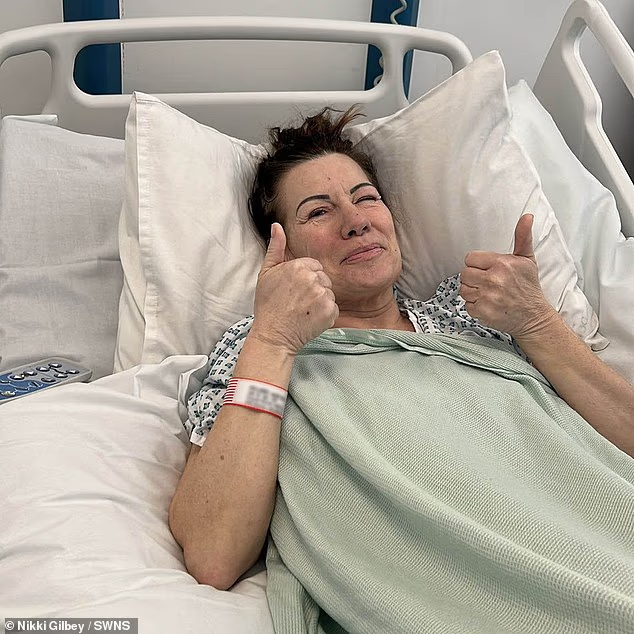
A grandmother who claims doctors advised her to take laxatives for her constipation was left devastated when she later discovered she actually had pancreatic cancer.
Sarah Williams, from South Benfleet, Essex, had been struggling with bowel movements in January 2025 when she sought out the advice of her GP.
However, the 53-year-old was allegedly told by doctors on a consistent basis that she had to go to the pharmacy and get some laxatives.
While caring for her grandchildren the following month, Ms Williams was told by a friend that her eyes had turned yellow, and in a panic she immediately called 111.
After being rushed to Southend University Hospital, the learning support teacher underwent blood tests and a CT scan.
She was diagnosed pancreatic cancer the following day.
‘We were all shocked, my husband and I burst into tears, and he phoned our children to tell them the news,’ Ms Williams recalls.
She added: ‘I knew something was wrong with me, but I never expected to be told you have cancer. Our whole family were devastated.
Ms Williams was left devastated when she was later diagnosed with pancreatic cancer
‘I had to make sure I didn’t go down any rabbit holes on Google and just focus on getting better.’
Ms Williams said she had repeatedly contacted her GP because she knew something wasn’t right.
But, she said: ‘As soon as I told them I was constipated, they would tell me to go to the chemist and get some laxatives.’
The NHS’s official guidance lists diarrhoea or constipation, as well as the whites of your eyes or skin turning yellow, as symptoms of pancreatic cancer.
‘Having the symptoms does not definitely mean you have pancreatic cancer, but it’s important to get checked by a GP,’ they say.
Pancreatic cancer is typically diagnosed at a late stage when treatment is less successful, because it causes few symptoms early on.
As a result, just one in four patients live more than a year after their diagnosis.
The pancreas is a pear-shaped gland tucked behind the stomach, responsible for producing hormones that aid digestion and convert sugar into energy.
Because of its location and relatively small size, doctors often can’t feel a pancreatic tumour during a physical exam, another barrier to early treatment.
And whilst getting older is one of the biggest risk factors for the silent killer, with almost half of cases diagnosed in over 75s, experts have warned it’s on the rise in younger age groups – especially women.
Following her eventual diagnosis, Ms Williams was presented with three options: no treatment, chemotherapy, or surgery.
She chose to undergo the Whipple procedure, a major operation to remove the tumour and 20 surrounding lymph nodes at the Royal London Hospital.
Although initially successful, Ms Williams was left in agony after her stitches split, leaving her needing yet another operation.
After nine days of being monitored she was discharged. But within hours of returning to the comfort of her own bed, she woke up screaming with pain and was rushed back to Southend Hospital.
Doctors discovered she had two blood clots in her lungs – and sepsis.
She said: ‘For five days, all they could do was help with the pain, before transferring me back to Royal London Hospital.’
Ms Williams spent four weeks there recovering before returning home at the end of April 2025.
She was then referred to St Bartholomew’s Hospital in London for 12 rounds of chemotherapy, which she started on June 6, 2025.
But after just six weeks, a scan revealed that her white and red blood cells were not high enough to continue the treatment.

Ms Williams says she was ‘shocked’ and ‘burst into tears’ after the news of her diagnosis
The day before her 53rd birthday on November 29 last year, Ms Williams found herself in yet more agony and was back in the hospital.
She said: ‘I was in so much pain, I wasn’t eating, I kept being sick. A CT scan revealed a 10cm abscess in my liver, which they drained.’
Ms Williams spent the run-up to Christmas in a hospital bed yet again, before being released on December 22 with intravenous antibiotics to be taken for four weeks.
On January 2026, a PET scan showed inflammation in her liver, but Sarah claims the NHS suggested waiting until April to investigate.
Worried, Ms Williams sought a private second opinion and a CT scan and blood tests revealed cancer was present in her lungs, liver and pancreatic bed.
She is now funding the chemotherapy privately amid lengthy NHS waiting lists for the treatment.
‘My sister, Nikki, launched a GoFundMe so we can pay for chemotherapy privately,’ Ms Williams said.
‘The amount of support and messages I have got is overwhelming. So many people, people we used to work with, old school friends, have contributed; it is overwhelming.
‘We want to extend our gratitude to everyone who has donated to help me.’
Experts still don’t know exactly what causes the majority of cases of pancreatic cancer, but have suggested smoking, alcohol use and obesity could all increase the risk of the disease.
A landmark study published in February looked into the link between diet and cancer risk found vegetarians are 21 per cent less likely to develop the disease than meat-eaters.
There is existing evidence that eating a lot of red and processed meat may increase the risk of pancreatic cancer, due to the formation of nitrosamines upon cooking – compounds known to cause cancer.
But the fresh research suggested obesity could also play a role, with vegetarians tending to have a lower body-mass index score than meat eaters.
But experts say more research is needed to understand why and the evidence is not definitive.