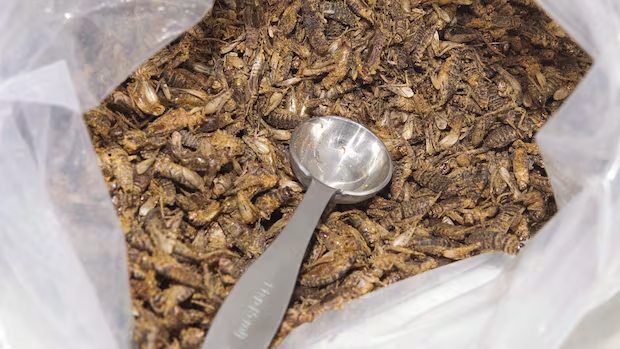
The business of insect farming was supposed to grow big and fast.
In London, Ont., that promise took shape in Aspire Food Group Canada. Billed as the world’s largest cricket farm, it was a 150,000-square-foot, fully automated facility designed to house billions of insects and produce millions of kilograms of protein each year.
Crickets are touted as a low-carbon protein source, requiring less farmland than traditional livestock and offering the potential to address world food insecurity.
The idea had global backing. In 2013, it won the $1-million US Hult Prize, presented by former U.S. president Bill Clinton. It went on to attract investors from the United States, Canada, Ireland and South Korea, along with tens of millions of dollars in federal loans and grants.
The facility came online in 2022, entered receivership in 2025 and it remains unclear how much public money was recovered. The final sale price is secret. It’s still sealed by court order.
CBC News contacted all five of Aspire Food Group’s founders. None agreed to speak on the record.
Almost a year later, what is clear is this: the collapse of the world’s largest cricket farm wasn’t sudden — it was the result of a mismatch between the scale investors bet on and a market for eating insects that never fully materialized.
“The biggest barrier is the yuck factor, or the disgust,” Sadaf Mollaei, an assistant professor at the University of Guelph whose work focuses on sustainable food systems and consumer behaviour, told CBC News.
The ‘yuck factor’
Mollaei said most North Americans have a deep-seated discomfort when it comes to eating insects and many consumers are reluctant to try it.

Even if they were willing, she said, crickets aren’t cheap. A 454-gram bag of cricket powder can retail for $49.99 — more than even premium cuts of beef on a per-pound basis.
“It’s a premium product,” Mollaei said. “It’s not cheaper. The selling point has never been a lower price, it’s the fact it’s better for the environment and it’s a healthy product.”
When the industry first took off more than a decade ago, expectations were sky-high. There were hopes of rapid growth and widespread adoption, but in reality, the market in North America never developed as quickly as many anticipated.
It left producers in a bind: they can’t lower prices without more customers and they can’t attract more customers without lowering prices.
“The biggest challenge is still price point,” said Darren Goldin, an insect farmer and the vice-president of operations at Entomo Farms in Norwood, Ont., about 30 kilometres east of Peterborough.
The company started by producing crickets for pet food in 2013 and grew slowly, eventually expanding to about 50,000 square feet of production space, about a third the size of Aspire’s London facility.

Court documents show Aspire used tens of thousands of stacked plastic bins, or totes, to house crickets.
Goldin said his operation relies on open rooms with cardboard “cricket condos,” allowing farmers to see the insects, feed and water at a glance.
“You can visually assess what’s happening very, very easily,” he said. “Contrast that to Aspire’s model, where everything is in a giant tote and the tote’s got a lid on it and it gets put away on a shelf.”
From ‘cricket condos’ to closed systems
Goldin said cricket farming requires constant attention to quickly respond to changes, something he said would be difficult in an automated system.

“It’s like a really intricate web,” he said, noting that even small changes — such as insect density, food and water access, even temperature — can ripple through an operation, increasing stress on the livestock and creating problems that are difficult to control.
“What they [Aspire] were trying to accomplish was a very, very challenging task.”
Court documents show the London facility never came close to operating as planned. A system that worked at a small scale in Texas struggled to translate to Ontario, where differences in environment, ongoing design changes and problems with equipment all contributed to underperformance.
Sale price is a secret
By June 2024, the court filings said, Aspire was operating at roughly half capacity and needed tens of millions more in financing just to try to fix the issues to ramp up production.
Farm Credit Canada (FCC) was owed roughly $41 million at the time of receivership, court documents show. The Crown Corporation declined to answer questions about how much of that sum has been recovered.
“Out of respect for court proceedings and customer privacy, we will allow the court-filed documents to speak for themselves,” Eva Larouche, a senior media relations consultant with FCC, wrote in an email to CBC News.
Agriculture and Agri-Food Canada (AAFC) said it also provided about $8.5 million to Aspire, with roughly $7.8 million of that total still outstanding.

Court documents show the property was sold and the transaction completed, with the purchase price paid to the court-appointed law firm in charge of selling Aspire’s assets.
In an emailed statement, the City of London said its $1 million in back taxes has since been paid in full, but it’s unclear whether that money came from the sale of the proceeds.
The city did not respond to a request to elaborate further.
The facility was sold to Halali Group Holdings in October 2025, but the price remains sealed by court order, meaning it’s still not clear how much public money was lost.
Requests for comment to Halali co-owner Hussain Al-Ali were not returned.