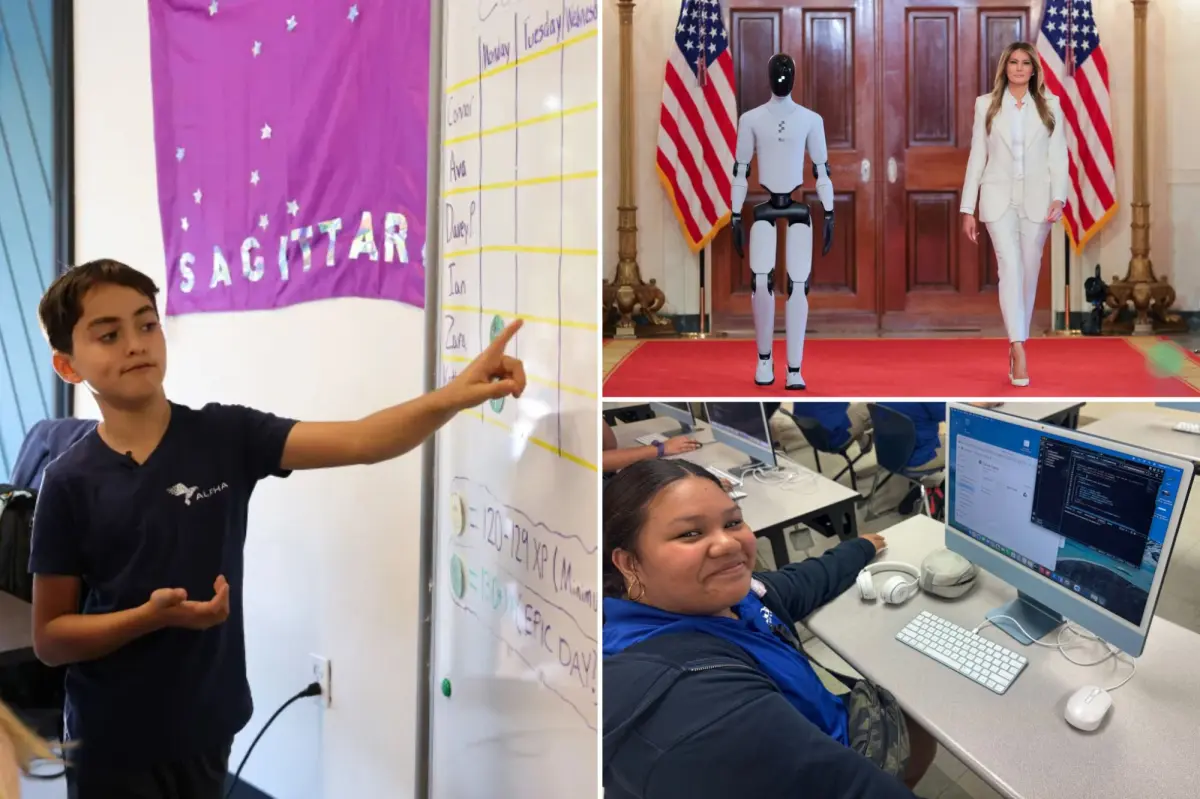
No textbooks, no homework, no teachers. Welcome to the future of education.
At least according to Alpha School, a fast-growing network of private academies that claims to be revolutionizing education with artificial intelligence.
At Alpha — which has locations in Austin, Miami, San Francisco and New York City, and charges tuition of up to $65,000 a year — students spend just two hours a day learning core subjects (math, reading, science) via AI tutors.
Private Alpha, which costs $65,000 a year, isn’t alone. Across the US, a new wave of schools is going all-in on AI — from a public option in Georgia that calls itself the nation’s first AI-themed school to a charter academy in Hawaii that built its own AI curriculum from scratch.
These schools are drawing the attention of families, often with parents working in the tech and finance fields, who want an alternative to what they see as outdated traditional education.
Sarah Cone, a venture capitalist in New York City, enrolled her daughter in second grade at Alpha’s Financial District campus — open for students in Pre-K through ninth grades — last fall after “waiting with bated breath for Alpha School to get to [Manhattan],” she said.
Less than a year in, “my child is, like, a different student,” Cone said. “She’s just completely engaged and motivated.”
But for all the lofty promises, there are, of course, critics who worry the rush to embrace AI could come at the expense of kids’ social and emotional development.
“These are early days,” Emily Glickman, a private school consultant in New York City, told The Post. “Parents worry about AI’s impact. But no one — educator or parent — is sure what to do about it yet.”
This week, at a White House summit of 45 first ladies including France’s Brigitte Macron of France, Israel’s Sara Netanyahu and Ukraine’s Olena Zelenska of Ukraine, Melania Trump introduced a humanoid robot from Figure AI.
She spoke of a not-distant future where kids will be taught to “develop deep critical thinking and independent reasoning abilities” — by robots.
“Imagine a humanoid educator named ‘Plato,’” Trump said. “Access to the classical studies is now instantaneous: literature, science, art, philosophy, mathematics, and history. Humanity’s entire corpus of information is available in the comfort of your home.”
Educators aren’t there yet. But New York City Public Schools just introduced guidelines saying teachers can use AI for tasks like scheduling, brainstorming and drafting some communications. But the district also made clear that aritical intelligence will “never be allowed” for grading, counseling, creating special education documents or decisions related to discipline or promotion.
Less clear, however, is how the system allows AI use for students.
“Student use of AI raises complex and evolving questions related to academic integrity, equity and access, and instructional practice,” according to the district website, which notes it’s allowed for exploration and some creative projects.
Stanford graduate MacKenzie Price co-founded Alpha School in Austin in 2014, but it only started gaining widespread attention over the past few years as AI use has gone mainstream.
Her 2 Hour Learning model is based on the the idea that artificial intelligence can adjust to each students’ pace, versus what Price told ABC News is the “impossible job” of teachers instructing a room of “20-plus students who are all at wildly different levels of knowledge.”
The program, Price is quick to explain, doesn’t use chatbots — which she calls “cheat bots” — but rather, she told ABC, a “mastery-based tutoring experience that meets students exactly where they’re at.”
Alpha claims this intensive, personalized model helps students advance at rates 2 to 4 times faster than traditional methods.
Cone said that’s what attracted her: “My child is not bored at all because she gets material that’s always her level.”
Once the core subjects are out of the way, the rest of the day is spent in life-skills workshops for topics like public speaking, financial literacy and entrepreneurship, as well as “leadership, grit and teamwork” — plus classes in how to build the technology itself.
Those activities are supervised by human “guides,” rather than certified teachers, who are “focused on motivational and emotional support,” Price told ABC News.
One big difference between “guides” and teachers: The former earns $150,000. According to the National Education Association, the average public teacher’s salary in the US was $72,030 for the 2023-2024 school year.
“The fact that they have the AI tutors frees up the Guides to help more and do the things that only humans can do,” Cone said.
Price acknowledges that there is still fear around AI school learning, and that the general public may be slow to adopt it.
But Joe Liemandt, a billionaire tech founder who says textbooks are obsolete, came on as a major backer. Hedge-fund billionaire Bill Ackman has called Alpha School a “truly breakthrough innovation.” And US Education Secretary Linda McMahon toured Alpha’s Austin campus last year.
While Alpha’s physical schools are concentrated in tech hubs and major cities, 2 Hour Learning is also being rolled out in online schools. Last year, the business partnered with education group Prequel to launch two virtual schools in Arizona, including a tuition-free charter.
Indeed, this learning is not just limited to pricey private schools.
When Seckinger High School opened in Buford, Georgia — a suburb of Atlanta — in August 2022 as part of the Gwinnett County Public Schools System, it claimed to be “the nation’s first AI-themed school. Seckinger uses tools like Gemini, CoPilot and MagicSchool AI, weaving artificial intelligence into every class, including AI history and ethics as well as a capstone focused on designing real-world AI solutions.
Before Kūlia Academy, a public charter school in Honolulu, opened in 2024, educators created their own AI and data science curriculum by pulling lesson plans from MIT and Stanford.
Students — currently just sixth and seventh graders, though there are plans to expand through 12th grade — study two hours of math and two hours of English every day, but they also learn how to design and build AI models.
They start by focusing on the fundamentals of writing code and analyzing data before moving on to complex AI algorithms. And they are banned from using ChatGPT to write code until they understand how to write it themselves.
Kūlia (the name translates from Hawaiian as, generally, striving for excellence) runs a slightly longer school day, from 8 a.m. until 4 p.m., so most students can finish their work on-site with no homework. Administrators say their students outpace national norms, advancing more than twice as fast as other kids in reading and math skills.
And they insist that humanity is their North Star.
“The question is, now you analyze this data — what does it mean for us humans?” Kūlia executive director Andy Gokce told The Post. “We don’t want to raise robots or engineers who are going to be like, ‘OK, I’m just going to do this. I don’t care if it’s going to harm people.’”
Unsurprisingly, AI education is attracting a lot of parents who work in tech and other future-facing fields.
At Alpha School’s campus in Brownsville, Texas, nearly half the students have parents employed by SpaceX, which has its Starbase facilities about 20 miles away. (A spokesperson said the majority of students are on scholarship.) And the school is opening two more Bay Area locations to meet growing demand there.
The wording in Alpha’s promotional materials echoes Silicon Valley pitch decks — promising disruption of a stagnant institution and a place where students “crush academics” by learning twice as fast.
But Glickman, the private school consultant, said many of the affluent families she works with have trusted legacy schools for generations and don’t want their kids to be “guinea pigs” for new models.
“The Holy Grail would be if Dalton, Collegiate, Brearley, Horace Mann etc. offered a distinctive plan” for AI, Glickman said, referencing New York City’s most storied private academies. “Since they haven’t yet, do you take a leap with Alpha? It’s a new brand.”
And AI learning does raise thorny questions: Will it hurt children’s mental health or hinder their social and emotional development? Will it increase screen time? Can it foster real critical thinking or truly replace a human teacher?
Dr. Rebecca Winthrop, a global education expert who leads Brookings Institutions’ Global Task Force on AI in Education, stresses that students need caring adults to support their learning and that AI should never do so much of the work that kids don’t struggle or engage deeply in the material.
“We know when that happens, they don’t develop the skills, and they’re completely shortchanging their cognitive development,” she said.
Alpha School has already faced questions about whether it delivers on its promises.
A February investigation by 404 Media alleged that Alpha was not adequately protecting students’ data — including videos — and that its AI tools were generating faulty lesson plans.
“Alpha Schools strongly disputes the inaccurate and misleading claims contained in the recent media report regarding our technology platform, student privacy practices and approach to AI-powered learning tools … ” a spokesperson said. “We will continue to prioritize the safety, privacy and success of every child we serve … .”
As for the screen time issue, K-12 students nationwide now spend an average of 77 minutes per school day on school-issued devices, according to 2025 data from Lightspeed Systems. Price told The Post that Alpha students — with their afternoons devoted to life-skills learning — “actually get more time to connect with their peers as well as their teachers than students in a traditional school environment do.”
Still, neither Kūlia nor Seckinger High School have plans to eliminate teachers.
“Teachers’ importance, I don’t see it decreasing,” Gokce, Kūlia’s executive director, said. “In the long run, if the robots become really good at handling human beings’ emotions, that is a question I’m still thinking about.”
Amber Pomaikalani Leon Guerrero, Kūlia’s Director of Student Success, believes AI will only underscore what humans are good at.
“Technology will become more powerful,” she said. “But relationships, culture and leadership, I think will matter even more.”