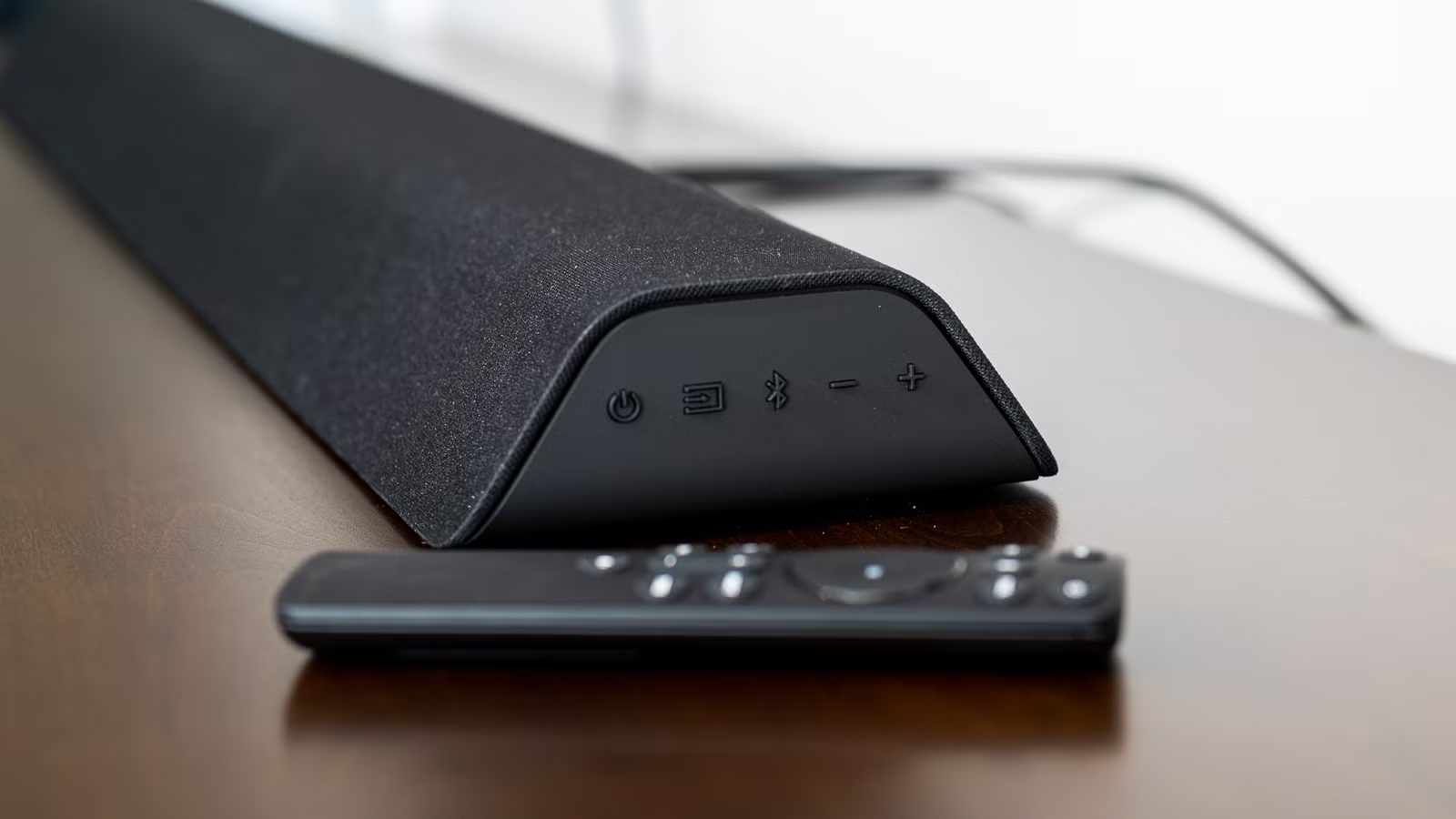
Modern televisions don’t have space for the large, front-firing speakers that you used to find on CRT TVs. If you’re lucky, you’ll get halfway decent speakers pointing down or out of the back of the TV. None of the arrangements make for a good listening experience, especially if you need to hear dialogue.
Thankfully, there is a relatively inexpensive fix.
Why is dialogue so hard to hear now?
Watching a TV show has become a frustrating experience
Whenever I’m watching TV using a TV’s built-in speakers, I constantly find myself slowly increasing the volume to make sure that I can clearly hear the conversation, only to be nearly deafened when something loud happens.
It isn’t a problem with my hearing, your hearing, or even the TV—the problem is a combination of questionable audio mixing and compression.
Bad mixing makes everything hard to hear
Audio mixing is the way that sounds in a TV show or movie are combined from separate sources, like dialogue, background sounds, and special effects, into a finished product. Good mixing often goes unnoticed, since everything will seamlessly fall into place and “sound right” without you realizing it. On the other hand, bad mixing tends to be pretty obvious. You’ll find yourself missing dialogue, certain sounds won’t seem to match up with where they should be in a scene, and some sounds will be conspicuously louder than they seem like they should be.
Oppenheimer is a recent movie that had famously controversial (allegedly bad) mixing. The music and sound effects were loud enough that it often made the dialogue difficult to hear, even in a movie theater. When I rewatched it, the first thing I did was reach for the subtitles.
On the other hand, Dunkirk and The Lord of the Rings: The Return of the King are both regarded as having excellent sound mixing.
Unfortunately for your television, mixing is often done with theaters—or soundbars—in mind. Some of those setups have dozens of speakers. When the standard stereo mix is an afterthought, you wind up with dialogue that is muddy and difficult to hear.
Additionally, I’ve also occasionally caught streaming apps inexplicably changing their audio settings to 5.1 by default, even in setups that only have stereo speakers. That usually cuts out the center channel content—which is dialogue-heavy—completely.
Compression hurts audio quality
Besides poor mixing, modern TV and movies also suffer from another problem: compression. When a streaming service streams a movie to you, it doesn’t send the entire thing uncompressed—the bandwidth demands would just be too much for most home internet connections. Instead, they compress the video and audio so it takes up less space and can be sent more easily.
That is why streaming a 4K movie might only use up 10 to 15 gigabytes of data over a few hours, while a 4K UHD movie on a Blu-ray might be between 50 and 70 gigabytes if it isn’t compressed.
The trade-off is quality. Modern compression algorithms are pretty good, but if you pay close attention, you’ll sometimes notice that dialogue is muddier on a streaming platform than it is on the corresponding Blu-ray, even if you’re listening to the same movie on the exact same sound system.
If you want an exaggerated example of how compression affects sound, NPR has a demo that lets you listen to a few songs in an uncompressed format, 320Kbps, and 128Kbps (the worst). If you’re not sure what to listen for, pay close attention to high-frequency sounds like cymbals or “s” and “th” sounds in speech.
Buying a soundbar solves your dialogue problem
A dedicated center channel is all you need
Since many TV shows and movies are mixed with a dedicated center channel in mind, the solution is simple: add a soundbar.
A soundbar serves as an all-in-one replacement for the speakers on your TV. They usually include the equivalent of a front left, front center, and front right speaker.
The center channel is mostly used for dialogue, while the left and right channels playback other sounds in the scene. Most soundbars allow you to adjust those channels independently, so if you want, you can boost the audio of the center channel without making everything louder. They may also feature special dialogue amplification software, which selectively increases the volume of the frequency range of human speech.
Those features make a bigger difference than you might expect. Dialogue that was previously a bit tiring to listen to because it was hard to hear is now easy to follow.
As an added bonus, even many budget soundbars often come with small satellite speakers for surrounds, which allows you to try out 5.1 surround sound without investing a lot of money into a dedicated AVR and speaker system.
Don’t buy a soundbar without listening to it
As with everything sound, I’d strongly recommend you try out soundbars before buying it. There are many other factors that will change whether you like the sound produced by a soundbar besides its center channel, and if you’re going to drop hundreds on a piece of audio equipment, 20 minutes of listening is a worthwhile time investment.