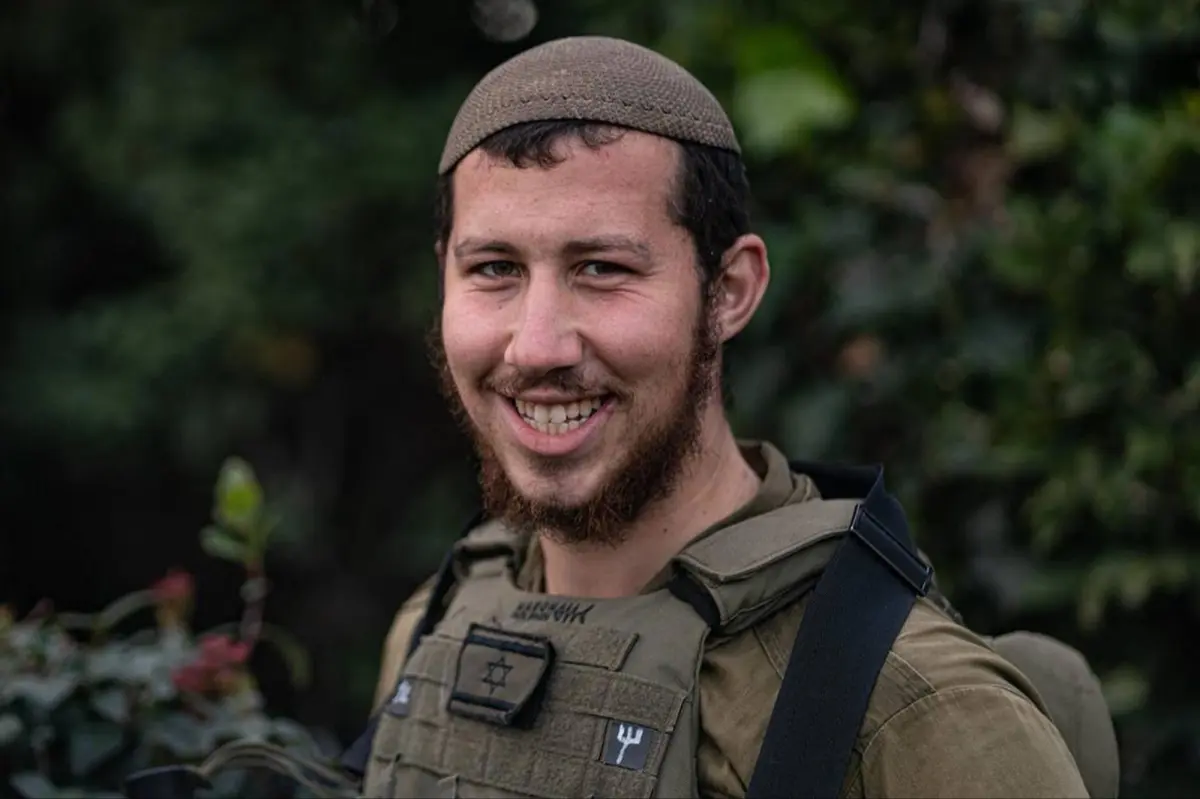
An Israel Defense Forces soldier was killed in combat in Southern Lebanon, the military announced on Sunday morning.
The soldier was identified as Sgt. Moshe Yitzchak Hacohen Katz, 22, from New Haven, Conn.
“My wife and I send our heartfelt condolences to the family of Sergeant Moshe Yitzhak HaCohen Katz, of blessed memory, who fell in battle in Lebanon,” said Israeli Prime Minister Benjamin Netanyahu. “Moshe, of blessed memory, immigrated to Israel from the United States, enlisted in the Paratroopers Brigade, and fought bravely in defense of our homeland. On behalf of all the citizens of Israel, we embrace Moshe’s family in their time of sorrow and wish a swift and full recovery to our soldiers who were wounded in the same incident. May his memory be blessed,” the statement continued.
Israeli Defense Minister Israel Katz also paid tribute to the fallen soldier, writing that “Moshe chose to leave a full life in the United States, make aliyah to Israel, and enlist in the IDF out of a profound sense of Zionism and mission. I salute him for his heroism and his contribution to the security of the State of Israel, and I share in the heavy grief of his family. May his memory be a blessing.”
Three other soldiers were moderately wounded in the same incident, according to the IDF. They were evacuated to hospital and their families notified.
The death toll among Israeli troops since the Hamas-led Oct. 7, 2023, cross-border massacre stands at 930.
Sgt. Aviad Elhanan Wolansky, 21, from Jerusalem, was killed in action in Southern Lebanon during operations against Hezbollah terrorists, the IDF said on March 26. Four other soldiers — two officers and two enlisted men — were lightly to moderately wounded, evacuated to hospitals in Israel and their families notified.
Wolansky was the son of Brig. Gen. Yair Wolansky, the Israeli Defense Ministry’s inspector, and the grandson of Rabbi Oded Wolansky, a senior rabbi at Jerusalem’s Har Hamor Yeshivah; he was named for an uncle killed in a terrorist attack during the Second Intifada.
Israeli Prime Minister Benjamin Netanyahu and Defense Minister Israel Katz praised his bravery and sacrifice, while the military noted that Staff Sgt. Ori Greenberg, 21, from Petach Tikvah, was also recently killed fighting Hezbollah in Southern Lebanon.
Hezbollah began firing rockets and suicide drones at Israel on March 2, in retaliation for the Jewish state’s targeted killing of Iranian Supreme Leader Ali Khamenei, who was killed in the opening strikes of Operation Epic Fury against the regime on Feb. 28.
In response to the terrorist organization’s violation of the US-brokered Nov. 27, 2024, truce agreement with Lebanon, Jerusalem launched an aerial campaign against Hezbollah and ordered IDF troops to advance and take control of additional areas in Southern Lebanon to halt cross-border attacks.
“Hezbollah is a terrorist organization that openly seeks to destroy the State of Israel and therefore has no place in any political settlement. The goal should be clear: removing the threat. Any attempt to include it in a ceasefire grants it legitimacy and breathing space instead of defeating it,” Otzma Yehudit lawmaker Yitzhak Kroizer told JNS.
“The responsibility for what happens on Lebanese soil lies with the Lebanese government. A country that allows a terrorist organization to operate from its territory against Israel should bear the consequences,” he said.
Addressing potential negotiations with Iran, Kroizer said engagement with the Islamic Republic in its current form holds no value.
“The regime in Tehran has spent years building military and strategic assets aimed at Israel, including pursuing nuclear capabilities. For them, negotiations are a tool to buy time, not a real solution,” he said.
“Israel must continue to act decisively to eliminate the threat, even if that means acting independently. The first responsibility of the Israeli government is the security of its citizens, and it cannot rely on promises or agreements that are not enforced,” he added.
Likud lawmaker Avichay Buaron told JNS that Hezbollah “cannot continue to exist as a terrorist military organization.”
“I am not prepared to endanger our citizens by allowing Hezbollah to fire shells at will. This has been happening for some 50 years, and our citizens have suffered enough,” he continued. “We will not accept any situation in which Hezbollah does not disarm. If it refuses, we will take action against it—and that also means taking action against Lebanon.”
On Iran, Buaron said negotiations would only be meaningful if they resulted in what he described as Tehran’s surrender.
“That means achieving all of our war objectives, including dismantling its nuclear program, infrastructure and ballistic missile capabilities. It also means disarming its proxies, including Hamas, not only Hezbollah. If they agree to all these conditions, we would consider it a surrender agreement,” he said.
“We have not yet reached that point. We will get there only when we are closer to that outcome, and it will take more time,” he added.