Daily Mail journalists select and curate the products that feature on our site. If you make a purchase via links on this page we will earn commission – learn more
Today’s fifty-something woman is very different to previous generations’ – despite how many people see us.
We may still be portrayed as old ladies, our hair greying, our clothes fuddy and unfashionable, pottering around and trapped in routines imposed on us through marriage or societal expectations – but many of us have given ourselves permission to discover a newfound freedom and lead our best lives ever.
And why wouldn’t we? Entering our post-menopause years means that we are free from reproductive hormones, periods, and contraception.
There can be seismic shifts in other areas of our lives too, as children leave home and our careers begin to shift or wind down.
Menopause is not an ending, but a powerful new beginning.
We are not ageing like our parents and grandparents before us – hitting fifty often brings with it the dawning realisation that if we’re lucky, we could have 20 or 30 healthy years ahead of us.
This stage of life offers an opportunity to reconnect with ourselves, to rediscover what truly matters, and to prioritise self-love and self-care without guilt.
I have certainly felt that being postmenopause has been one of the happiest times of my life – so much so that I was inspired to write a book about it.
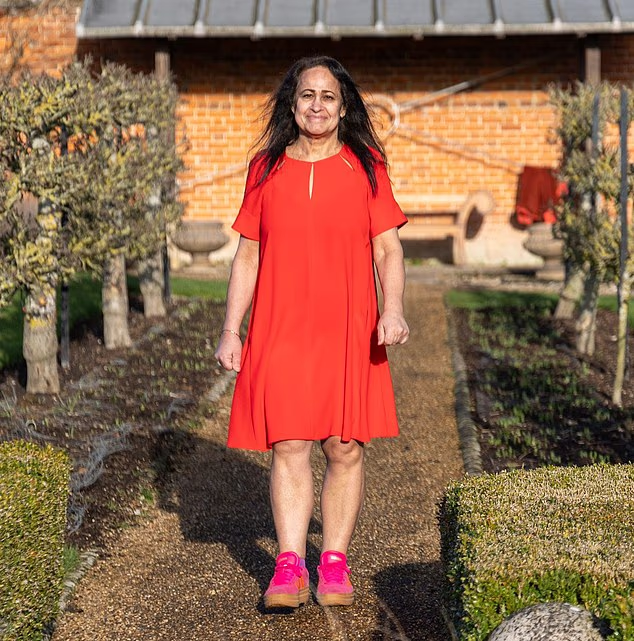
Professor Joyce Harper has written a new book about
But I am not the only woman enjoying what I have dubbed the post-menopause revolution.
For my book, Your Joyful Years; empowering good health and happiness beyond 50, I spoke to fifty women about how this phase of their life is panning out for them.
Their stories offer guidance, reassurance, and permission to live authentically on your own terms.
One summed up this later stage of life perfectly when she told me: ‘I think ageing is beautiful.
‘My greatest love of ageing is the wisdom that comes with it, it’s like a fine wine. We get better with each year.’
And she’s not the only woman who enthused to me about her later years.
‘I see ageing as a ripening, a time of second abundance, a second spring of reawakening and re-energising,’ said another of my inspiring interviewees.
I also know many women find themselves struggling at this time of life, when a lot is going on and changing – much of it out of their control.
A lot of us fall into what has been dubbed the ‘sandwich generation’. We’re responsible for looking after our parents and our children – and maybe grandchildren! – as well as maintaining marriages, careers and friendships, plus running a household.
But regardless of these external factors, I believe that we all have the potential to make life post-menopause special, fulfilling and exciting – and what better time to start than now?
As I compiled my book, I noticed several distinct themes that appeared in my selected women’s stories.
I have distilled them into seven easy to follow tips. You don’t need to do all of them – I’m certain that even embracing one of them will bring meaningful, positive change to your daily life.
1. Embrace intimacy, sex and orgasms
You may have been through a tough time with hot flushes and vaginal dryness, but now your periods have stopped and your hormones have hopefully settled down, you can make this your time to flourish.
I look at menopause as a reset button, not the full-stop on my life as a sexual being.
When we have an orgasm, our bodies release a cocktail of happy hormones which provide significant health benefits, including: reducing stress, anxiety, and depression; improving our overall sense of wellbeing; and helping us sleep.
Whether this is on your own or with a partner, it is healthy for our genitals to be stimulated.
But things can change as we age so it’s more important than ever to have an honest conversation with our partner about what works and does not work in the bedroom.
Remember, intimacy does not necessarily need to result in sex.
Affectionate touch such as kissing and cuddling can increase oxytocin, supporting feelings of calm and connection.
2. Find your tribe of women
Many of us are finding the company of women even more important as we age – whether you are single or in a relationship, it is great to spend time with the girls.
Female friends have the ability to provide emotional healing, reduce feelings of isolation, and offer strength in times of need.
Many women also find they are more in tune with their female friends post-menopause than ever before – there seems to be less competition and more understanding.
One of the women I spoke to told me: ‘I’ve become really close to my school friends in this decade of our life, closer than we’ve ever been.
‘Earlier in our lives, some were having children, some were doing careers, and now we are who we are.’
But I know some women have lost touch with their friends. If so, maybe catch up with girlfriends you may not have seen for years.
You’ve got nothing to lose by getting in contact.
Or meet new friends by exploring new hobbies. Loneliness is a killer so it is important more than ever to find your tribe.
And, if you’re worried about any cattiness endemic in many female friendships, one interviewee me told me she has found the opposite is true as she’s got older.
‘I think that through your 20s and 30s and into your 40s, there is maybe a bit of competition, but that’s gone at this stage of our lives,’ she said.
‘I think we become much more accepting of all our weird and wonderful ways.’
If your friendships have drifted or you’ve relocated, it’s normal to feel isolated and unsure how to connect with a new group of women. But remember, there will be others who feel the same – eager to get out and explore the local area or the wider world – hoping to meet somebody just like you!
Friendships and community are key to a happy life as we age – and we’re never too old to make new memories or share a giggle.
3. Give yourself permission and time for self-care
If you look back at your life, you might feel – like many women – that you have spent a huge number of years, perhaps decades, looking after everyone else and prioritising their needs over your own.
This is exactly why midlife is the time to start putting ourselves first for once – and it is not selfish, it is vital if we want to cultivate good health and happiness for the remainder of our lives.
Because of the demands placed on us over the years – not all of them reasonable – many women believe that they don’t have the time to look after themselves or do things that bring them joy.
I’m sorry, but I strongly disagree that this is the case.
If you do not feel you have enough space in your day, or don’t know where to start, take baby steps by dedicating just 15 minutes a day to ‘you time’.
Each morning, decide what you will do that day that will make you happy – it can be as simple as going for a walk, reading a book, journalling, or taking a relaxing bath. Whatever works for you.
Do it daily and watch your sense of wellbeing and joy grow.
If the idea of this makes you feel guilty that you are taking time and attention from your family or children, address your mindset.
One of the women I interviewed told me that she effectively sees her life as two halves; parenting and the present time.
‘I’ve done the mother part. That was the first part of my life. But there’s something more I feel that I can contribute to in the second part of my life,’ she said.
And if you’re stuck for what your daily happiness activity might look like, use it as an exercise to find what makes your heart soar.
As one of the women in my book told me, it’s been a long time coming.
‘I think that it can be a wonderful time of life,’ she said. ‘I think that it’s a time when we actually get to do something we want to do for ourselves.’
4. Health really is wealth – take it seriously
There is no quick fix to look after our health and we have to understand that as we age, the chances of getting a serious disease increases.
We need to think about what we eat and how we sleep, plus find time to exercise, and give ourselves the time, space – and permission! – to relax and reset.
There is an abundance of scientific evidence that shows that sticking to a healthy lifestyle will not only make us feel better right now but will reduce the risk of chronic health conditions, which become much more debilitating as we age.
The women I interviewed did have some health problems, including cancer, diabetes, and more. But they knew the importance of looking after their physical and mental health.
Today’s lifestyles are hectic, the notion of a healthy work/life balance has gone out of the window, and we need to address this.
There are many ways to look after our mental health and you need to do what works for you – this may be as simple as spending some time alone (without your phone) or taking a walk in nature.
Personally I love cold water swimming, saunas, sound baths, yoga and dancing.
One of my interviewees told me: ‘I’m aware when I’m feeling off balance, it’s a good sign to relax and I go to the beach.’
Others told me they were the healthiest they’d ever been in their lives – but it had taken a lot of work and consistency.
However, no amount of mindfulness or healthy eating can stop the dark clouds of depression closing in. Mental health can become a problem where you need professional help – and you should never hesitate in asking for it.
5. It’s time to revisit hobbies, or find new ones!
Hobbies are activities we do just for the fun of it, and they can offer powerful benefits for our mental and physical health.
Doing activities we enjoy, whether creative, physical, or social, can lower the stress hormone cortisol and increase our happy hormones.
By triggering these calming and uplifting hormonal shifts, we feel more relaxed, energised, and emotionally balanced.
What hobbies do you do? Maybe there were hobbies you used to do but you’ve forgotten about? Or maybe it’s time for a new hobby?
Being creative is especially good for our mental health. This isn’t just about drawing; what about cooking, gardening, or a craft workshop? There are so many of these across the country.
It could even form part of your daily 15 minutes of self-care.
‘For me, making a thing is essential to being alive,’ said one woman I spoke to.
‘If I go a day, a single day, without making something; journalling, doodling, knitting, sewing, writing a blog, or an article, or a podcast or something, then I feel less alive. It’s absolutely essential to my wellbeing to create every day in some way.’
6. Have a sense of purpose
Having a sense of purpose is about feeling alive, useful, and connected to something that matters.
It gives structure to our days and helps us navigate change, and can be found through work, relationships, creativity, looking after others, or community.
For many people, family is a central source of their sense of purpose, but kids leave home. For some women, their sense of purpose is intertwined with their careers but most people will retire.
There is so much research on how important having a sense of purpose is for our health.
The Harvard Study of Adult Development is one of the longest-running studies about happiness. One of its most consistent findings was that those that have meaning and direction in their lives, and who are engaged in something larger than themselves, tend to be healthier, happier, and live longer.
We need to find our own sense of purpose, not what anyone else expects or wants from us. Think about your sense of purpose and trust it to guide you towards what feels meaningful now.