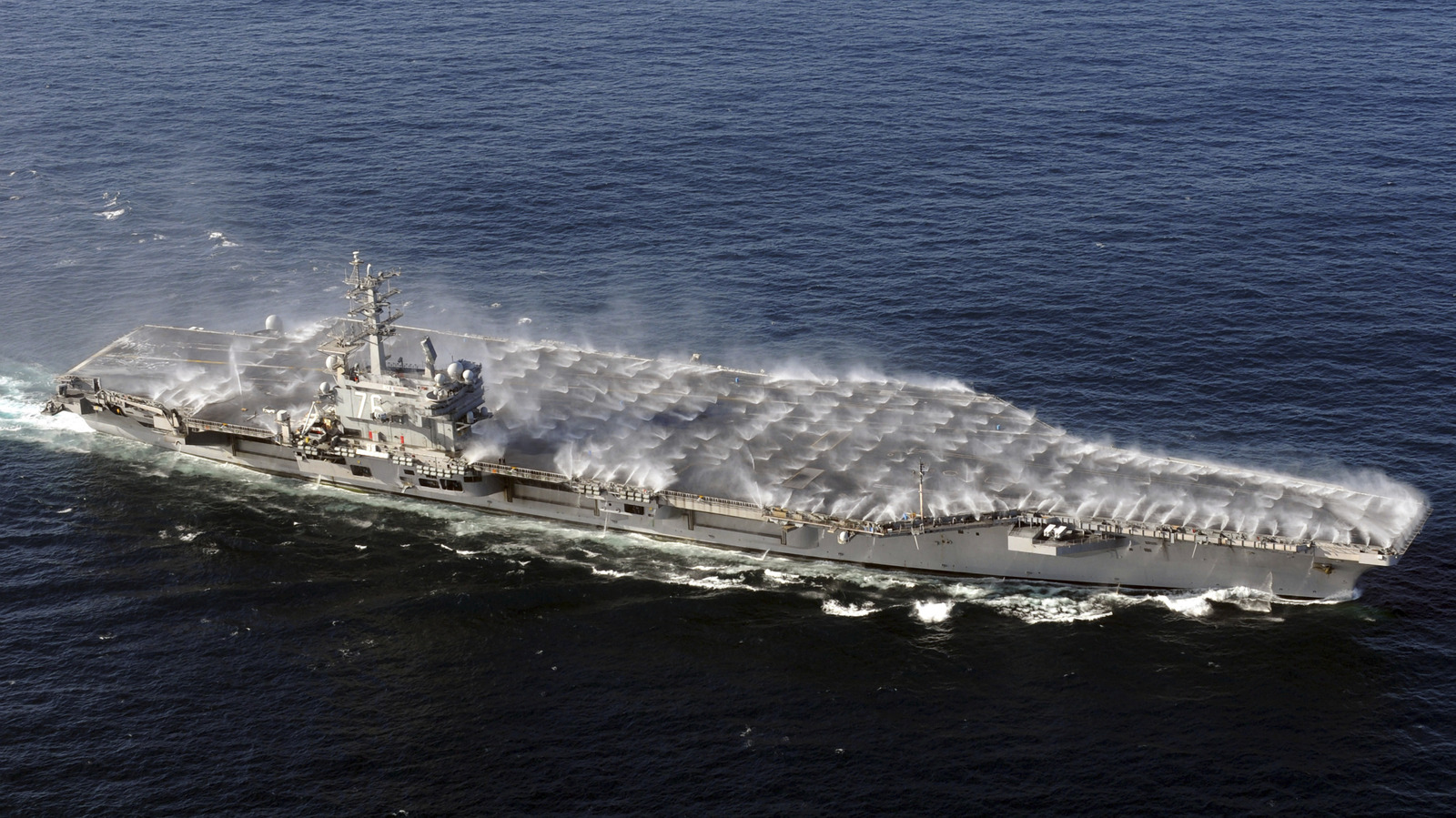
The dangers of fire on the flight deck were tragically highlighted in 1981 aboard the USS Nimitz. In this instance, an EA-6B Prowler was attempting to land and crashed into several F-14s. The resulting fire and explosions killed 14 crew members and injured another 42. The damage to the aircraft carrier, including the destroyed aircraft, was estimated to be around $60 million.
In the aftermath, investigations found that, although firefighting efforts began immediately, critical systems did not respond as quickly. The carrier’s Aqueous Film-Forming Foam (AFFF) washdown system — designed to blanket the flight deck in fire-suppressing foam — was not fully activated for more than two minutes. Part of this system also discharged only seawater due to technical faults.
That delay proved to be costly. Even after the main fire was brought under control, the danger wasn’t over. Concealed ordnance later detonated in the wreckage, causing additional casualties. Incidents like this, although rare, highlight a reality on the flight deck: When a fire breaks out, every second counts, and everyone must know what they’re doing. So, what actually happens in those first moments when a fire breaks out, and who is responsible for bringing the situation under control?
Responding to a flight deck fire
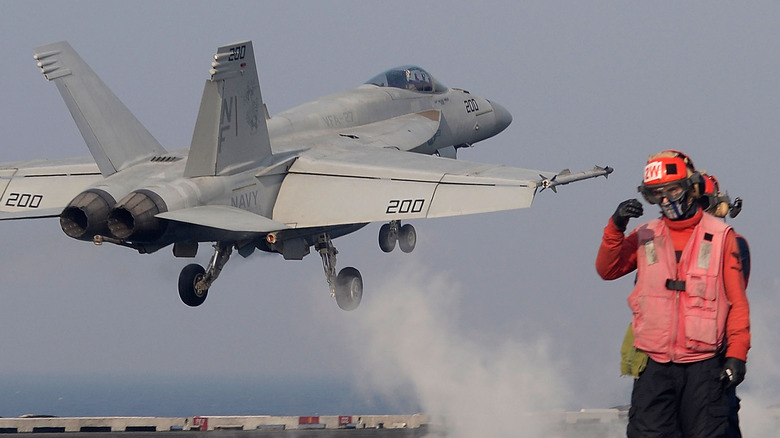
When a fire breaks out on a carrier’s flight deck, the response begins with whoever is closest, although it quickly becomes a coordinated effort. Crew members are trained to move toward clearly marked firefighting stations positioned across the deck. These stations, including AFFF foam outlets and integrated communication ports, allow personnel to activate fire suppression systems and report the incident.
At this point, dedicated crash and salvage crews take over. Identified by their red jerseys, these teams are effectively the flight deck’s fire department. As well as being responsible for fighting the fire, they’re also tasked with rescuing personnel and operating specialized firefighting equipment. The “red jerseys” are directed by the Aircraft Crash and Salvage Officer — or Air Bos’n — who supervises the team during the handling of such emergencies.
In terms of firefighting itself, the aforementioned AFFF foam remains the go-to method. However, the firefighting teams also have access to a range of supporting systems that can be used depending on the situation. Saltwater stations — marked with a “W” — can be used if a broader firefighting response is required. Additionally, portable fire extinguishers using agents such as PKP dry chemical and CO2 are available if needed. While the lessons learned from the Nimitz incident have undoubtedly improved safety on carrier flight decks, there is no room for complacency anywhere on a carrier when it comes to fire. This was demonstrated by the recent fire on the USS Gerald R. Ford — currently the world’s largest aircraft carrier.
Why flight deck fires are so dangerous
While the fire on the Gerald R. Ford demonstrates the risks of a fire anywhere on a ship, the flight deck of a carrier is a real danger zone. At any given moment, the deck could be packed with fuel-laden aircraft, live ordnance, and equipment, all in close proximity. This is why the flight deck of an aircraft carrier is one of the world’s most dangerous workplaces. It’s also an environment where even a small fire could escalate rapidly.
Fuel is one of the biggest risks. Aircraft are often fueled up for a mission or in the process of being refueled, and any ignition source could potentially lead to a fast-spreading fire. In the 1981 USS Nimitz incident, leaking JP-5 fuel from at least one damaged aircraft helped sustain the blaze, allowing it to spread across the flight deck. The presence of fuel alone is a big enough risk, but add some high-explosive ordnance to the mix and the potential for secondary explosions is introduced.
Again, this was a point that was tragically illustrated in the Nimitz incident. In that case, a Sparrow missile detonated after the fire had been declared out and firefighters were clearing smoldering debris. The ensuing blast killed another two crew members and injured 29. On a carrier’s flight deck, there is no margin for error or delay — only a narrow window in which a fast coordinated response is the difference between a minor incident and a large-scale catastrophe.