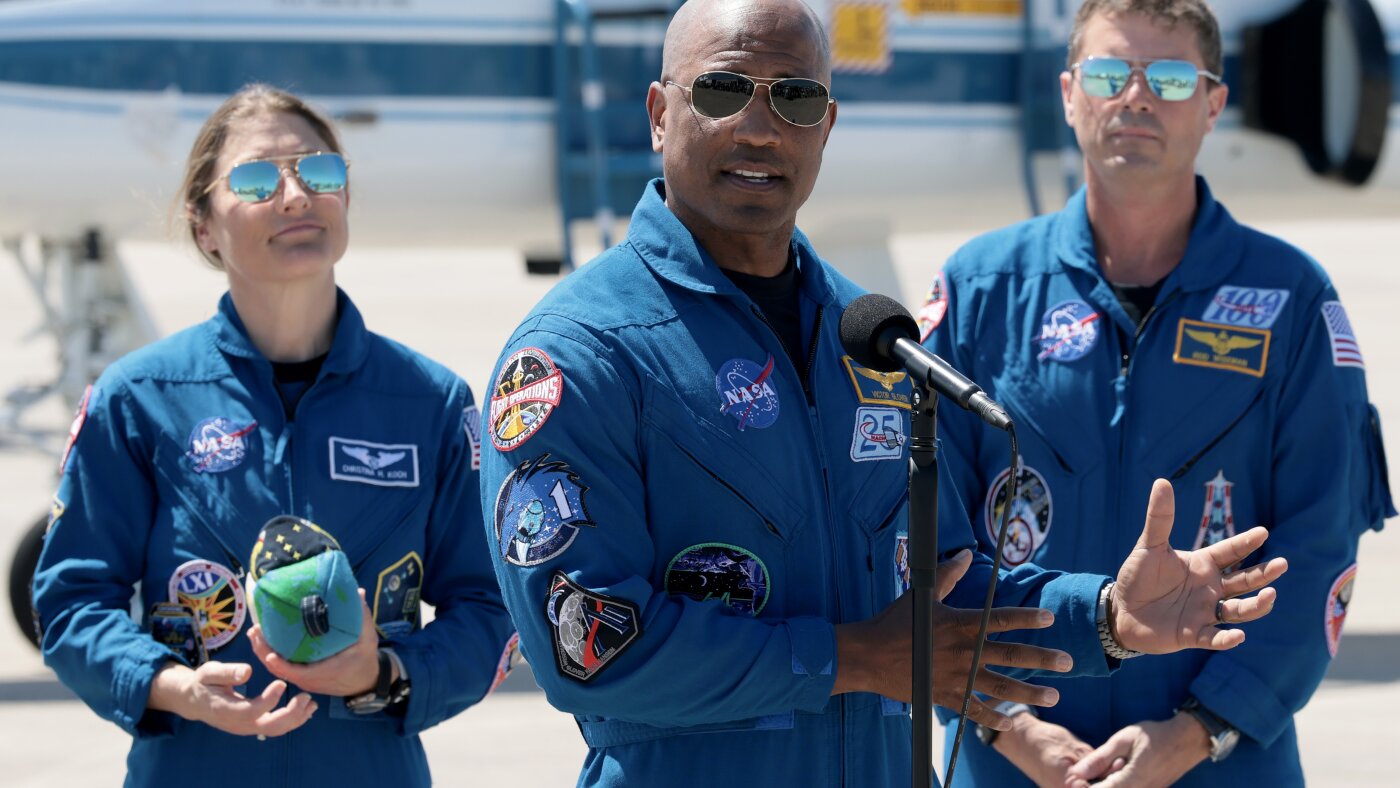
Artemis II crew members — mission specialist Christina Koch (left) and commander Reid Wiseman (right) — listen as pilot Victor Glover speaks to the media after arriving at the Kennedy Space Center on March 27, 2026 in Cape Canaveral, Florida. The astronauts’ planned 10-day mission will take them around the Moon and back to Earth.
Joe Raedle/Getty Images
hide caption
toggle caption
Joe Raedle/Getty Images
NASA astronauts could be just days away from blasting off towards the moon for the first time since 1972, when Apollo astronaut Eugene Cernan took his last steps in the gray lunar dust.
As soon as Wednesday, a four-person crew could launch on a mission to fly around the moon in an Orion capsule that’s currently perched at the top of a 322-foot, orange-and-white rocket waiting at Kennedy Space Center in Florida.
“When those engines light, this thing is moving out,” said Reid Wiseman, the NASA mission’s commander, during a briefing with reporters on Sunday. He said that it was “surreal” to drive out to the launch pad and see this massive rocket.
The crew’s first launch opportunity will come on April 1, at 6:24 p.m EDT. Mission managers have several more launch opportunities through April 6.
“Things are certainly starting to feel real,” said NASA astronaut Christina Koch. She and Wiseman are in preflight quarantine, along with their fellow NASA astronaut, pilot Victor Glover, plus astronaut Jeremy Hansen from the Canadian Space Agency.
If their trip goes as planned, it will be the first time that a woman, a person of color, and a non-American will venture out around the moon.

“We are getting very, very close, and we are ready,” says Lori Glaze, the acting associate administrator for NASA’s exploration systems development mission directorate.
During a briefing, mission managers said that launch preparations were going smoothly and they were not dealing with any technical issues that might threaten a Wednesday attempt.
“The one thing we are watching is the weather,” says NASA exploration ground systems manager Shawn Quinn, who says the forecast currently calls for an 80% chance of favorable launch conditions.

No moonwalks, but a flyby
This will be the first launch in NASA’s Artemis moon program that includes a crew.
Over three years ago, during the Artemis I test flight in November and December of 2022, NASA put an Orion capsule through its paces without astronauts on board. That capsule went on a looping trip around the moon that lasted over three weeks and covered over a million miles before splashing back down in the Pacific.

This time around, the astronauts will first orbit Earth so that they can check out key systems on their spacecraft, including life support, communication, and navigation.
If everything goes as planned, they’ll fire their vehicle’s propulsion system to send themselves on a looping figure-eight path around the moon and back, a deep space journey that will take them more than 230,000 miles away from Earth. It will take several days to get out to the moon, and the entire mission is expected to last about ten days.
The closest they’ll come to the moon is about 4,000 to 6,000 miles above the lunar surface, as they swing behind the moon and briefly lose contact with mission controllers.
At that distance, according to NASA, the moon will appear to be about the size of a basketball held at arm’s length, with the distant blue Earth beyond it.
A lander still to come
This mission is a key step towards an eventual moon landing that will support NASA’s goal of establishing a permanent lunar presence, including a moon base, with the help of international partners.
But work on critical hardware — most importantly, the landing vehicle — remains incomplete, although NASA has been pushing to speed up its two lunar lander contractors, SpaceX and Blue Origin.
NASA officials now plan to test out one or both landers in Earth’s orbit before trying to press on with a lunar landing attempt. To do so, they added a lander checkout mission next year to the Artemis program’s lineup of launches.
Under the current timeline, a landing on the moon could be attempted in 2028.
But long-time NASA veteran Wayne Hale, who spent decades as a flight controller and space shuttle program manager before his retirement, thinks that timeline is going to be challenging.
“I kind of worry about whether it will be before 2030 or not, but hopefully not long after that,” says Hale.
He says NASA’s new roadmap for the moon, unveiled last week at the agency’s headquarters, is ambitious, involving multiple robotic missions, a lunar base, and power station development.
“All of these are good but, to use a cliche — show me the money,” Hale noted, adding that he hopes Congress will provide the necessary funds, but he’s skeptical.
A new moon race?
Already, the Artemis program has spent something in the range of $93 billion, according to one recent accounting from the agency’s inspector general.
NASA’s return to the moon has essentially been in the works since 2004, when President George W. Bush gave a speech announcing that NASA would finish building the international space station, retire its fleet of aging space shuttles, and make its new focus the moon, as a stepping stone to Mars.
“It’s really the same program, with a little tweaking along the way, that we are trying to execute 22 years later,” notes John Logsdon, a space policy historian and professor emeritus at George Washington University. “It’s taken forever.”
In the 1960s the space race with the Soviet Union seemed existential, says Logsdon, and this generated an urgency that just doesn’t exist for the current moon program. “This is just something that seems the logical next thing to do, but not with any great commitment to getting it done on any kind of reasonable schedule,” says Logsdon.
China is also seeking to put people on the moon, and some lawmakers in Congress and officials at NASA have tried to use that as a new space race that could inspire more funding and support.
Most people alive today have no memory of being able to look up at the moon and know that astronauts are there. Recent surveys suggest wide support among Americans for NASA’s return to the moon, says Teasel Muir-Harmony, curator for the Apollo collection at the Smithsonian’s National Air and Space Museum.
“The Artemis program is actually more popular than the Apollo program was,” says Muir-Harmony. “In general, the polls suggest that today, Americans are more supportive of the program than they were in the 1960s.”