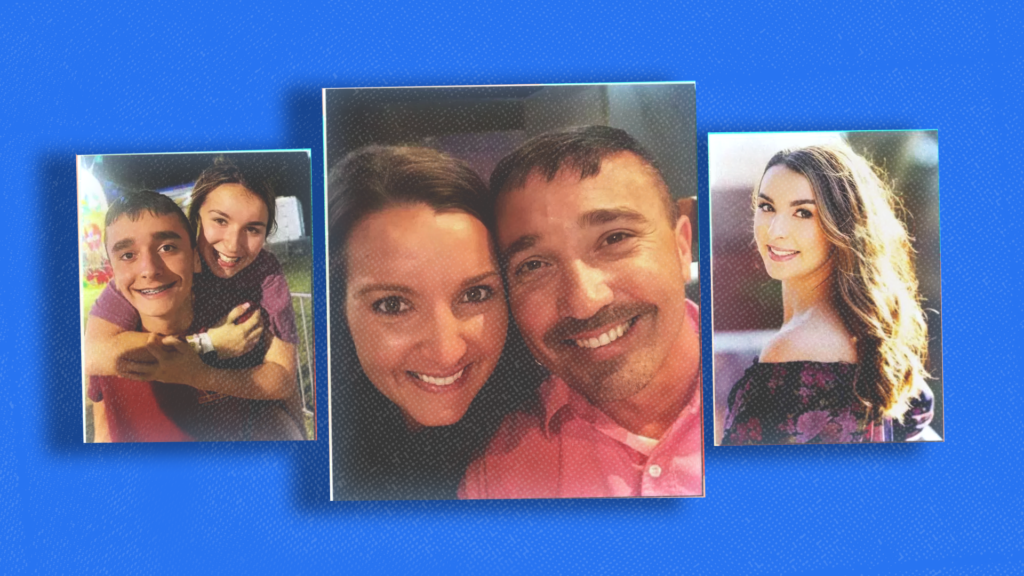
More than seven years after two Texas cops kidnapped a teenaged girl they falsely claimed had been “abandoned,” a federal jury has concluded that the officers violated her Fourth Amendment rights by unreasonably seizing her from her home. In a verdict delivered last week, the jurors said that seizure also violated her parents’ due process rights under the 14th Amendment. And they agreed that one of the officers had violated the Fourth Amendment by searching the family’s kitchen without a warrant, consent, or exigent circumstances. In the second phase of the trial, the jurors approved $175,000 in compensatory damages and $125,000 in punitive damages.
The verdict validates constitutional claims that Megan and Adam McMurry made in a federal lawsuit they filed in October 2020, two years after Officers Alexandra Weaver and Kevin Brunner, both of whom worked for the Midland Independent School District, visited their apartment and left with their daughter, Jade, then 14. That intervention, the jury concluded, was not justified in the circumstances, since Jade was not in any danger. The verdict “was vindicating after having our lives turned upside down and trampled through for the past seven and a half years,” Megan McMurry told KMID, the ABC affiliate in Midland.
The bizarre episode at the center of the case happened when Adam McMurry, then a member of the National Guard, was deployed to the Middle East, and Megan McMurry, a special education teacher at Abell Junior High School in Midland, was in Kuwait looking into a job that would have allowed the family to live near him. Megan McMurry had alerted her colleagues to her trip and had asked two neighbors, Vanessa and Gabe Vallejos, to keep an eye on Jade and her brother, Connor, then 12, who was a student at the school where McMurry worked.
On October 26, 2018, the guidance counselor who was supposed to take Connor to school was ill, so she texted Weaver, who lived in the neighborhood, asking if she could give Connor a ride. Although another Abell employee ended up bringing Connor to school, Weaver’s involvement did not end there.
Weaver was convinced that Jade had been “abandoned” and was in urgent need of a “welfare check.” Brunner, her supervisor, agreed, which is how they both ended up at the McMurrys’ apartment that morning.
Jade, who was homeschooled and in the midst of her online studies, did not understand what the cops were doing there. But within a minute, they had decided she needed to be rescued.
Brunner told Jade to put on warmer clothing so she could leave the apartment. As Jade began to follow Brunner’s instructions, body camera video showed, he asked her, “Do you mind if she [Weaver] comes in the house with you?” Jade’s response was ambiguous: “Mm-hmm.” Then she burst into tears, saying, “I’m scared.”
Taking that as an invitation, Weaver entered the apartment and began poking around. She inspected the living room and the kitchen, opening the pantry, the refrigerator, and the freezer. Her search found no evidence that Jade was in any danger. She and Brunner nevertheless removed Jade from her home, grilled her, prevented her from communicating with her parents, and took her to Abell Junior High School. Jade was detained until that afternoon, after Texas Child Protective Services (CPS) concluded there was no evidence of abuse or neglect.
At the point when Weaver and Brunner whisked Jade away, they knew that Vanessa Vallejos was checking in on her and Connor. Jade had told them as much, offering to put them in touch with Vallejos. During the trial, KMID reports, the defendants “tried to argue that Ms. Vallejos refused to come to the apartment to confirm the arrangements, despite the body cam [footage] showing Ms. Vallejos offering to come to wherever the officers were.” Brunner “instructed her to go to Abell, because the officers told her they were taking Jade to Abell, where her brother was attending class.”
Weaver and Brunner had already filed a CPS complaint, and they were determined to act on their unfounded suspicions. They were so sure of themselves, in fact, that they pursued criminal charges against McMurry even after CPS decided there was no case to be made. In January 2020, a jury took just five minutes to acquit McMurry of abandoning or endangering her children.
That prompt acquittal suggested the jurors did not think Weaver and Brunner’s avowed concern for Jade’s welfare was reasonable. Nor did U.S. District Judge David Counts, who in September 2021 rejected the officers’ motion to dismiss the McMurrys’ lawsuit.
Weaver and Brunner argued that they were shielded by qualified immunity, a doctrine that bars federal civil rights lawsuits unless they allege violations of “clearly established” law. After Counts rejected that claim, Brunner appealed to the 5th Circuit, which affirmed Counts’ decision in December 2022.
“The facts here are particularly egregious,” Judge Andrew Oldham noted in a concurring opinion. He elaborated:
Weaver performed an illegal search in front of her supervisor (Brunner). And instead of settling for one constitutional violation (the search), Brunner went on to commit two more (unlawfully seizing [Jade] and violating the McMurrys’ due-process rights). And after taking custody of [Jade], Brunner prevented [her] from talking to her father and the Vallejos for a significant amount of time. All while [Jade] was crying and confused. Then CPS told Brunner that his safety concerns were baseless. And still, inexplicably, Brunner persisted and pushed for criminal charges against Mrs. McMurry. Like CPS, a jury of Mrs. McMurry’s peers squarely rejected Brunner’s charges. But the damage was already done: Mrs. McMurry was already fired, was already prevented from teaching again, and had already spent 19 hours in jail.
After that resounding defeat, Brunner unsuccessfully asked the 5th Circuit to reconsider the case and unsuccessfully sought Supreme Court review. Then Brunner and Weaver filed motions for summary judgment with the district court, reasserting their qualified immunity claims. Unsurprisingly, Counts was no more impressed by their arguments the second time around.
The 5th Circuit “has already held in this case that [Jade] was unlawfully seized ‘in violation of the Fourth Amendment as a reasonable fourteen-year-old would not have believed she was free to leave when an officer removed [her] from her home for questioning while instructing her not to respond to calls from her father,'” Counts noted in June 2024. “Defendants’ motions even confirm the facts underlying that holding. So no, this was not ‘a consensual act of transportation’; [Jade] was unlawfully seized in violation of her Fourth Amendment rights.”
Were those rights “clearly established”? As Counts noted, the 5th Circuit had already said they were “under these exact facts.”
As for the due process claim, Jade “was following her parents’ instruction to continue her homeschooling in the family apartment during school hours,” Counts wrote. “Defendants then overruled that parental instruction by unlawfully removing [Jade] without a court order or exigent circumstances. Thus, Defendants ‘obviously deprived the McMurrys of their liberty interest’ in the care, custody, and management of their child.”
The McMurrys “did not receive the process they were due,” Oldham had noted. “In fact, they received no process whatsoever. No ex parte court order, no warrant, no notice, no hearing. Nothing. Surely, the McMurrys had a right to at least some predeprivation process before their child was snatched from their home.”
You might think those unambiguous decisions would have cleared the way for the McMurrys to finally present their claims to a jury. But after Counts reiterated that Weaver was not entitled to qualified immunity, she appealed that ruling to the 5th Circuit, which upheld it last June.
“The parties do not dispute that Weaver searched the refrigerator without a court order or consent,” Judge Carolyn King wrote in an opinion joined by the two other members of the 5th Circuit panel. “To comply with the Fourth Amendment, the search must be justified by exigent circumstances. But Weaver does not argue that there were exigent circumstances, and the district court found that there were none. Instead, Weaver relies on a ‘special needs’ or ‘community caretaking’ exception to the warrant requirement. Neither applies here.”
A warrant “may not be required where there is a ‘special need’ that is ‘divorced from the State’s general interest in law enforcement,'” King noted. Likewise “when the police perform ‘community caretaking functions’ that are ‘totally divorced from the detection, investigation, or acquisition of evidence relating to the violation of a criminal statute.'” But the search in this case was obviously related to a criminal investigation, as confirmed by the charges that McMurry later faced.
Was Weaver on notice that her search was unconstitutional? King thought so, noting that the 5th Circuit, in a case decided a decade before Weaver perused the McMurrys’ kitchen, had “held that government officials conducting home visits ‘to investigate possible child abuse’ must satisfy ‘the typical Fourth Amendment standards of a court order, consent, or exigent circumstances.'”
That precedent, Gates v. Texas Department of Protective and Regulatory Services, also established that “the government may not seize a child from his or her parents absent a court order, parental consent, or exigent circumstances,” King noted. “Again, Weaver does not argue there were exigent circumstances, and a jury could find that Weaver did not have reasonable cause to believe that fourteen-year old [Jade] faced any ‘immediate danger’ at home alone in a gated apartment complex in the middle of the day.”
The due process claim against Weaver “is premised on [Jade’s] Fourth Amendment claim for unreasonable seizure,” King added. “Accordingly, the McMurrys have established a constitutional violation sufficient to survive summary judgment for the same reasons: [Jade] was seized without a court order or exigent circumstances.”
In a concurring opinion, Judge James Ho highlighted one of the arguments offered by Weaver’s appellate lawyer. Because Jade was studying at home, the lawyer suggested during oral argument in February 2025, the apartment may have qualified as a school, a setting in which Fourth Amendment requirements are relaxed. “Was she taken from an apartment or was she taken from her school?” he said. “There’s no case law whatsoever that establishes that an apartment stays an apartment when you’re going to school.”
That position is “obviously wrong as a matter of rudimentary constitutional principle,” Ho wrote. “The Fourth Amendment expressly assures every one of us—including families who homeschool—that ‘[t]he right of the people to be secure in their persons, houses, papers, and effects, against unreasonable searches and seizures, shall not be violated.’ To justify intrusions on this bedrock liberty based on the educational choices parents make for their children does not evade the constitutional objection—it exacerbates it.”
Ho also took the opportunity to reiterate his dismay at the 5th Circuit’s repeated rejection of the First Amendment lawsuit that Priscilla Villarreal, an independent journalist in Laredo, filed after she was arrested for asking a police officer questions about a public suicide and a fatal car crash. Villarreal cited Supreme Court decisions recognizing that qualified immunity does not require highly fact-specific precedents in cases involving conduct that is “obviously unconstitutional.” But the appeals court “waved away those decisions on the ground that they’re ‘Eighth Amendment cases,'” Ho wrote, “and that they establish only a ‘narrow[] obviousness exception’ that should not apply to obvious violations of the First Amendment.”
Ho thought that decision, along with a 2011 5th Circuit precedent involving religious freedom, may have encouraged Weaver’s lawyers to argue that she deserved qualified immunity even though her conduct was plainly outrageous. “It seems absurd to suggest that the most egregious constitutional violations imaginable are somehow immune from liability precisely because they’re so egregious,” he wrote. “It would make a mockery of our rights to grant qualified immunity just because no one in government has yet to be abusive enough to commit that particular violation—and then stubborn enough to litigate it, not only before a district court, but also in the court of appeals.”
Although “I’m of course duty bound to follow en banc precedent,” Ho added, “I’m not obliged to extend it….I will not make things worse by extending this mistaken body of precedent and refusing to protect citizens from obvious violations of the Fourth Amendment as well as the First.”
Ho also questioned the application of qualified immunity to cases that do not involve “split-second” decisions. “It’s one thing to grant qualified immunity when it comes to police officers who are forced to make split-second judgment calls in life-and-death situations,” he said. “It’s quite another thing to immunize public officials who make a deliberate and calculated decision to violate one’s constitutional rights.”
Although the McMurrys eventually beat back the challenges to their lawsuit, their case illustrates how difficult it can be to vindicate your constitutional rights. “In our judicial system, it is damn near impossible to hold government actors accountable when they violate our constitutional rights,” Megan McMurry says in an email. “They have endless resources and huge law firms that endlessly blame the victims to excuse the behavior of the government actors, cops, etc. In this case, the defendants repeatedly tried to blame me. ‘Look at the McMurrys. It’s their fault this happened. Don’t look at what we did! We are cops and deserve a medal!'”
Weaver and Brunner literally made that argument during the trial. Their lawyers “maintain[ed] the officers acted appropriately and deserved a medal for their actions,” KMID reports. The jurors clearly did not agree.
In fact, McMurry thinks the jury would have approved higher damages if Weaver’s attorney had not intimated that the defendants would personally bear the cost. “Multiple jurors said they were misled” on that point, she says, and “we are filing a motion for a new Phase 2 trial” based on that misrepresentation.
McMurry notes that the school district and its insurer have been covering the cost of Weaver and Brunner’s defense. And even in the rare cases where police officers are held liable for constitutional violations, their employers routinely indemnify them.