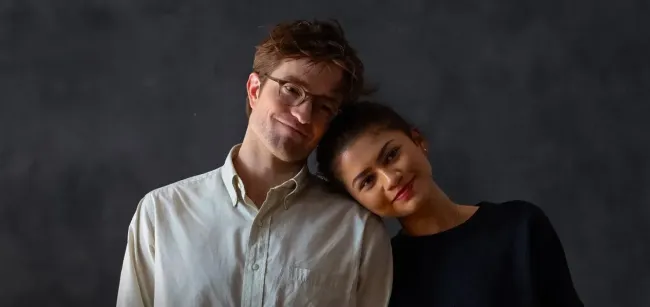
Imagine that you’re about to marry Zendaya, or at least a bookstore clerk who looks just like her. Imagine that you met her at a Boston coffee shop a few years earlier (where you clumsily — maybe even sleazily — schemed to make an introduction), embarked upon a storybook romance, and eventually began to live together in a leafy studio apartment with one of those adorable corkscrew staircases that scream “we’re not even thinking about children yet.” Imagine that you know everything you could ever think to ask about this kind, radiant, and loving fantasy of a forever partner. And then imagine what she could possibly let slip just a few days before the ceremony that would cause you to think about crashing out of the relationship altogether.

Needless to say, there are very, very few things that could even semi-plausibly sour that dream into a nightmare with a single turn of phrase, and the wild secret that Emma (Zendaya) reveals to Charlie (Robert Pattinson) during an impromptu game of “What’s the Worst Thing You’ve Ever Done?” at a last-minute menu tasting is — upon first bite — indeed harder to swallow than even the driest of wedding cakes. But the brilliance of Kristoffer Borgli’s “The Drama,” or at least the brilliance of the sketch comedy-adjacent conceit that it exploits to mixed results, is rooted in the fact that Emma’s confession is impossible to laugh off completely.
Like the impish anti-romance that crumbles around it, the movie’s twist is both transgressive enough to be pleased with itself and also rooted in a reality that refuses to be dismissed as a bad joke. It’s shocking, yes, but mostly because it’s rare to see a mainstream film so eager to stick out its tongue and lick one of the last genuine third rails of American discourse.
Which rail would that be? I wouldn’t dare spoil that for you, as the surprise is half the fun. That might be too high of a percentage for an 105-minute experience, but if “The Drama” is effectively a one-gag movie, there’s no denying that its gag is a good one, or that Borgli — a hyper-online shit-stirrer whose salable provocations, combined with his sometimes not so salable ones, continue to position him as an A24-friendly Lars von Trier — milks it for all that it’s worth. Possibly more.
Suffice it to say that anyone expecting a straightforward rom-com is in for a bumpy night, as Borgli is only interested in love and other social crises so far as he can leverage them to explore his favorite topic: The crucible of living at the mercy of other people’s opinions. Skewering the marriage industrial complex to similar ends as his “Drib” satirized 21st century advertising and “Sick of Myself” exalted in the Cronenbergian grotesqueries of the influencer mindset, “The Drama” is likewise compelled by the public spectacle of a modern wedding — by the judgment it invites, and the mass approval it demands, of our most intimate relationships.
While the movie has some fun asking whether people actually want to know everything about their partners (a devil’s bargain since time immemorial), its real interest lies in how that knowledge is colored by who shares it. To that point, “What’s the Worst Thing You’ve Ever Done?” isn’t a terrible game to play with someone right before you commit to sharing the rest of your natural life with them, but maybe it’s not a great idea to play it while your two best friends are sitting at the same table, especially if — like Charlie, a simpering museum curator with a strong jaw and a weak spine — you’re easily influenced by those around you.
Had Emma confided in Charlie alone, it’s entirely possible that the British expat would have absorbed the shock with a stiff upper lip and a mental note to revisit the topic in couples therapy a few years down the line. But everything changes because Mike (Mamoudou Athie, bringing the relaxed compassion he brought to “Kinds of Kindness”) and his scandalized wife, Rachel (a terrific Alana Haim, wielding her outrage with hegemonic force), are there to witness it. No amount of love or lived experience can spare Charlie from the blowback of his bride’s new context; his idea of Emma is suddenly and irrevocably distorted by the way it looks reflected across Rachel’s squinted face. In a single sentence, his future spouse is reduced to a taboo concept.
As in Borgli’s “Dream Scenario,” a person turns into a meme before our eyes. Where that movie was about one man intruding upon everyone else’s thoughts, however, this one is about everyone else’s thoughts intruding upon one man. And where that movie scaled its premise into a sustainably clever satire of the attention economy, this one — its edgelord glee tempered by the sincerity of its analysis — struggles to contain the collateral damage of its big idea or to iterate on the mischievous thrill of its gasp-inducing first-act reveal.
Funny enough on a lizard brain level, an early scene featuring Zoë Winters as a hot shot wedding photographer nevertheless feels like what “SNL” might do with this material, and subsequent attempts at broad comedy — including a semi-bungled climax that never finds a satisfying rhythm for its chaos — strain for brute-force laughs in a film whose humor is better expressed through quietly deranged queasiness (see: the bit where Pattinson accosts a wheelchair-bound Anna Baryshnikov as part of a desperate bid to heed off some liberal hysteria). “She always finds a way to turn my drama into comedy,” Charlie says while stress-testing his vows for Mike’s approval, but the movie itself doesn’t have quite the same hit rate.
While I suppose the same could be said of the film’s ability to turn its comedy into drama, the rubbernecking schadenfreude of Borgli’s approach here depends less on the success of his extremes than it does on the impossible balance his characters try — and fail — to restore between them. Like all of his work, “The Drama” giddily upends the social equilibrium that keeps our world spinning, and marriage is nothing if not a perfect microcosm for how people have institutionalized the negotiation of logic and emotion: too much of either and the whole thing threatens to topple over.
On the most obvious level, we see that play out in Charlie’s attempts to harmonize the truth of what he’s always known about Emma with the implications of what he learns about her right before their wedding, and Pattinson — so good as an indifferently handsome coward who’s never been at odds with his self-image before — is kept in check by Zendaya’s heart-aching performance as a troubled loner who’s always had a tortured relationship with community. But what makes “The Drama” really interesting, if also a bit too vague and spread thin to fully make good on its best ideas, is how Charlie and Emma’s situation crystallizes the ambient psychic distress of living in a country plagued by some very acute bouts of denialism and learned helplessness (Daniel Pemberton’s flutey score contributes to the movie’s analgesic mood).
Charlie, like Borgli, isn’t from America, and his story is steeped in the outsider experience of someone who wasn’t raised in this slow-boiling pot; he’s rattled by his sudden confrontation with one of our greatest evils, but he also knows his fiancée too well to abruptly write her off as some kind of incurable sickness. Similar to how he saw Emma as a perfect angel before Rachel’s voice got in his head, Charlie can no longer think of his adopted home without shouldering the cultural baggage that comes with it.
While Zendaya plays Emma with a wounded sweetness that makes it a bit too easy for us to sort out what Charlie should do (her character is helpfully complicated by a series of unnerving flashbacks), his foreignness leaves him more susceptible to how their friends react to Emma’s secret. Once he learns about [REDACTED], he begins to see evidence of it everywhere, to the point that he can’t make sense of how the rest of us just go about our lives without meaningfully confronting the problem.
We’re mostly left to intuit as much on our own time, as “The Drama” is, by design, too unsettled for clarity, let alone social instruction. The film shares in the discomfort of Charlie’s dilemma, unfolding with pained awkwardness and grasping for more conventional plotlines in a desperate bid for stability (Hailey Gates plays “the other woman” in a storyline handled with all the cringe you’d expect), even though it’s obvious that Borgli prefers nausea over depth.
But the nausea runs deep enough, and the potential glibness of its approach is answered by a question that “The Drama” wretches closer to with every painful moment: How do you politely address something that polite society refuses to address at all? Hell is always other people in Borgli’s films, and this one — if thinner and more rhetorical than his others — stands out for how sharply it details the freefall down from heaven. “I used to be ugly,” Emma offers to Charlie by way of explanation. Now it’s everyone else’s turn.
Grade: B
A24 will release “The Drama” in theaters on Friday, April 3.
Want to stay up to date on IndieWire’s film reviews and critical thoughts? Subscribe here to our newly launched newsletter, In Review by David Ehrlich, in which our Chief Film Critic and Head Reviews Editor rounds up the best new reviews and streaming picks along with some exclusive musings — all only available to subscribers.