Listen to this article
Estimated 5 minutes
The audio version of this article is generated by AI-based technology. Mispronunciations can occur. We are working with our partners to continually review and improve the results.
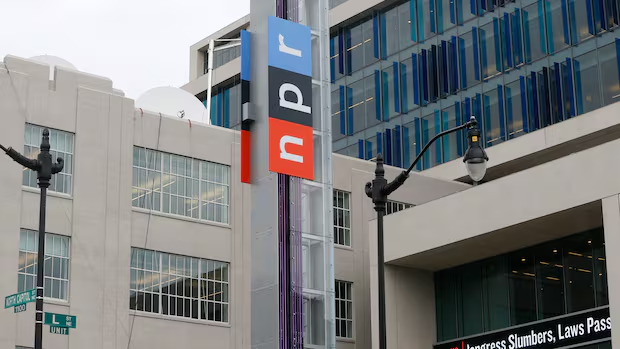
Citing the First Amendment, a U.S. federal judge on Tuesday agreed to permanently block the Trump administration from implementing a presidential directive to end federal funding for National Public Radio and the Public Broadcasting Service, two media entities that the White House has said are counterproductive to American priorities.
The operational impact of U.S. District Judge Randolph Moss’s decision was not immediately clear — both because it will likely be appealed and because too much damage to the public-broadcasting system has already been done, both by the president and Congress.
Judge Moss ruled that U.S. President Donald Trump’s executive order to cease funding for NPR and PBS is unlawful and unenforceable. The judge said the First Amendment right to free speech “does not tolerate viewpoint discrimination and retaliation of this type.”
“It is difficult to conceive of clearer evidence that a government action is targeted at viewpoints that the president does not like and seeks to squelch,” wrote Moss, who was nominated to the bench by then-president Barack Obama, a Democrat.
The judge noted that Trump’s executive order simply directs that all federal agencies “cut off any and all funding” to NPR, which is based in Washington, D.C., and PBS, based in Arlington, Va.
“The federal defendants fail to cite a single case in which a court has ever upheld a statute or executive action that bars a particular person or entity from participating in any federally funded activity based on that person or entity’s past speech,” the judge wrote.
Last year, Trump, a Republican, said at a news conference he would “love to” defund NPR and PBS because he believes they’re biased in favour of Democrats.
“The message is clear: NPR and PBS need not apply for any federal benefit because the president disapproves of their ‘left wing’ coverage of the news,” Moss wrote.
NPR accused the Corporation for Public Broadcasting (CPB) of violating its First Amendment free speech rights when it moved to cut off its access to grant money appropriated by Congress. NPR also claims Trump wants to punish it for the content of its journalism.
“Public media exists to serve the public interest — that of Americans — not that of any political agenda or elected official,” said Katherine Maher, NPR’s president and CEO. She called the decision a decisive affirmation of the rights of a free and independent press.

PBS chief Paula Kerger said she was thrilled with the decision. The executive order, she said, is “textbook” unconstitutional viewpoint discrimination and retaliation. “At PBS, we will continue to do what we’ve always done: serve our mission to educate and inspire all Americans as the nation’s most trusted media institution.”
Last August, CPB announced it would take steps toward closing itself down after being defunded by Congress.
Plaintiffs’ attorney Theodore Boutrous said Tuesday’s ruling is “a victory for the First Amendment and for freedom of the press.”
“As the Court expressly recognized, the First Amendment draws a line, which the government may not cross, at efforts to use government power — including the power of the purse — ‘to punish or suppress disfavoured expression’ by others,” Boutrous said in a statement.
“The executive order crossed that line.”

The Trump administration has been trying to re-shape U.S. universities using threats of funding cuts and student deportations. For The National, CBC’s Terence McKenna takes a closer at how the schools are responding and why some describe it as ‘part of the slide into fascism.’
The judge agreed with government attorneys that some of the news outlets’ legal claims are moot, partly because the CPB no longer exists.
“But that does not end the matter because the executive order sweeps beyond the CPB,” Moss said. “It also directs that all federal agencies refrain from funding NPR and PBS — regardless of the nature of the program or the merits of their applications or requests for funding.”
NPR and three public radio stations sued administration officials last May. While Trump was named as a defendant, the case did not include Congress — and the legislative body has played a large role in the public-broadcasting saga in the past year.
Trump’s executive order immediately cut millions of dollars in funding from the Education Department to PBS for its children’s programming, forcing the system to lay off one-third of the PBS Kids staff.
The Trump order didn’t impact Congress’s vote to eliminate the overall federal appropriations for PBS and NPR, which forced the closure of the Corporation for Public Broadcasting, the entity that funnelled that money to the TV and radio networks.