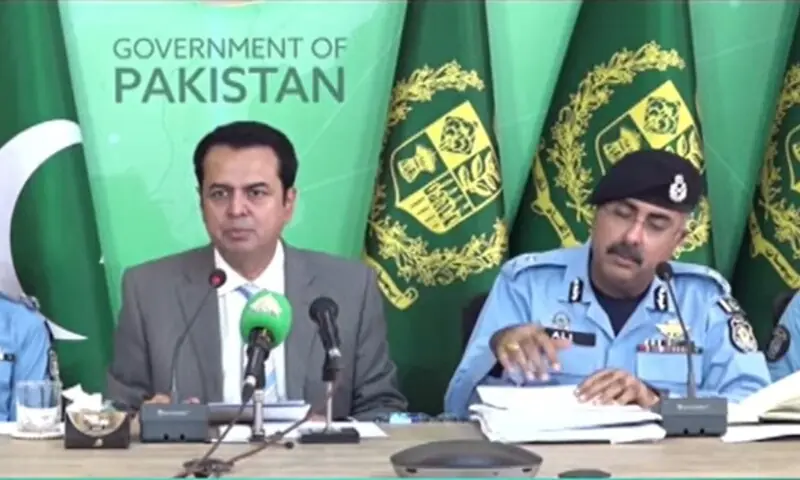
State Minister for Interior Tallal Chaudhry said on Tuesday that all the suspects involved in the killing of a prominent businessman in Islamabad during a dacoity had been arrested.
Police said on Monday that a businessman identified as Amir Awan was murdered during an alleged dacoity at his farmhouse located in Orchard Scheme. Political figures, VIPs and big-shots, including an adviser to the prime minister, own property in the neighbourhood where the incident took place.
In a press conference in Islamabad on Tuesday, Chaudhry addressed the incident and said, “The suspects belong to the Mansoor Khan gang … They are from Khyber Pakhtunkhwa. The dangerous nature of the gang had prevented the local police from arresting them. Afghanis, as well as other people, are included in the gang.”
He said the safe city cameras and the professional attitude of the Islamabad police contributed to arresting the suspects. He said that the Islamabad inspector general, on the directions of the interior minister, personally monitored the case.
“The heart-wrenching incident shattered hearts. After the dacoits took the life of Amir Awan, the concerns of Islamabad citizens and the business community were valid,” he said.
During the press conference, the minister also highlighted other criminal cases that had occurred in Islamabad, saying that those had also been solved within hours.
He said there was no dacoity with murder or murder case in Islamabad that had been solved.
“I can say this with full belief and with figures. All cases were worked out 100 per cent, whether they be blind murder or dacoity with murder. People were arrested, some were killed in police encounters, some are on-trial prisoners, while others are serving sentences,” he asserted.
Citing figures, he said that there was a 63 per cent reduction in heinous crime in the capital city as compared to the last year. He said that regular crimes, including car theft, motorbike theft, robberies and other small crimes also fell by 78pc.
At the outset of the presser, Chaudhry maintained that the law and order situation in Islamabad was different from other cities due to the presence of diplomats and Pakistan’s institutions.
He also noted that international delegations, foreigners, including ambassadors and businessmen, and people from four provinces and Gilgit-Baltistan and Azad Jammu Kashmir resided in Islamabad.
He said that the interior minister took basic decisions related to the law and order situation in the city after assuming the charge of the ministry.
“At that time, the safe city project did not cover one fourth part of the city. The cameras and their quality lagged behind the technology used in the modern world. Likewise, police had a scarcity of resources, from training to recruitment. The city also lacked a forensics lab,” he said, adding that these issues were addressed.
“The forensic lab is the next phase. The safe city project will be completed this year. It will not be a safe city but a smart city, and Islamabad will be the country’s first smart city where almost all governance issues will be handled through cameras and artificial technology,” he added.
Meanwhile, Islamabad Inspector General Syed Ali Nasir Rizvi, who was also present at the press conference, told the media that the incident was a “national-level” case.
He said that conversations in the media and on social media regarding the “mystery” behind the killing were prompting questions about what prompted the crime.
“It is a test case for Islamabad police’s capabilities and potential — whether or not they have been empowered in the areas of technology, cellular technology, digital surveillance, investigative skills and other areas in the last two years, they had to prove themselves in this test case,” he said.
He said that Awan’s farmhouse, where the incident occurred, was a protected area with multiple security parameters in place.
He said that police collected data from the geo-fencing of six places and analysed the details of 137 calls, collected the footage of 257 cameras and interrogated 93 people. The Islamabad police chief further said that artificial intelligence was used in the case to simplify the tasks.
A special control room was established where the information was received from KP, Rawalpindi and Islamabad, he said. He added that police raided 31 places in the twin cities, adding that the suspects were arrested from KP’s Charsadda and Mardan.
“It is an inter-provincial gang that conducts crimes in Islamabad, KP and different areas of Punjab. They keep themselves ready to resist so they have one or two big weapons,” he said.