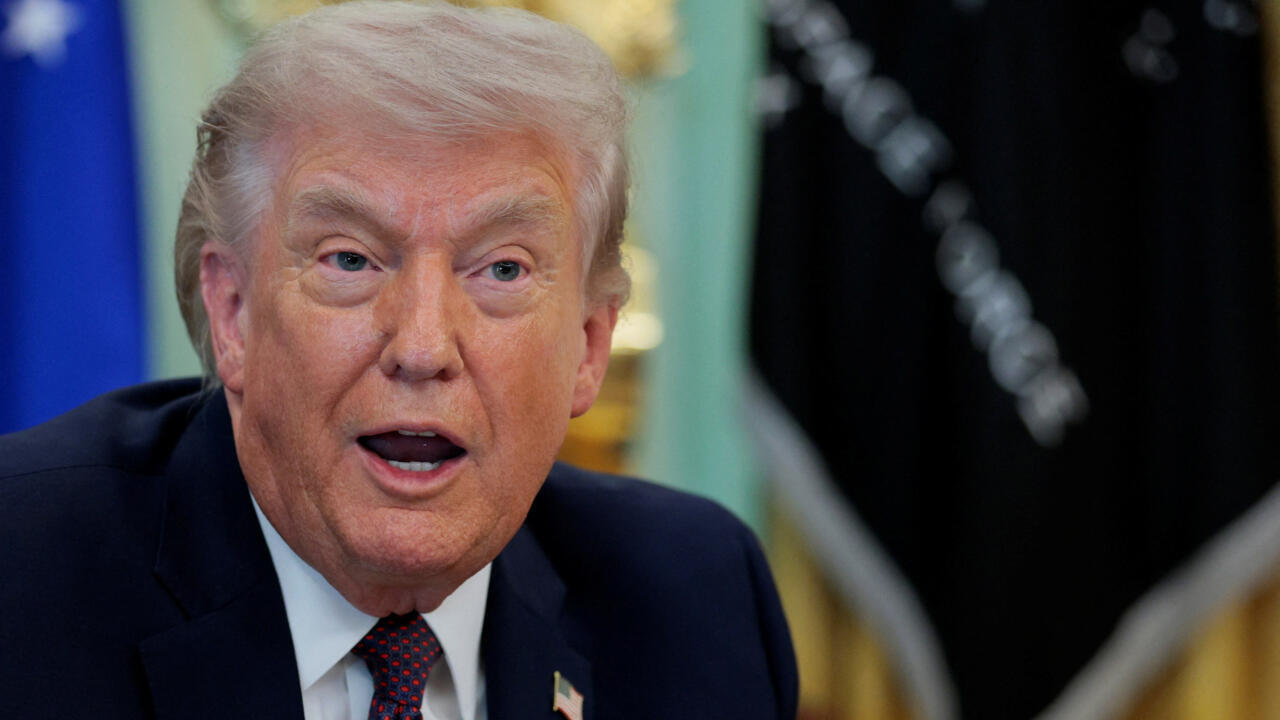
President Donald Trump was set to address the nation Wednesday night and offer an update on the war in Iran, his first prime-time speech since launching strikes alongside Israel more than a month ago.
The speech will offer Trump a wide audience to articulate clear objectives for the war that could attempt to reconcile weeks of changing goals and often contradictory messages about whether he’s winding down or ready to escalate military operations – even as Iran kept up its attacks on Israel and Persian Gulf neighbours and airstrikes pounded Tehran.
It comes amid rising oil prices, volatile financial markets and polling showing many Americans feel the US military has gone too far in Iran – even as more American troops move into the region for a possible ground offensive. Trump opted not to deliver such an address closer to when the US and Israel first launched attacks, and questions now remain about whether it is now too late for what he says to break through.
A White House official, who was not authorised to speak publicly ahead of the address and spoke on condition of anonymity, said the president will talk about US progress on achieving his goals in Iran and will reiterate his estimated timeline for concluding operations within two to three weeks.
The president, in comments during an Easter lunch on Wednesday afternoon, said of Iran: “We could just take their oil. But you know, I’m not sure that the people in our country have the patience to do that, which is unfortunate.”
“Yeah, they want to see it end. If we stayed there, I prefer just to take the oil,” Trump said. “We could do it so easily. I would prefer that. But people in the country sort of say: ‘Just win. You’re winning so big. Just win. Come home.’ And I’m OK with that, too, because we have a lot of oil between Venezuela and our oil.”
The media was not permitted to watch the president’s remarks at the lunch, but the White House uploaded video of the speech online before taking it down. The White House did not return requests for comment from The Associated Press on the video and why it was taken down.
In a social media post earlier Wednesday, Trump maintained a belligerent tone, demanding that Iran stop blocking the Strait of Hormuz – the waterway vital to global oil supplies – or the US would bomb the Islamic Republic “back to the Stone Ages.” The president has also said the US “will not have anything to do with” ensuring the security of ships passing through Hormuz, an apparent backtrack from a previous threat to attack Iran’s power grid if it didn’t open the strait by April 6.
In the same Easter lunch, the president reiterated some of his complaints about NATO allies for their reluctance to get involved in securing the Strait of Hormuz while suggesting that China, Japan and South Korea could also step up to reopen the waterway.
“Let South Korea, you know, we only have 45,000 soldiers in harm’s way over there, right next to a nuclear force – let South Korea do it,” Trump said of efforts to reopen the strait. “Let Japan do it. They get 90% of their oil from the strait. Let China do it.”
In another morning social media post, Trump wrote that “Iran’s New Regime President” wanted a ceasefire. It wasn’t clear to whom the US president was referring since Iran still has the same president. Iran’s Foreign Ministry spokesman, Esmail Baghaei, called Trump’s claim “false and baseless,” according to a report on Iranian state television.
Speaking earlier to Al Jazeera, Iranian Foreign Minister Abbas Araghchi signalled Tehran’s willingness to keep fighting. “You cannot speak to the people of Iran in the language of threats and deadlines,” he said. “We do not set any deadline for defending ourselves.”
Hours before Trump’s address, Iranian President Masoud Pezeshkian posted a lengthy letter in English on his X account appealing to US citizens and stressing that his country had pursued negotiations before the US withdrew from that path. “Exactly which of the American people’s interests are truly being served by this war?” he wrote.
Since the war began on Feb. 28, Trump has offered shifting objectives and repeatedly has said it could be over soon while also threatening to widen the conflict. Thousands of additional US troops are currently heading to the Middle East, and speculation abounds about why.
Trump has also threatened to attack Iran’s Kharg Island oil export hub. And the US could decide to send in military forces to secure Iran’s uranium stockpile – a complex and risky operation, fraught with radiation and chemical dangers, experts and former government officials say.
Adding to the confusion is what role Israel – which has been bombing Iran alongside the US – might play in any of these scenarios.
Trump has been under growing pressure to end the war that has been pushing up the cost of gasoline, food and other goods. The price of Brent crude, the international standard, is up more than 40% since the start of the war.
The US has presented Iran with a 15-point plan aimed at bringing about a ceasefire, including a demand for the strait to be reopened and for its nuclear programme to be rolled back.
Iran insists its nuclear programme is peaceful. And in a report last week by Iranian state TV’s English-language broadcaster, an anonymous official was quoted as saying Iran had its own demands to end the fighting, including retaining sovereignty over the strait.
In the interview with Al Jazeera, Araghchi acknowledged receiving direct messages from US Mideast envoy Steve Witkoff. He insisted, however, that there were no direct negotiations and said Iran has no faith that talks with the US could yield any results, saying “the trust level is at zero.”
He warned against any US attempt to launch a ground offensive, saying “we are waiting for them.”
In a deal ostensibly to give diplomacy a chance, US officials have given “clear assurances” that Araghchi and Iran’s Parliamentary Speaker Mohammad Bagher Qalibaf won’t be targeted, according to three officials who spoke on condition of anonymity because they’re not authorised to speak publicly about the matter.
(FRANCE 24 with AP)