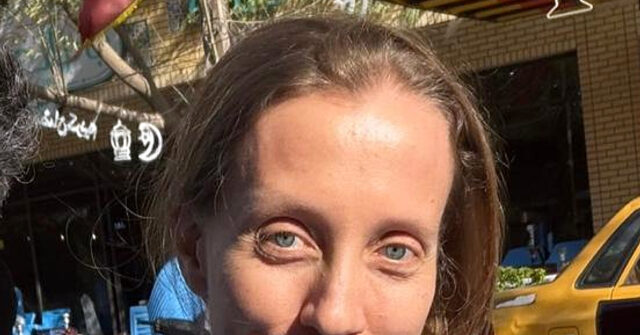
American freelance journalist Shelly Kittleson was abducted in Baghdad, Iraq, on Tuesday night. According to the U.S. State Department, a suspect detained by Iraqi authorities is linked to an Iran-backed Shiite militia called Kataib Hezbollah.
The Iraqi Interior Ministry confirmed that a foreign journalist was abducted on Tuesday, but did not officially reveal the identity of the victim. Two unnamed Iraqi security officials later told the Associated Press (AP) that the victim was a female United States citizen.
Video of the abduction was caught by security cameras and quickly spread across social media. In the video, two men accost the victim on a street corner in central Baghdad and force her into a car, apparently with some difficulty:
The Iraqi security sources who spoke to the Associated Press said the “unknown individuals” made their getaway in two vehicles, one of which crashed during hot pursuit near the town of Al-Haswa, south of Baghdad. The kidnappers and their victim transferred into another vehicle and eluded their pursuers.
Iraqi security forces were reportedly able to arrest one suspect, but the rest of the gang remains at large.
Al-Monitor, a Middle Eastern news site that has published work from Kittleson in the past, identified her as the victim and called for her “safe and immediate release.”
“We stand by her vital reporting from the region and call for her swift return to continue her important work,” Al-Monitor said.
Assistant Secretary of State for Global Public Affairs Dylan Johnson said on Tuesday that the State Department was “aware of the reported kidnapping.”
“The State Department previously fulfilled our duty to warn this individual of threats against them and we will continue to coordinate with the FBI to ensure their release as quickly as possible,” Johnson said.
“An individual with ties to the Iranian-aligned militia group Kataib Hizballah believed to be involved in the kidnapping has been taken into custody by Iraqi authorities,” he added.
Johnson repeated the State Department’s warning that Iraq is under a Level 4 Travel Advisory, and American citizens have been advised to leave immediately, “including members of the press.”
Iraqi security sources confirmed to several media outlets that the 49-year-old Kittleson, a veteran Middle East correspondent who has written about conflicts in Afghanistan, Iraq, and Syria, was the victim. She has Italian heritage and is usually based in Rome, but frequently travels to the Middle East.
Alex Plitsas, a senior fellow at the Atlantic Council in Washington, DC, and a friend of Kittleson’s, confirmed that she was warned by the FBI that Kataib Hezbollah added her name to a “kidnap or kill” list of American targets.
Plitsas said she chose to remain in Baghdad and continue reporting, designating him as her primary contact in case of emergency.
A U.S. official told CBS News on Wednesday that Kittleson was “contacted multiple times with warnings of threats against her, including a warning that KH specifically wanted to abduct female journalists.” The last official warning before her abduction was delivered on Monday night.
Coalition for Women in Journalism founder Kiran Nazish told CBS that Kittleson departed for Baghdad last Thursday, with plans to stay with a family that said it would “keep her safe.”
Kataib Hezbollah (KH) is one of the most powerful Shiite militias in Iraq, and it has close ties to Iran’s Islamic Revolutionary Guard Corps (IRGC). When an airstrike ordered by President Donald Trump eliminated IRGC Gen. Qasem Soleimani in Baghdad in January 2020, the founder of KH died alongside him.
American and Israeli warplanes have struck KH targets several times over the years since then, including strikes conducted since the beginning of Operation Epic Fury at the end of February. KH announced that its spokesperson and senior commander Abu Ali al-Askari was eliminated by an airstrike on Baghdad on March 14.
KH and other Shiite militants were essentially deputized by the Iraqi government during the war against the Islamic State into the “Popular Mobilization Forces” (PMF), an assembly of militias that is nominally loyal to the prime minister of Iraq. In truth, their first loyalty lies with Iran, and during the Gaza War they collectively became known as the “Islamic Resistance in Iraq” (IRI).