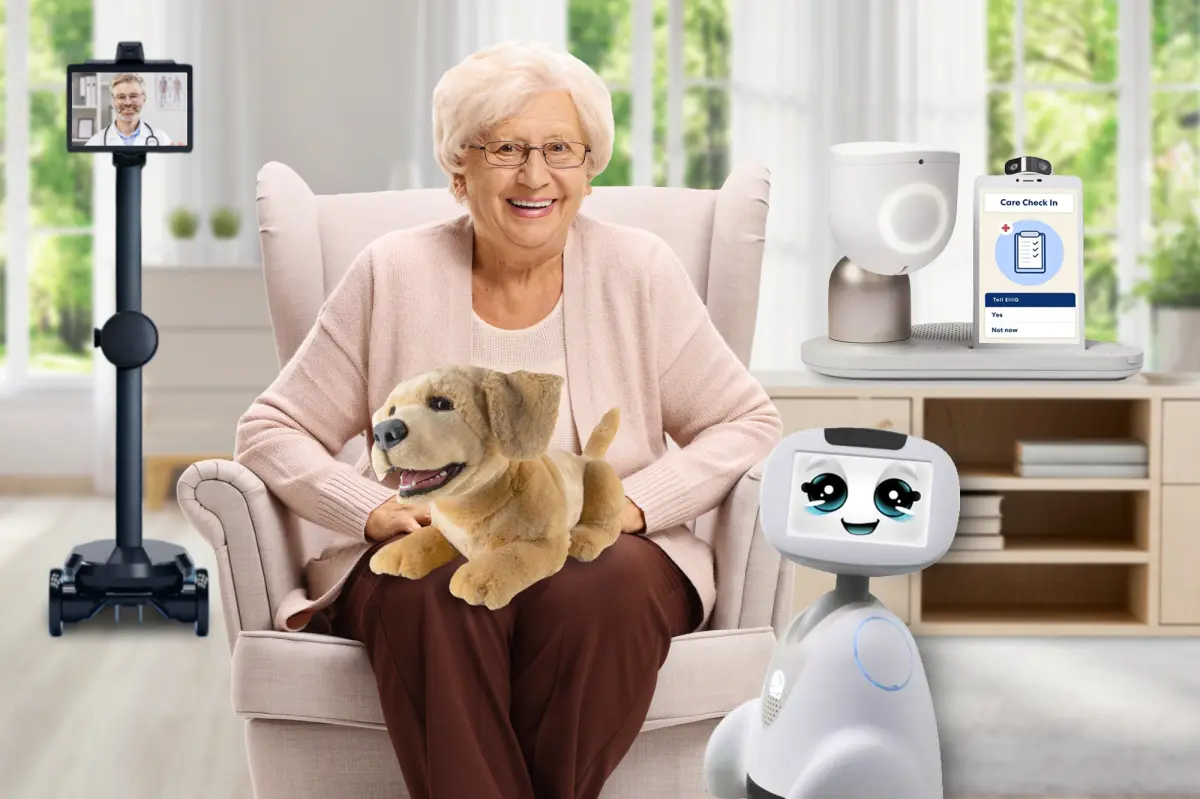
They grew up dialing rotary phones — and now they’re opening the door to robot roommates.
That’s the vision powering the booming AgeTech industry, as companies bet seniors are ready to embrace gadgets that make getting older safer, easier… and maybe even a little more fun.
And contrary to stereotype, seniors appear more than ready. A 2025 AARP survey found 46% of those 80 and up see technology as an ally in healthy aging, and nearly all of them use at least one device in their daily lives.
But we’re not just talking about your grandma’s tablet.
Research shows that seniors are increasingly adopting a range of gadgets, from health trackers and wearable devices to AI companions that keep them connected, engaged and on top of their care.
The trend was on full display earlier this year at the 2026 Consumer Electronic Show’s (CES) AgeTech Collaborative, where cutting-edge robotics promised to reimagine what modern aging and longevity can look like.
Here are five standout devices that stole the spotlight.
Meet GR‑3: The friendly humanoid
If the older adult in your life is longing for a live-in companion, Fourier’s GR-3 “Care-bot” may be a good fit.
This 5‑foot‑5, 156‑pound humanoid made its US debut at CES 2026. Billed as a “wellness assistant,” it features a friendly face, soft exterior and an emotional processing system that combines vision, audio and touch to provide comfort and connection.
GR‑3 can recognize faces, make eye contact, respond to touch with lifelike gestures like blinking or head tilts, carry on conversations and even play games like chess. It can also help with everyday tasks, such as fetching a glass of water or medication.
Beyond companionship, Fourier plans for GR‑3 to eventually support seniors with mobility, health monitoring and physical rehabilitation.
How to get it: The first wave of GR‑3 robots is mainly going to eldercare facilities, hospitals and research institutions. Private consumers can contact Fourier’s sales department for more information.
Unverified reports on third-party sites list the GR‑3 at $119,995.
Luna: Your chatty, health-conscious companion
This AI-powered device from Cairns Health is like a friendly roommate that also doubles as a personal health assistant.
It chats throughout the day, checks in on how you’re feeling, reminds you to take medications or keep appointments, and even suggests activities like brain games or light stretches.
But Luna’s real magic happens quietly in the background.
Perched on a nightstand or shelf, it swaps cameras for millimeter-wave radar technology, monitoring even subtle movements — like the rise and fall of a chest — while keeping privacy intact. It tracks heart rate, breathing and sleep, all without the hassle of having to wear or charge devices.
Luna also keeps tabs on seniors’ daily routines, from eating habits to movement patterns, and can flag any changes that may signal potential health issues, like late-night wandering.
If it detects a problem, Luna alerts caregivers instantly. It also sends weekly reports that give families a clear snapshot of their loved one’s health and activities.
How to get it: Luna is available in the US by subscription. Plans run $99 per month or $948 annually, with a $149 activation fee.
Jennie: The golden retriever you don’t have to walk
Want something a little more playful? Jennie by Tombot might steal your heart.
This lifelike golden retriever robot acts as an emotional support animal for seniors who can’t care for a real pet, like those with mobility challenges or dementia.
Fully autonomous, Jennie responds to voice, touch and movement with realistic behaviors, from tail wags to puppy sounds, and even features a detectable “heartbeat.”
“It’s a pet for people who can’t have pets,” Pat Brown, a representative from Tombot, told The Post. “They don’t make sudden moves, so they won’t startle or trip anyone, but they’re very realistic and provide stimulation and an emotional bond.”
Luna, GR‑3 and Jennie all aim to tackle one of the biggest challenges facing older adults: loneliness.
Studies show that more than a third of Americans ages 50 to 80 feel lonely, with nearly as many reporting social isolation. Over time, this can take a major toll on mental and physical health, fueling problems like anxiety, heart disease, obesity and dementia.
How to get it: Jennie is priced at $1,500, but you’ll have to wait to get your paws on her. The robotic pet sold out quickly, with preorder customers set to receive the first units later this year. You can add your name to the waitlist here.
Niko: The robot that gives seniors a lift
Other robotic devices are designed to help with mobility, rehabilitation and everyday self-care.
ReviMo’s Niko helps seniors and others with physical limitations in lifting and transferring themselves — from bed to wheelchair or even to the toilet — all without a caregiver.
The device has two sets of arms: One forms a “scooping seat” that slides under the user, while the other wraps around the torso for support. It can lift a person to standing height for tasks like reaching high shelves, with retractable handlebars for extra stability.
Controlled via remote or dashboard, Niko comes equipped with safety sensors, a rearview camera and an alarm button. The current model supports up to 250 pounds, with a 400-pound version in development.
How to get it: Niko isn’t available for purchase yet, but you can add your name to the waitlist, with delivery expected next year. The device is projected to cost around $15,000, and the team is working to make it insurance-friendly.
Co-Suit: The exoskeleton that steadies your step
For seniors who are unsteady, have muscle weakness or are recovering from mobility-limiting injuries like a stroke, Cosmo Robotics’ Co-Suit gives a helpful boost.
This lightweight wearable exoskeleton features a simple belt-and-Velcro design, providing motorized support to the hips and knees whenever it senses the user trying to stand or walk.
“When you’re walking, the robot will predict right before your foot tries to strike the ground, and at that moment, it will activate the motor, which acts like a spring, and it will reduce the impact,” explained Minhong Park, an engineer with Cosmo Robotics.
If it detects a stumble or sudden shift in balance, the device stiffens the joints instantly, acting like a supportive brace to help prevent falls. With a three-hour battery life, it’s designed to be worn in public and around the house.
The Co-Suit was just one of several wearable lower-limb exoskeletons on display at CES — part of a growing trend of devices aimed at enhancing physical function in older adults.
How to get it: The Co-Suit on display at CES was a prototype, but the official device is expected to debut later this year. Pricing has yet to be announced.