SPOILER ALERT: This post contains spoilers for “7:00 pm,” the 13th episode of “The Pitt” Season 2, now streaming on HBO Max.
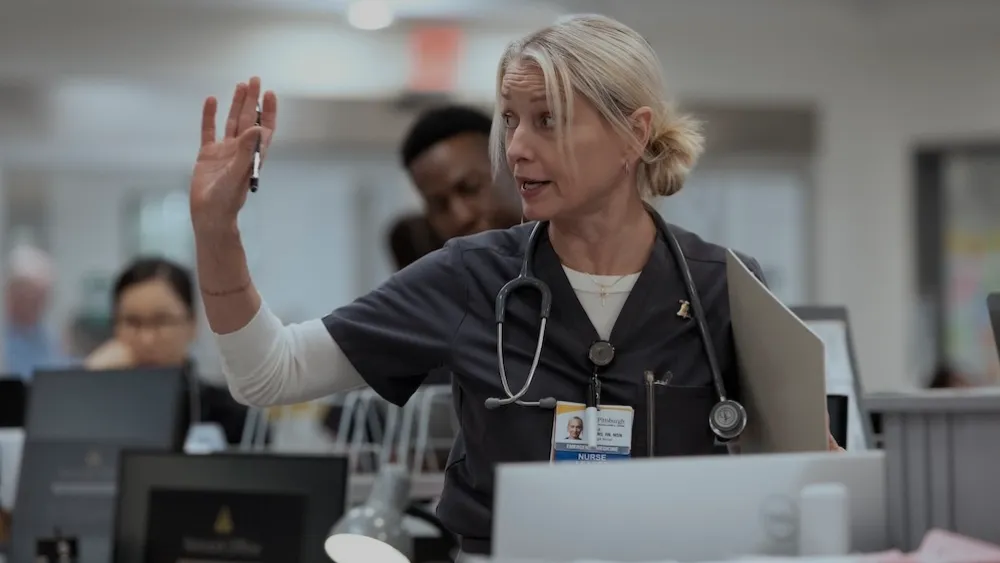
Katherine LaNasa says that her charge nurse character, Dana Evans, on “The Pitt” would never use the word “triggering,” but the Emmy winner can’t help but reach for it when trying to grapple with the end of Season 2’s 13th hour on the clock. For two episodes now, Dana has been at odds with Robby (Noah Wyle), her strongest ally in the ED and the person who typically levels her out —a service she also provides to him.
But neither is operating at their best by 7:00 p.m. on July 4th. Specifically for Dana, she’s triggered on two fronts. After her student nurse Emma (Laëtitia Hollard) was attacked by a coked-out patient, one that Dana subdued with a punch and a mysteriously handy shot of Versed, she is struggling to find any sense of calm as she bats away the PTSD of her own attack last season.
“She’s incredibly off balance,” LaNasa tells Variety. “She’s still really reeling from that punch. She didn’t take care of herself. I think it’s part of why it was really important to her that the rape victim set herself up to be able to get justice for herself, should she change her mind. Because Dana didn’t do it. Dana didn’t press charges. That’s a fine choice if you want to make that choice. But I don’t know that it’s working out well for Dana.”
Adding to her defensive behavior is Robby’s persistent inquisition about the tactics she used to handle Emma’s attacker. Every time he tries to ask about why she had a sedative in her pocket or questions what really happened, she launches into her own line of questioning about Robby’s increasingly concerning mindset around his impending motorcycle-bound sabbatical.
By the end of Episode 13, she has confronted him yet again about his inability to clearly state the true purpose of his trip and his volatile anger over the state of the ED ahead of his impending absence. She reminds him that they can survive without him until he is back, just like they did when she quit last season following her own assault.
Warrick Page/MAX
“What if I don’t come back?” he responds in the episode’s final exchange, cutting to black on a stunned Dana’s face.
“I think that if he leaves, she’s there all alone, and Dana is a person who doesn’t face her own need for help either,” LaNasa says. “But more importantly, there is just something very organically stressed out about her with him not being OK and not making a commitment to come back. It’s that kind of unwillingness to answer me or sometimes even look at me. That would be her worst nightmare, if anything happened to him. They’ve been through this for decades together. It would be like losing a spouse in a way. So I think she’s just up to here with her inability to reach him. He’s vital to her.”
This isn’t the first shouting match they have engaged in this season, or even this episode. Their last few encounters have left Dana on the brink of tears or screaming in anger at herself in the bathroom. Robby, for his part, isn’t exactly smiling after each bout either. But this final talk of the episode is their most honest and alarming.
Before he even admits he might not come back, Dana tells Robby that he’s being overly confrontational and aggressive, and he needs to go home if that’s what he wants. Her exact words are that he needs a time-out, like she used to give her kids; he responds by telling her he doesn’t need a mother. He had one of those, he says, and she walked out on him.
In that moment, Dana learns something deeply personal about her friend and colleague that she never knew, and emphatically apologizes for stepping on an emotional landmine she didn’t know was there. Robby responds, “It doesn’t matter. Who gives a fuck?”
“I like that moment, and I try to just justify it for myself,” LaNasa says. “You could just assume that people weren’t close [with family], and if they didn’t ever open up about their parents or something, you just let it be. I don’t have much of a relationship with one of my parents, and most people don’t really know that about me. It doesn’t really come up, so it makes sense why it hasn’t for them.”
But for Dana, her maternal instinct toward Robby comes from a genuine place of concern that her friend has decided to take his own life. “There’s a kind of panicky desperation that he triggers in her,” LaNasa says. “I think the whole thing feels terrifying, and I think it’s also happening at a time when she doesn’t feel OK. I had a therapist once that told my husband and I, ‘You both can’t have a problem at the same time. Who’s going to be the one who listens?’ At this point for Dana and Robby, nobody can listen. Nobody’s doing OK. Nobody is the pillar.”
Even though they spend the episode oscillating between avoiding each other and going at each other, Dana never loses sight of her bedside manner. She joins Emma to continue their season-long care for the unhoused Digby (Charles Baker), whom they have bathed and now offer to give a haircut. As they gently ease him into the idea of tidying up his appearance, they talk about his family and his daughter’s wedding. Emma’s kindness toward him leaves Dana beaming, a mentor-mentee relationship that is often reserved for Robby and his residents. After worrying about her safety all day, LaNasa says it wasn’t hard to muster pride for the young woman sitting in front of her.
“It’s easy to feel,” she says. ”I also feel really proud of Laëtitia. She just graduated from Juilliard and walked onto the set. It’s incredible.”
In that scene, Dana pulls back the curtain on her own family, which she doesn’t often talk about and audiences have never seen, given the series’ four-walls, single-day framework. She mentions that she has cut her husband Benji’s hair throughout their entire marriage; she later mentions her children to Robby in their heated exchange. While the series has never drawn audiences a full family tree for Dana, LaNasa often thinks about who she is outside her pressure-cooker job. It’s second nature to her understanding of Dana, so much so that she can launch into it at a moment’s notice.
“Dana has a middle daughter that has been tricky,” she says. “That has caused her a lot of stress. You’re only doing as well as your kids. If one of your kids is doing poorly, that’s how well you’re doing. I think that she’s got a daughter that kind of keeps her a little on edge, and she’s always hoping that one’s OK. In my imagination, she is very close to her granddaughter. She has a 23-year-old granddaughter, and that’s someone that she’s looking forward to seeing on certain nights. Those are the nights that she comes over, and they have their movie and their pizza or whatever they do. They have their little rituals.”
For Dana’s husband, LaNasa doesn’t fully buy into the little insight the show’s writers have given him so far.
“I know they said that he would fly off the handle, but I would say that I generally view him as just a big, calm hunk of a man,” she says. “I think that Dana’s home is very tidy and kind of minimal, and I don’t think that she has bad taste. She just likes things calm. I think she likes her family to come over. But I think Dana is tired. Dana is really tired. I imagine, also, that she went to the family cabin out in the woods somewhere after she got punched, and she was going to take some time off. But because she wasn’t getting any help, she just really wasn’t doing well. One of her daughters was like, ‘This isn’t working for you. You need to go get some help.’ So I think she got some help. I just don’t think she got enough help.”
All of that informs the person who stands in front of Robby at the end of episode 13, pleading for him to be honest about what he really envisions for this sabbatical. LaNasa was nervous about the writers’ choice to give the sturdy duo of Robby and Dana so many hurdles this season, but she ultimately gave in to that freefall.
“Noah was really down for us to have conflict, and I said, ‘Let’s do it,’” she says. “I trust [executive producers] John Wells and R. Scott Gemmill immensely. I didn’t want it to come across that they’re nasty to each other. I want the audience to know and for the story to be that they love each other, but that they’re human and they’re struggling.”