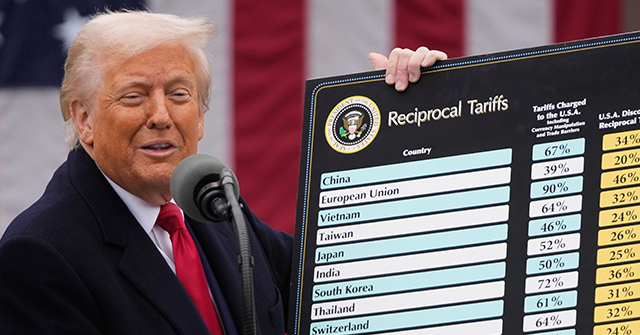
One Year After Liberation Day: The Tariffs Are Working
One year ago today, President Trump stood in the Rose Garden and declared Liberation Day. He announced sweeping reciprocal tariffs to end decades of unfair trade, bring factories and jobs back, and restore economic independence. The language was bold: factories and jobs would come “roaring back,” and we would “supercharge our industrial base.”
Early predictions were dire. Olivier Blanchard, the former chief economist of the International Monetary Fund, warned that broad tariffs combined with uncertainty would trigger a recession, with any apparent trade-balance improvement proving temporary as the dollar appreciated and undid the gains. Larry Summers, the former Treasury Secretary and ex-president of Harvard, floated massive estimates of economic damage. Many mainstream voices insisted the policy would fail on every front.
The results after one year show the tariffs are working.
These tariffs arrested the long-running upward trend in the trade deficit, forced trading partners to negotiate, generated substantial revenue, and revealed underlying strength in manufacturing. While employment headcount didn’t roar back yet, factory payrolls have stabilized. While we were never going to undo decades of damage to the American manufacturing sector in a matter of months, we’ve made more progress than even optimists had the right to expect.
The Trade War That Never Happened
The Trump administration’s strategy of announcing tariffs, pausing them, negotiating, and occasionally threatening higher rates was derided by critics as the haphazard start of a trade war. It would provoke massive retaliation, they claimed, and might even create a new trade alliance that left America isolated, with China emerging as the new leader of the global economy.
That never happened, and it should have been clear that it never was a real possibility. The central role of the U.S. in the global economy was built on our willingness to absorb the large and persistent trade imbalances created by the mercantalist economic policies of our trading “partners” and to absorb the resulting capital imbalances by maintaining a reserve currency and issuing Treasuries. The global trading order depends on the U.S. acting as the consumer of last resort. No other country is willing or able to play this role, and the governments of Europe and Asia are unwilling to reform themselves in ways that don’t depend on it.
So we never got a trade war or a new trading bloc centered on China. Instead, more than a dozen trading partners — including the UK, EU, Japan, South Korea, India, and Vietnam — moved quickly into frameworks, pauses, exemptions, and new commitments on market access and purchases. Retaliation remained limited. Even China made it clear it preferred to talk rather than engage in endless tit-for-tat tariff hikes.
Taming the Trade Deficit
Critics claimed tariffs would do nothing to reduce the trade deficit — or might even make it worse through retaliation and currency appreciation. For years, the deficit had been expanding aggressively, growing at an average annual rate of roughly 11.2 percent from 2020 to 2024, with a 16.7 percent surge in 2024 alone. The goods-only deficit widened by $157.9 billion from 2023 to 2024. They told us we could never turn this around and said the real culprit was our budget deficit.
Yet in 2025, the trajectory actually did change. The full-year goods-and-services deficit came in at $901.5 billion — essentially flat, down a tiny $2.1 billion (0.2 percent) from 2024. On a goods-only basis the deficit widened by just $25.4 billion — an 84 percent slowdown in the rate of deterioration.
Exports grew a healthy 6.2 percent ($199.8 billion increase), outpacing import growth of 4.8 percent. Monthly deficits improved sharply after the March 2025 front-loading spike of $135.9 billion, with some later months dropping to multi-year lows as low as $31.1 billion in October.
One reason critics said tariffs would backfire was that the dollar was supposed to appreciate, making U.S. exports less competitive. Instead, the dollar depreciated modestly. The best explanation is that the “haphazard” pattern of announce-pause-negotiate-threaten created uncertainty that prevented the textbook offsetting appreciation and instead reinforced the tariffs’ effect in the short term. It may not match the tidy models academics prefer, but this intuitive approach delivered results where cleaner policymaking had failed for decades.
Far from backfiring, this stabilization shows the tariffs worked even better than most proponents expected. The dangerous upward trend has been arrested.
Staunching the Bleeding in Manufacturing Payrolls
Many critics of the tariffs have pointed to manufacturing payrolls as proof the tariffs failed. Scott Horsley of National Public Radio recently noted a decline of 89,000 jobs between April 2025 and February 2026, declaring that the promised manufacturing boom had not materialized.
But that is highly misleading. As trade analyst Alan Tonelson has pointed out, while American manufacturing lost 81,000 jobs in the first 11 months of Trump’s second term, it lost 179,000 jobs in the preceding 11 months. Using the April-to-February window favored by critics, the sector shed 162,000 workers in Biden’s final year. In other words, the pace of the decline in factory payrolls has been cut roughly in half.
This criticism also ignores the massive shift in immigration policy. Since Trump began enforcing border security and deporting unauthorized workers, the labor market has transitioned from immigrant-driven abundance to supply constraint. Dallas Fed research estimates a net outflow of 548,000 unauthorized workers in 2025, and the Department of Homeland Security puts the total number who left or were removed at roughly three million. The Dallas Fed notes this has brought break-even payroll growth near zero.
Manufacturing, which relied heavily on foreign-born workers, felt this acutely. As American Compass policy director Chris Griswold recently reported in Commonplace, estimates suggest around 11 percent of the unauthorized workforce is in manufacturing. A proportional share of the three million would imply that roughly 333,000 factory workers were removed from the labor force — more than three times the reported payroll reduction.
If that math holds, it suggests that somewhere around 244,000 new workers — primarily Americans and authorized immigrants — were added to manufacturing payrolls. From the perspective of American workers, factory employment really is roaring back.
Further evidence of strong demand for factory labor comes from compensation. Average hourly earnings in manufacturing surged 4.3 percent in 2025, well above the 3.8 percent rise for the economy as a whole. Factories were forced to raise pay to hold onto and replace workers.
Job openings also tell the story. Monthly manufacturing job openings rose by over 100,000, from a low of 389,000 in April 2025 to a high of 495,000 in January 2026. In the comparable 2024 period, openings fell by 44,000.
Beyond payrolls, the supercharging is visible. After years of stagnation, manufacturing gross output rose 4.76 percent last year. Real private fixed investment in equipment surged 9.55 percent — the strongest annual gain in years. Productivity is improving, reversing the long trend of deterioration. “As compared to a decline over the prior decade and prior year, manufacturing productivity grew at an annualized rate of 1.6 percent during the three quarters after Liberation Day—this despite a decline in the fourth quarter,” American Compass explained in its Tariff Tally.
Even the softening in manufacturing structures investment and construction spending fits the picture: these figures eased after an extraordinary subsidized boom under the CHIPS Act and Inflation Reduction Act that pulled forward future projects. Levels remain extremely high by historical standards, and tariffs likely helped sustain that elevated activity as the Biden-era subsidies faded.
From Liberation Day to the Golden Age
One year after Liberation Day, with many tariffs only taking full effect mid-year amid heavy front-loading, the policy has delivered measurable results: an arrested deficit trend, real negotiation leverage, substantial revenue, and clear signs of manufacturing reorientation through output, equipment investment, employment stabilization, and wage pressure.
This is the realistic progress that comes from enforcing reciprocity after decades of one-sided trade. The foundation is being laid. American industry is undergoing a revival. The tariffs haven’t yet created a golden age, but they have moved along the path to that promised land.