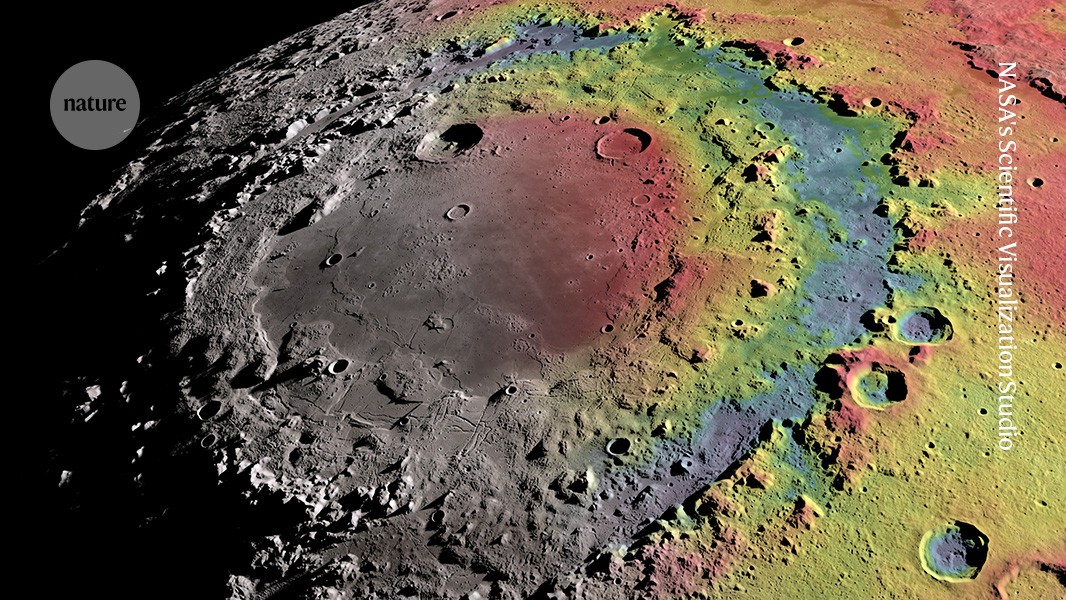
This Monday, 6 April, if all goes to plan, the astronauts aboard NASA’s Artemis II mission will fly around the far side of the Moon. It will be the first time humans have visited our celestial neighbour since 1972.
Lift off! Artemis II mission sends humans to the Moon — opening a new era of exploration
At mission control at NASA’s Johnson Space Center (JSC) in Houston, all eyes will be on the Moon during the six-hour fly-by, set to begin during the afternoon in Texas. Lunar scientists, in particular, are eager to learn what the astronauts see. The far side of the Moon is markedly different than its near side, which faces Earth; the far side has hardly any of the vast lava flows that mark the near side, but it has a thicker crust and many more impact craters.
On the basis of the Orion spacecraft’s current trajectory, Artemis II scientists in Houston have been updating predictions for what the astronauts will observe during the fly-by (see their latest visualization here). Orion launched into space from Florida on 1 April, and after orbiting Earth to check out the spacecraft’s systems, the astronauts onboard ignited its engines and set course for the Moon the next day.
The Moon and Sun are in a geometry such that only 20% of the lunar far side will be illuminated by sunlight when the astronauts fly by it, according to NASA. That’s a bit of a disappointment because many parts of the lunar far side have never been seen in sunlight by human eyes before, and scientists were hoping for a wider swathe to be visible.
Still, mission scientists are excited for the astronauts to see geological features on the part of the far side that will be illuminated. They gave Nature a sneak peek at these.
Craters galore
Top of many researchers’ lists is the Orientale basin — a 930-kilometre-wide, multi-ringed impact basin in the Moon’s southern hemisphere. It is the largest and the youngest of the many impact craters that formed during a prolonged asteroid blizzard that hit the Moon, known as the Late Heavy Bombardment, beginning around 4 billion years ago. Orientale’s three concentric rings likely formed when a massive asteroid smashed into the Moon, vapourizing material that sloshed outward like a tidal wave and triggered the Moon’s crust to collapse around the point of impact.
Orientale “holds a lot of importance in understanding impact cratering across the Solar System”, says Kelsey Young, Artemis II’s chief lunar scientist. Because it is so large and so detailed, scientists use it as an archetype for understanding how impact basins form on other planets. The basin, which has been imaged previously by robotic probes circling the Moon, lies on the boundary between the lunar near and far sides. So when the Moon wiggles a little bit in its orbit, astronomers on Earth can catch a glimpse of the basin’s edge. But the full glory of Orientale has not really been seen by humans — until, perhaps, now.

Artemis II astronauts Jeremy Hansen (with camera) and Reid Wiseman practice photographing the Moon at Johnson Space Center in Houston, Texas.Credit: NASA/Kelsey Young
“It’s just enormous, super complex, and you could stare at it probably for hours,” says Artemis II astronaut Jeremy Hansen.
Other craters that will be illuminated during the fly-by, and which have not been observed by eye in sunlight before, include the 64-kilometre-wide Ohm crater, which has a central peak poking above lava flows on its floor (and is named after German physicist Georg Ohm, of Ohm’s law fame). The astronauts will also study the 9-kilometre-wide Pierazzo crater, named after Italian-American planetary scientist Elisabetta Pierazzo, who was an expert in impact cratering and died in 2011, at age 47.
The astronauts will look for subtle changes in colour and brightness across the lunar surface, as well as at how the changing sunlight angle affects their views and perceptions of lunar topography. Such dynamic observations can add layers of human perception and insight to the detailed photographs of the lunar surface taken by Moon-orbiting spacecraft, mission scientists say.