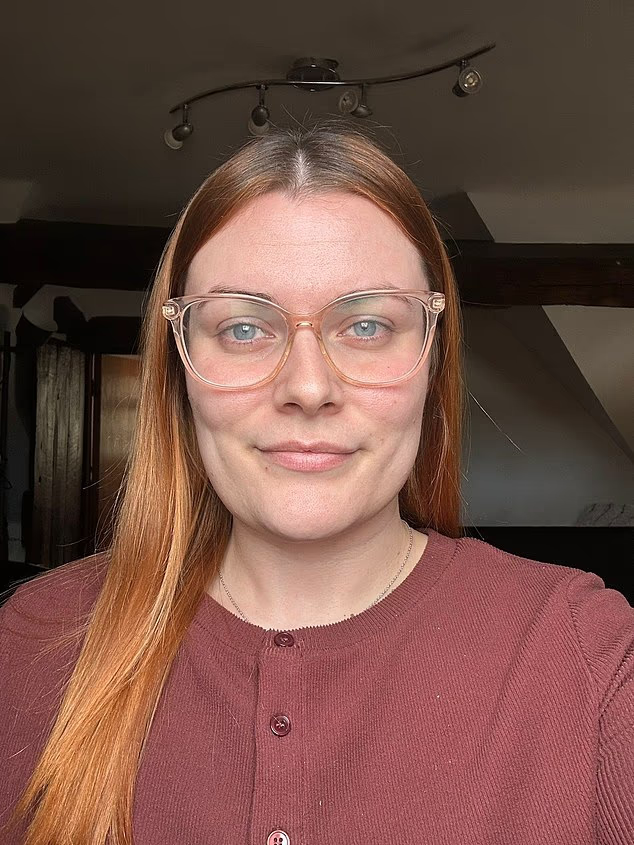
Struggling with a hormonal disorder that affects millions of women across Britain, 27-year-old Georgia from Birmingham faced a constant battle against unwanted facial hair – even having to shave twice a day.
Every morning, before work, she would run a razor across her chin, cheeks and upper lip.
But by evening the black hairs were already growing back, and she would have to shave again.
‘It made me painfully self-conscious,’ she said. ‘I was even too embarrassed to let my boyfriend touch my face.’
Daily shaving also gave her a painful rash on her neck and chin.
The medical term is hirsutism, where women grow thick, dark hair in a pattern more normally seen in men – on the face, neck, chest, stomach, lower back, buttocks or thighs.
Like the majority of women with the problem, Georgia’s excess hair was a symptom of polycystic ovary syndrome (PCOS), a hormone imbalance that can cause weight gain, irregular periods and fertility problems.
Experts believe the impact of hirsutism is often overlooked. Although excess hair is not itself harmful, it can be devastating for a woman’s self-esteem.
Georgia, 27, who is from Birmingham, suffers from polycystic ovary syndrome (PCOS)
Here, doctors have spelled out for The Mail on Sunday the pros and cons of a range of treatments.
Georgia, an operations manager at an insurance broker, chose laser hair removal – which she described as ‘the best thing I’ve ever done’.
Laser light is used to damage hair follicles and inhibit growth. After eight monthly sessions starting in October 2024 at the Victoria House Clinic, she now has top-ups every couple of months. So far, it has cost her about £1,000.
She said: ‘It’s expensive but had immediate results. After the first session, the hair stopped growing as quickly – I only needed to shave once a day. As treatment continued, the hairs became fainter and lighter: I shaved once every three days, then once a week.’
Laser treatment hasn’t improved her other PCOS symptoms, which can be ‘really painful’, but it has given Georgia a huge boost. ‘I feel so much more confident,’ she said.
Hirsutism affects around five to 10 per cent of women in the UK and is driven by increased activity of so-called male hormones, or androgens, including testosterone and dihydrotestosterone (DHT).
In men, these hormones regulate sexual development and hair growth. In women – who normally produce them in lower amounts – they play a role in ovarian function.
But when levels are raised, or the body becomes more sensitive to them, women can develop coarse, dark hair in a male pattern. In some cases, androgen excess is also linked to thinning hair on the scalp.
Consultant gynaecologist Dr Bassel Wattar, associate professor of reproductive medicine at Anglia Ruskin University, said: ‘Hirsutism can cause significant mental health impacts. For a woman, a thick beard can be profoundly disfiguring and cause social anxiety, depression and rejection issues.
‘Some of my patients isolate themselves completely because they don’t want to go outside with thick hair on their chin.’
The most common cause of hirsutism is PCOS, where faulty signalling between the brain and the ovaries produces a hormonal imbalance.
Dr Wattar said: ‘In women, testosterone is usually produced in small quantities in the adrenal glands. But with PCOS, the ovaries secrete additional testosterone, producing male-pattern hair growth.’
Hirsutism is also caused by conditions such as congenital adrenal hyperplasia, where the adrenal glands overproduce testosterone, or by a reaction to drugs such as epilepsy medicines or steroids.
Rarely, it is caused by tumours in the ovaries or adrenal glands secreting androgens. In some cases, hirsutism can be tackled by treating the underlying cause. But in cases linked to PCOS – an incurable, chronic condition – women must rely on options for tackling excess hair.


Georgia’s hair growth, a symptom of PCOS, and her face after laser hair removal treatment

Georgia would shave every morning, but by evening the hair would have grown back and she would have to shave again. Picture posed by model.
Shaving can irritate the skin and leave dark stubble. Waxing and plucking are more effective, pulling hair out from the root.
But Dr Gorav Wali, consultant dermatologist at Oxford University Hospitals, said: ‘It’s time-consuming and can be sore. Done frequently, it can irritate skin. Over-plucking can also cause acne and scarring.’
Over-the-counter bleaching creams make dark hair less noticeable while depilatory creams chemically dissolve the hair at the root – but both can irritate.
In terms of medical treatments, pre-menopausal women may be offered the combined contraceptive pill on the NHS to re-balance hormones, off-setting androgens and reducing hair growth.
Women may also be offered anti-androgen drugs on the NHS.
Dr Wali said: ‘The most common is spironolactone, which lowers the impact of androgens to reduce and slow hair-growth. It won’t entirely remove it, but can produce significant improvement.’
Many women use eflornithine, a prescription-only drug not usually available on the NHS. A 60g tube, enough for three months, costs around £60. Applied twice daily, it acts as an enzyme inhibitor in the hair follicles – slowing hair growth. Dr Wali said this needs to be used long-term and ‘doesn’t completely eliminate’ hair growth.
Electrolysis, which is rarely funded by the NHS so must be paid for at a private clinic or beautician – costing around £50 for a half-hour session. Tiny needles pass an electric current through follicles, destroying hair and stopping regrowth.
Dr Wali said: ‘Aside from the cost, electrolysis is time-intensive and can be quite sore. However it can last for months – even years – and is effective for all hair and skin types.’
Meanwhile, laser treatment is more effective for people with dark hair and light skin.
Dr Wali added: ‘Controlling excess hair growth may require a combination. For long-term improvement for someone with hirsutism with PCOS, the best option may be to use, say, a topical cream, plus spironolactone as well as electrolysis or laser.’