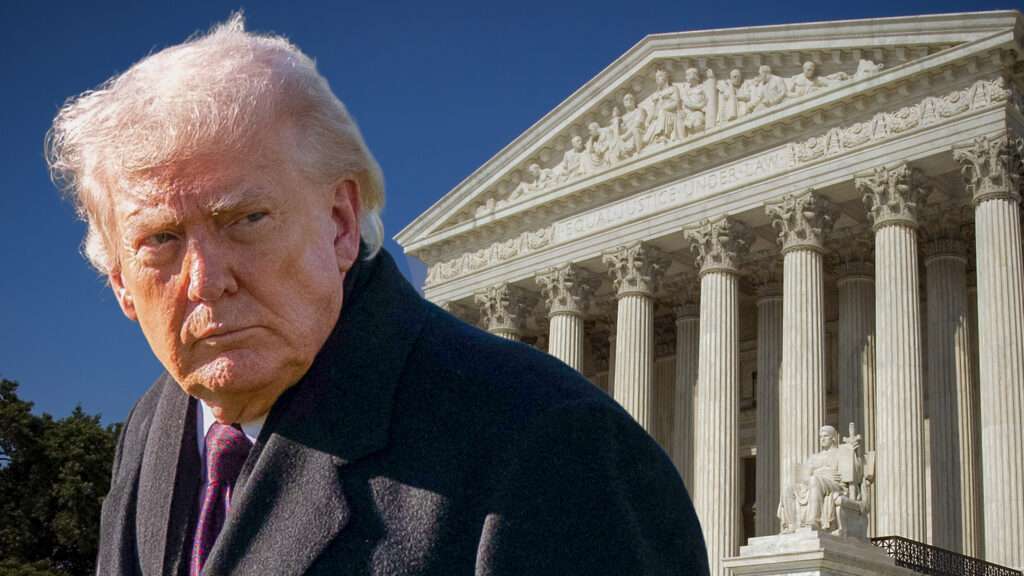
You may have heard that the U.S. Supreme Court killed off the practice of nationwide injunctions, the practice where a federal judge stops a federal policy from going into effect everywhere in the country while a single lawsuit challenging that policy plays out in court.
As a result, you may think that President Donald Trump is now free to implement his national agenda of immigration crackdowns without facing any more interference from pesky lower court judges, who have enjoined such presidential policies in the past.
That was certainly how the White House characterized the Supreme Court’s June 2025 decision in Trump v. CASA, which lifted several nationwide injunctions against Trump’s executive order purporting to abolish the constitutional guarantee of birthright citizenship for millions of U.S.-born children.
“Today’s decision restores the proper separation of powers between the branches of government,” declared White House Counsel David Warrington. “Ending nationwide injunctions is a tremendous victory for the American people and the rule of law.”
But Warrington’s statement did not exactly match the facts. It would have been more accurate to say that the Supreme Court limited the use of nationwide injunctions. And Warrington might have added that the Supreme Court left the courthouse doors wide open for federal judges to block the president’s actions nationwide through other comparable legal mechanisms, such as national class-action lawsuits.
Here’s how you know that Warrington missed the mark. Trump’s executive order on birthright citizenship was reblocked from going into effect nationwide by a federal trial judge barely two weeks after the CASA decision came down, and it has remained so blocked ever since.
If nationwide injunctions are truly dead, then they or their likeness have an uncanny habit of climbing out of the grave daily to haunt the president.
Serial abusers of presidential power have typically raised the loudest complaints against the use of nationwide injunctions. Take Trump’s predecessor, President Joe Biden.
Before the Trump administration asked the Supreme Court to abolish nationwide injunctions in CASA, the Biden administration asked the Supreme Court to abolish nationwide injunctions in a case called Garland v. Texas Top Cop Shop (2025), which involved a legal challenge to the federal Corporate Transparency Act. “A court of equity may grant relief only to the parties before it,” argued Biden’s solicitor general, Elizabeth Prelogar. “The district court violated that principle by issuing a universal injunction purporting to enjoin the Act itself and forbidding the enforcement of the Act even against non-parties.”
Perhaps the administration was still sore after its resounding 2023 loss in Biden v. Nebraska, in which the Supreme Court struck down Biden’s plan to unilaterally cancel billions of dollars in federal student loan debt via executive action. That case, as you may recall, took off only because the U.S. Court of Appeals for the 8th Circuit issued a nationwide preliminary injunction against the president’s plan.
As an authority for the debt cancellation, Biden had invoked the Higher Education Relief Opportunities for Students (HEROES) Act of 2003. According to President George W. Bush, who signed the HEROES Act into law, it “permits the Secretary of Education to waive or modify Federal student financial assistance program requirements to help students and their families or academic institutions affected by a war, other military operation, or national emergency.” In other words, Biden argued that a law specifically designed to ease the student debt troubles of service members fighting the war on terror should also be read to allow him to pursue a separate and more far-reaching domestic policy of his own devising.
The Supreme Court rejected Biden’s dubious theory of expansive executive action. “This is a case about one branch of government arrogating to itself power belonging to another,” the majority observed. “It is the Executive seizing the power of the Legislature.”
No president likes to lose in court. But the sorest losers may be those presidents who think they ought to possess the unilateral power to set national policy as they alone see fit. Perhaps that is why both Biden and Trump went gunning after nationwide injunctions. Overreaching executives tend to chafe when judges get in the way of their power grabs.
Which brings us back to Trump and his executive order on birthright citizenship. Although the Supreme Court’s CASA decision did tell the lower courts to dial back the use of nationwide injunctions, the Court also stated that other avenues of nationwide relief would still remain fully available.
For example, “in the wake of the Court’s decision,” Justice Brett Kavanaugh observed in concurrence, “plaintiffs who challenge the legality of a new federal statute or executive action and request preliminary injunctive relief may sometimes seek to proceed by class action…and ask a court to award preliminary classwide relief that may, for example, be statewide, regionwide, or even nationwide.” And that national class-action approach, Kavanaugh added, was just fine under CASA. “Today’s decision,” he wrote, simply “will require district courts to follow proper legal procedures when awarding such relief.”
Two weeks later, Judge Joseph Laplante of the U.S. District Court for the District of New Hampshire, an appointee of George W. Bush, took CASA at its word when he blocked Trump from enforcing the birthright citizenship order against “all current and future persons who are born on or after February 20, 2025,” and whose parents are either unlawfully present in the U.S. or whose parents are temporary visitors to the U.S.
“Because enforcement of the Executive Order would likely constitute unlawful behavior towards the entire class” of such persons, Laplante held in “Barbara” v. Trump, “and because a single injunction and declaratory judgment would provide complete relief to every member of the class, the class fits comfortably” within the federal rules governing national class-action lawsuits.
There are important technical distinctions between a nationwide injunction and a national class-action. But there are also important similarities. The most important is that, in both instances, a federal policy may be blocked from going into effect nationwide while a single lawsuit against that policy plays out in court. Either way, in other words, Trump still faces a judicial ruling that bars him from carrying out his executive order anywhere in the United States.
After repeatedly losing in the lower courts, the Trump administration finally asked the Supreme Court in September to rule on the merits of Trump’s birthright citizenship order. After sitting on the petition for nearly three months, the Court agreed in December to hear the case, which will be argued on April 1.
What will happen when the Supreme Court weighs the case, at last? It’s possible that Trump will win and the justices will use the opportunity to restrict the use of national class-action lawsuits against presidential orders just as they limited the use of nationwide injunctions. That would be a big win for every power-hungry president going forward.
But the Supreme Court might also rule against Trump’s order on the correct grounds that it violates the text, history, and original meaning of the Birthright Citizenship Clause. In so doing, the Court would not only strike a blow against Trump’s unconstitutional stance. It would solidify the national class-action lawsuit as a handy tool to use against presidential overreach.
This article originally appeared in print under the headline “Nationwide Injunctions Are Not Dead Yet.”