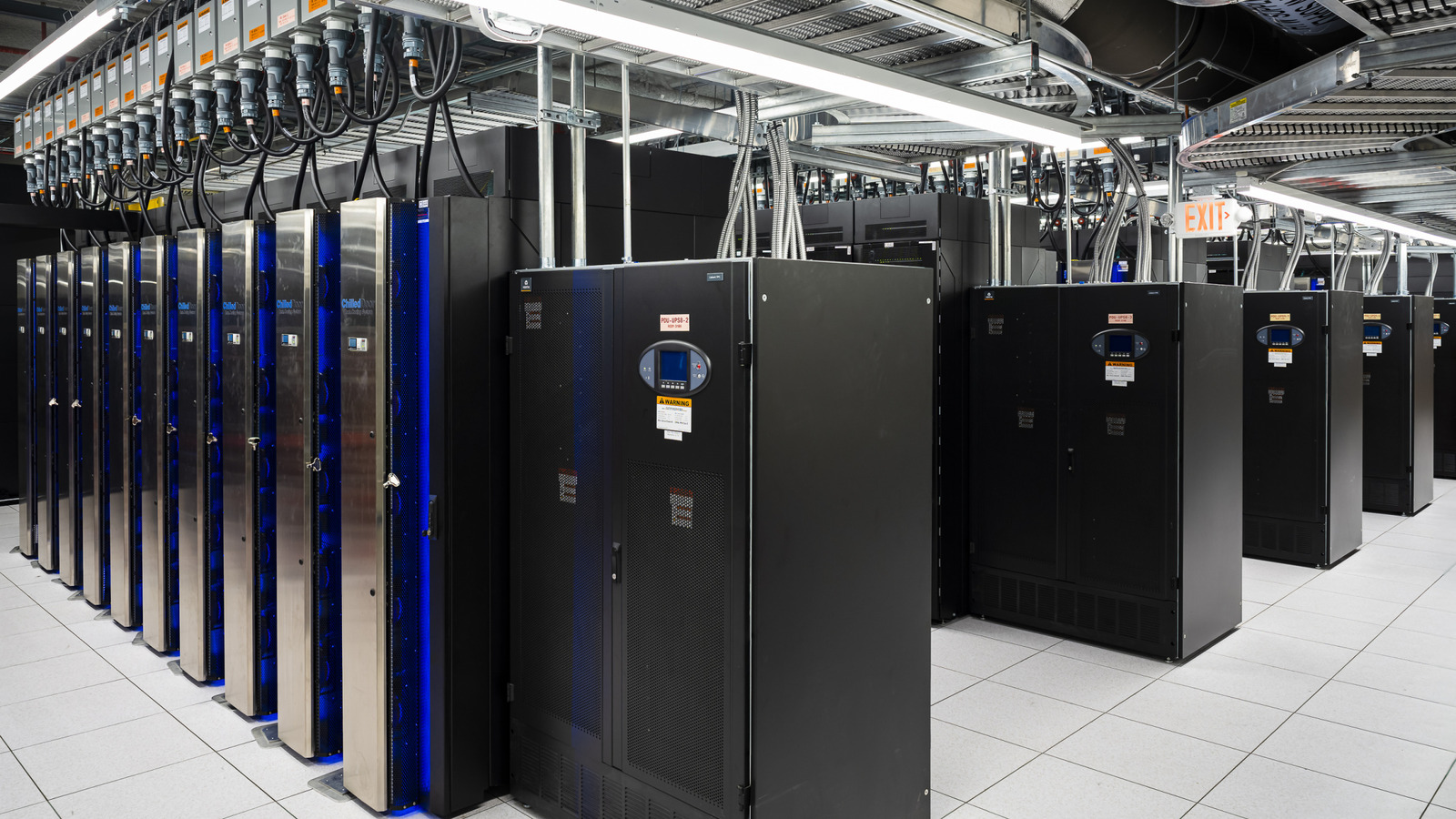
There’s no one answer to how many types of supercomputers there are. You can split supercomputers into different sets by architecture, processors, performance, use, or all four, which will get you a really big number. There isn’t even an official definition of what a supercomputer actually is. Generally, the term refers to machines at the cutting edge of computing power, but what counts as cutting edge is constantly changing.
In practice, the most widely accepted standard comes from the TOP500 project, which stress-tests the world’s fastest computers by measuring how fast they can solve a very large math problem. Performance is measured in FLOPS (Floating-point Operations Per Second), or, rather, petaflops, which is a quadrillion flops. As of November 2025, El Capitan at Lawrence Livermore National Laboratory is in first place, delivering over 1,800 petaflops. The 500th-ranked system operates at 2.57 petaflops. As time goes on, numbers at both ends of the leaderboard are going to get bigger.
The easiest way to define a type of supercomputer is by its architecture. There are vector and parallel systems, and parallel systems have several subtypes. We’ll cover these in more detail, but it’s also worth mentioning processing tech. CPU-based systems use traditional processors — like the CPU in your home computer, but scaled up — and GPU-accelerated systems use graphics processors, and many of them use both. You can also subdivide supercomputers by performance. Most Top500 entries’ performance is measured in petaflops, but some supercomputers – such as El Capitan – achieve performance in exaflops, which is a quintillion flops, or 1,000 petaflops. Looking ahead, quantum computers may redefine supercomputing entirely, requiring new ways to measure performance beyond FLOPS.
Types of supercomputer architecture
When it comes to defining different types of supercomputers, architecture is the clearest way to draw a distinction between two types. Early supercomputers of the 1970s and 1980s were built around vector processing. These machines were designed to perform a single instruction on entire arrays of data at once, making them exceptionally fast for things like physics simulations and engineering calculations. However, vector systems were highly specialized, expensive, and difficult to adapt to a wide range of problems.
Today, almost all supercomputers rely on parallel processing – they use a vast number of smaller processors working simultaneously on different parts of a task. Within this category, there are two important subtypes: Massively parallel processing (MPP) systems and cluster supercomputers. MPP systems are tightly integrated machines in which each processor has its own memory and communicates with other processors through a high-speed interconnect.
These systems are designed for extremely large-scale, complex simulations, such as climate modelling or nuclear simulations. Cluster supercomputers take a more flexible approach, connecting many individual computers, or nodes, often built from standard hardware, and coordinating them through software. This means clusters are often more cost-effective and scalable than MPP.
There’s also distributed supercomputing, where many separate computers work together over the internet. It’s suited for so-called embarrassingly parallel tasks — those that can be easily split into small pieces. For example, the Folding@Home project means anyone’s home computer can run protein simulations. Whether distributed systems should be considered true supercomputers is up for debate, though. Although they can achieve performance comparable to traditional supercomputers, there’s no one big, powerful computer behind it all.
What are supercomputers used for?
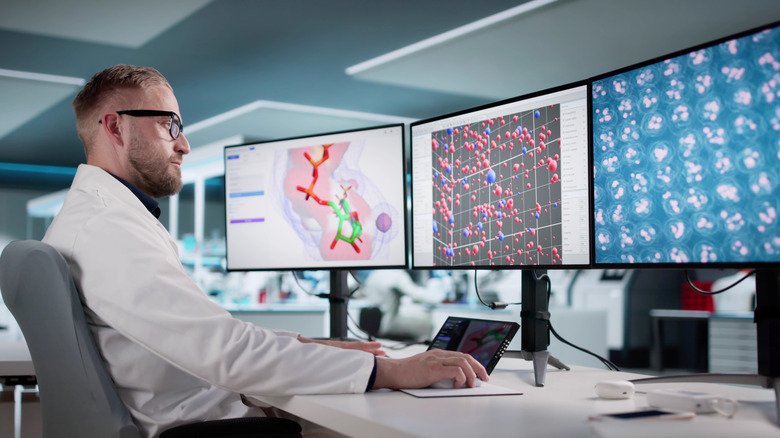
Having categorized supercomputers into different types, you might think that we could then easily explain what each type is used for, but it’s not as simple as that. Supercomputers are mostly general-purpose tools, although their architectures create natural strengths and weaknesses. There are still some limitations to what supercomputers can do, and many models combine different kinds of architecture for maximum results.
Supercomputers are ultimately defined by what they can do. That is, solving problems that are too large, complex, or time-sensitive for ordinary computers. One of their most important uses is weather and climate modelling. Supercomputers process vast amounts of atmospheric data to predict weather patterns and simulate long-term climate change, and they’re also central to scientific research. In physics, supercomputers simulate particle interactions and cosmological phenomena. In biology and chemistry, they model molecular structures and reactions, helping researchers understand diseases and develop new drugs. The ability to run detailed simulations saves both time and resources compared to physical experiments.
In recent years, supercomputers have become increasingly important for artificial intelligence and machine learning. Training large AI models requires enormous computational power, particularly when working with massive datasets. GPU-accelerated supercomputers are especially well-suited to this kind of workload. Supercomputers also play a key role in aviation engineering. The Frontier supercomputer, now placed in second place in the Top500 list after El Capitan, discovered an invisible flaw in all jet engines. Supercomputers are also used by governments for defence-related research and cybersecurity.