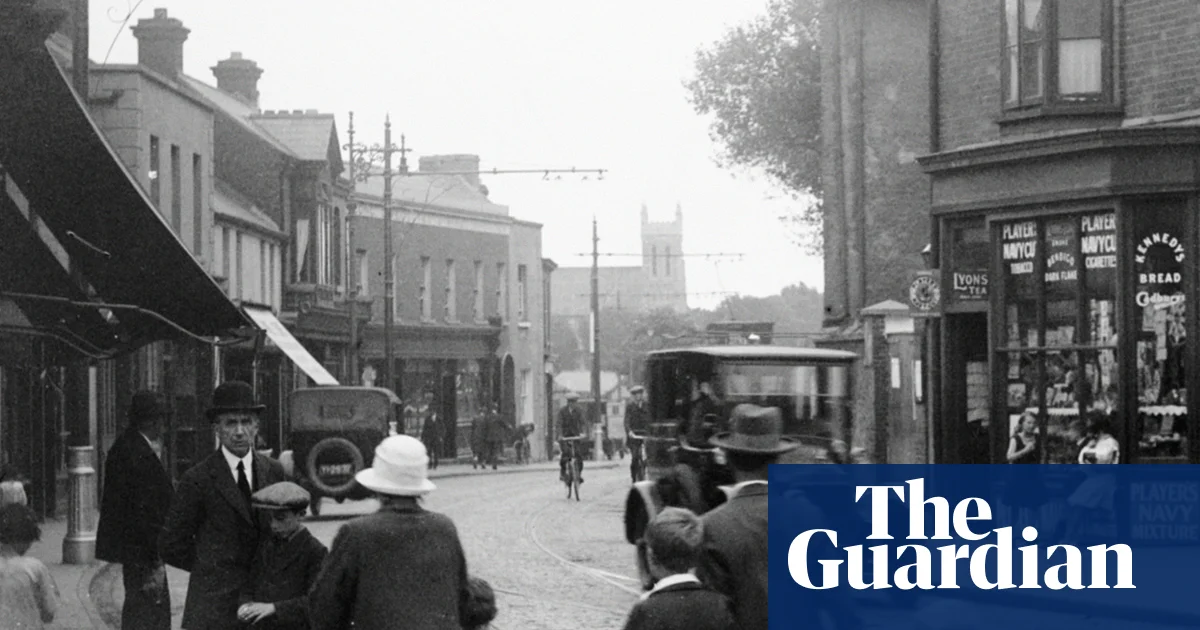
The first years of independent Ireland tend to be remembered, if at all, as a dreary monochrome of parochialism and conservatism.
After the blazing dramas of the 1916 rebellion and the 1919-1921 Anglo-Irish war, the infant state seemed to limp into a grey period of insularity, the dream of freedom giving way to anti-climax and drab conformity.
That perception is about to be shaken up with the release of the 1926 census in a landmark initiative that will make the personal details of almost the entire population from that era freely available exactly a century later.
The National Archives of Ireland has digitised the census returns, a vast dataset of more than 700,000 pages that give an intimate snapshot of the nation, and will post them online on 18 April, creating a research trove about the lives, occupations and, in some cases, secrets of 2.9 million people.
The findings will challenge perceptions that the new state – which had wrested independence from Britain but was not yet a republic – was a mono-ethnic backwater, said John Gibney, a Royal Irish Academy historian who worked on the project.
“Immigrants could be found in every corner of the Irish Free State at that time. It bucks the image we have of this dour, conservative society. It had conservative elements, but the 1920s were quite a globalised world. People engaged with popular culture, they travelled around, and the currents of that culture would have made their way to Ireland.”
The number of foreigners was small, but the census showed this smattering of British, American, French, Italian, German, Egyptian and other nationalities popping up around Ireland, said Gibney.
“You can almost see it at a ground level, a kind of cosmopolitan inflection. There’s far more variety than might sometimes be assumed. There was probably no town or village that didn’t have someone with a different accent to everyone else that was living there. It adds a strain of complexity to how we look at the past.”
Poverty and unemployment drove many natives to emigrate, yet the embryonic state offered opportunities to Germans, who flocked to Limerick to work for Siemens on a hydroelectric scheme, and to others such as an India-born Hindu law student who stayed at a Dublin boarding house, said Orlaith McBride, the director of the National Archives. “You get such a mix of people. It’s fascinating.”
Census returns provided by hotels showed that foreigners were holidaying in Ireland despite, or perhaps because of, its position on the periphery of Europe. “We also get a sense of who worked in the hotels – whole towns were taken up with the hotel,” said McBride.
Under the so-called 100-year rule, the census must by law be made public this month. With €5m (£4.3m) in government funding, a 50-strong National Archives team extracted the records from 1,344 boxes, restored damaged pages with paste and Japanese rice paper and catalogued and digitised the trove to make it freely searchable by scholars and the general public. Unlike the UK’s 1921 census, which was made public in 2021, there is no paywall.
“It has been quite a phenomenal undertaking,” said McBride. “It’s very, very labour-intensive.” Each census entry contains 21 topics, including age, sex, marital status, occupation, religion, housing conditions and ability to speak Irish.
In addition to households and hotels, forms were completed in prisons, hospitals, ships and other places where people resided on 18 April 1926. The 2,000 gardaí – police officers – who distributed and collected the census returns used their local knowledge to add information.
In one case, they noted that the purported daughter of an elderly woman was in fact her granddaughter, a fiction to shield the likelihood that the real mother was unmarried. In another case, a garda noted that a widowed farmer had married his housekeeper, a detail the couple omitted from the census form. “The census is going to reveal things to people about their families that they may or may not have known,” said Gibney.
Scholars hope the census will help to answer one of the era’s great enigmas: why did the Protestant population dramatically drop? From 1911 to 1926, the non-Catholic population in Ireland’s 26 counties – Northern Ireland was not part of the census – fell by 32%.
First world war casualties, the influenza pandemic and the British garrison’s withdrawal explain some but not all of the decline, leaving historians to debate if Protestants left because they felt unwelcome or menaced in an overwhelmingly Catholic state. Tracking people’s movements and occupations should shed light on the puzzle, said Gibson. “The census returns would hopefully provide some kind of answers.”
Exhibitions, documentaries, theatre productions and a book, The Story of Us: Independent Ireland and the 1926 Census, will mark the release of the records. Authorities have issued an appeal for “centenarian ambassadors” among the estimated 1,200 people who are aged 100. “They have a fascinating story to tell,” said McBride. “Their lives mirror the first 100 years of the evolution of modern Ireland.”