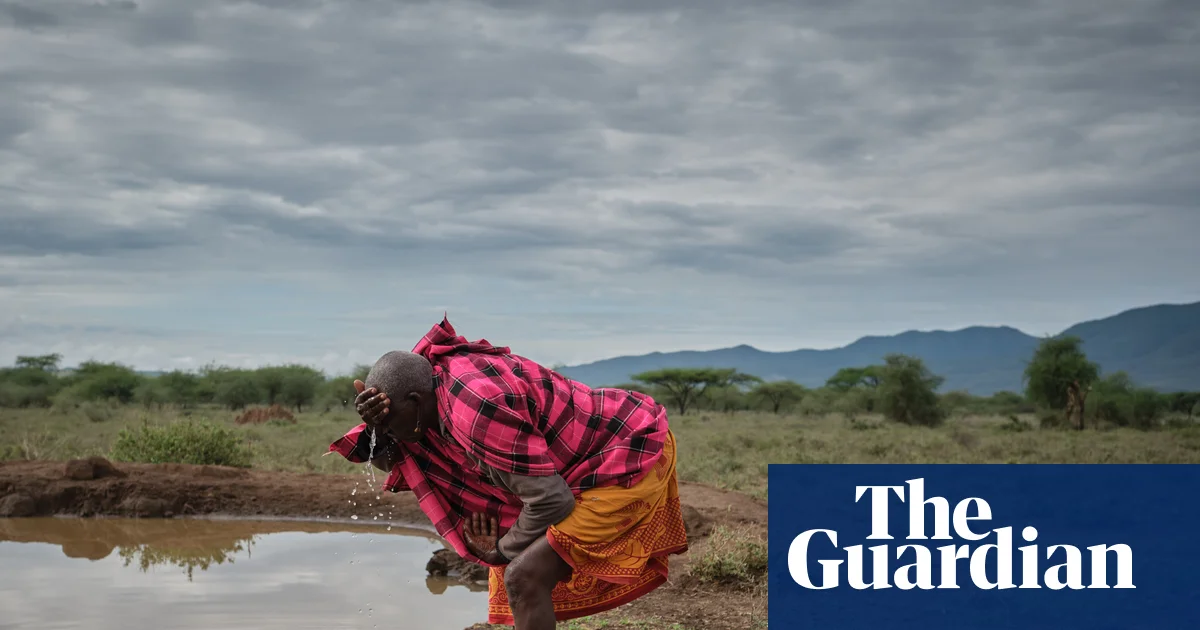
The day is hot and dry but the soil underfoot is soft. “After four months of drought, we received the first rains yesterday,” says Maasai elder Abraham Kampalei. “All we can do now is pray that they continue.”
Kampalei has lived for more than 50 of his 70 years with his family and animals in Oldonyonyokie, a hamlet in southern Kenya’s Kajiado county. He has witnessed the slow decline of the pastures. “I came here because of the abundance of grass for my livestock to graze. Today, there is almost nothing left of it,” he says.
In Kenya, drought is nothing new. Every year, communities in the country’s northern and north-eastern arid and semi-arid lands struggle with dwindling rains, leading to livestock deaths. The knock-on effects are life-changing – children drop out of schools as the money for education is diverted to feeding the family, while that poverty can also trigger displacement and early marriages.
With extreme climate patterns such as La Niña and El Niño intensifying, the net of drought is widening. Kajiado, historically far less drought-prone than Kenya’s north, is now reporting livestock deaths, pasture depletion and water scarcity in what appears to be an expansion of climate stress.
Kenya’s National Drought Management Authority reports 10 counties are experiencing drought conditions, including Kajiado, which is in the “alert” phase.
“This region has experienced drought before, but the severity is now greater due to the combination of drought and extreme heat, two factors rarely considered together, yet whose impacts are compounding as temperatures rise,” says Kenyan meteorologist Joyce Kimutai.
The climate scientist says that the drier-than-normal and warmer-than-average conditions are being driven by La Niña, compounded by human influence. “Heat levels are increasingly exceeding human tolerance due to anthropogenic factors, including greenhouse gas emissions and warming driven by fossil fuels, and we are likely to see even harsher conditions in the southern regions of the country.”
Leaning on his herding stick, Kampalei says he has seen drought’s impact: people migrating in search of wetter areas, livestock dying of thirst, schools closing. But he says this year’s drought feels particularly severe and long.
“Even though it rained yesterday, the drought is far from over, and it will likely get worse. My livestock have moved to better grazing lands far away, and I have already lost 10 cows on the way.”
A few metres away, three young girls wash clothes over an underground water tank beneath a rock catchment, a rainwater harvesting system built by the ministry of water development in Oldonyonyokie in the 1990s.
“We hadn’t come here for over a year, it was all dry,” says 18-year-old Sian Diana.
Nearby, a dead goat bears witness to the emergency brought on by four consecutive failed rainy seasons in east Africa. It was a crisis that deepened after poor, short rains during the October to December rainy season in 2025, leaving more than 2 million people across Kenya facing worsening food insecurity, according to the World Health Organization.
Diana has just finished school at Noonkopir secondary school in Kajiado, and her plan now is to study chemistry at Mount Kenya University. The drought has slowed, if not halted, her aspirations. “We’ve already lost 22 cows this year,” she says. “I’m worried my family might marry me off to get the dowry. It’s scary.”
Child marriage is illegal in Kenya, but 12.5% of Kenyan girls are married before they are 18, and 2.2% are married before 15, according to Girls Not Brides. In Kajiado, where recurring droughts are disrupting livelihoods, economic pressure on households has intensified.
“When the rains fail, poverty increases because we have to sell our livestock, and the risk that parents will marry us off becomes greater,” says Diana, with her friends, both 13, listening beside her.
However, ideas around child marriage in communities that have traditionally encouraged it are evolving. A 2024 Unicef study on the issue in Kajiad says child marriage is being reconsidered “in light of shifting social norms, particularly regarding access to education”, which “serves as a key preventive factor”.
Water scarcity in Oldonyonyokie means Diana rides her donkey once a week to refill 10 jerrycans from water drums which are placed along the roadside. The General Service Unit, a branch of Kenya’s National Police Service, and Tata Chemicals, an Indian multinational corporation, periodically refill the drums for residents as part of community and corporate social responsibility initiatives.
About 30km further north, Olorgesailie smells of wet earth. When the first soft showers of the year fell two weeks ago, Kakure Ole Kundu, a 70-year-old Maasai elder, grabbed his mobile phone to call his sons and say: “You can return now.”
They left several months ago with their animals for Narok, further north, in search of pasture. “If there were no drought, they would be here, in the Olorgesailie pasturelands, but now they are dry,” he says. In total they have lost more than 100 cows over the past two years.
The shifting climate, Ole Kundu says, has changed everything. “Maasai never used to do casual work, but now we are forced to: we herd other people’s livestock, build fences, farm in other places, work in Nairobi as security guards … These are changes the drought has brought.”
James Sankaire used to work for Kenya’s National Drought Management Authority in Kajiado. Although he retired three years ago, the 60-year-old draws on the knowledge he gained during a decade as a drought early warning field monitor.
“Compared to the past, now the dry spells last much longer instead of coming and going,” he says. “If you compare today with three years ago, it’s very different, because where there used to be grass, now there are a lot of terraces, and when it rains, water just flows straight to Lake Magadi.”
He blames the invasive mathenge, or mesquite, tree for contributing to soil deterioration. “They suck up all the water, and the shade they cast prevents grass from growing.”
For the Maasai elders, Sankaire is regarded as an oloibon – a “prophet” – someone to consult and trust, but his knowledge holds little promise.
“In 1974, 1984 and 1994, we suffered from very bad droughts, but now they come more frequently: 2011, 2019, 2022, 2026,” he says. “We went from major droughts every 10 years to droughts every two or three years.”