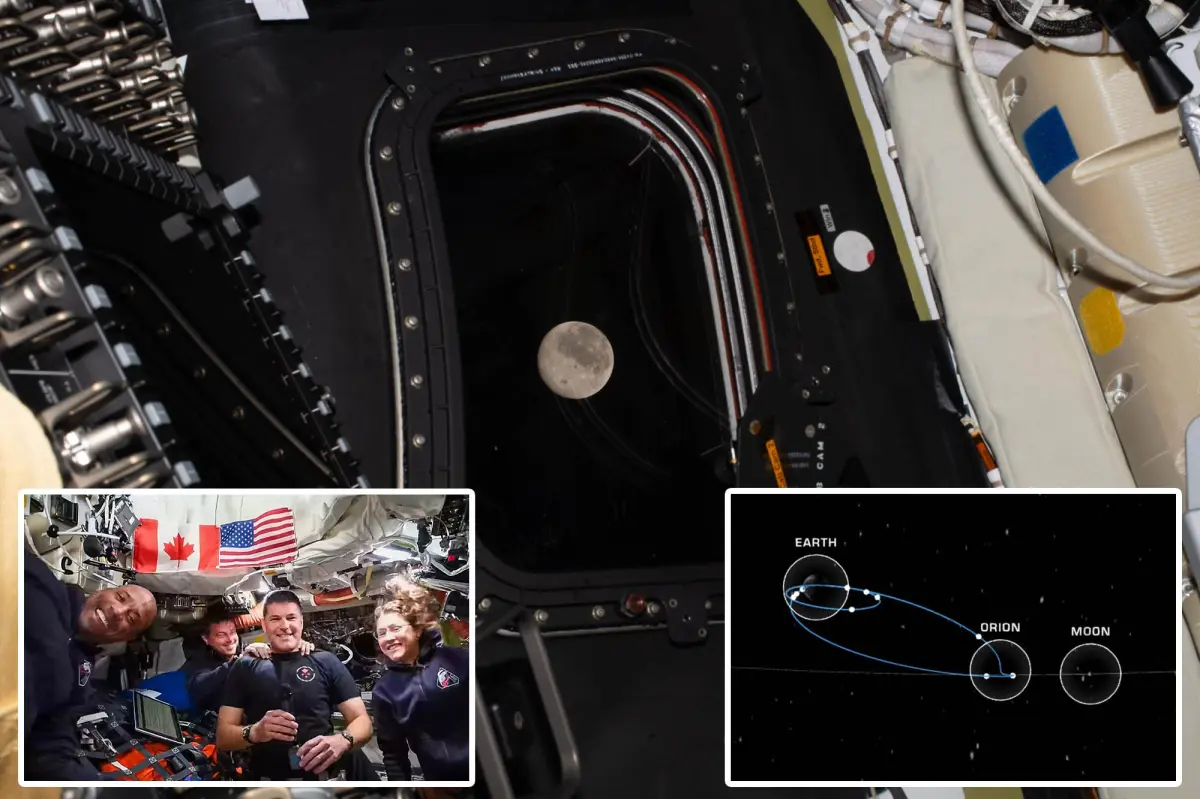
It’s the sound of silence.
Tonight, the moon-bound astronauts and NASA mission control will face a nail-biting moment this evening when the Artemis II enters a deep-space dead zone that cuts them off from Earth for around an hour.
This blackout period comes as NASA astronauts Reid Wiseman, Victor Glover and Christina Koch and Canadian astronaut Jeremy Hansen are slated to travel 252,757 miles from Earth during their fly-by of the moon, over 4,000 miles beyond the record set by the ill-fated Apollo 13 mission in 1970, Reuters reported.
This important milestone will occur at around 7:05 p.m. EST, during which the lunar explorers will get a never-before-seen view of the dark side of the moon.
However, coinciding with this pivotal point, at around 6:45 p.m., the crew will undergo one of the most frightening moments of the voyage — a total communications blackout, the BBC reported.
At that time, our pockmarked satellite will obstruct the signals between the Orion spacecraft and NASA’s mission control in Houston, leaving the astronauts alone with their thoughts in the void of deep space, more isolated than anyone in history.
This means that if something goes wrong during this tense part of the journey — which is littered with potential risks at every stage — there is no way the astronauts can alert Houston should they have a problem.
Michael Collins, who orbited the moon in the Apollo 11 command module in 1969 while compatriots Neil Armstrong and Buzz Aldrin explored the surface, reportedly lost contact with the pair and mission control for 48 minutes — a period during which he said he felt “truly alone” and “isolated.”
Michigan State University astronomy professor Darryl Seligman, who is not involved with the current mission, called this upcoming moment of silence “nerve-racking.” “I am totally in awe of the Artemis II astronauts and their bravery,” the space expert told The Post.
Nonetheless, Seligman said that he was “100% confident that everything will be smooth sailing tonight during the blackout period.”
Artemis pilot Victor Glover said he hopes this nerve-racking moment will help unite people back at home.
“When we’re behind the Moon, out of contact with everybody, let’s take that as an opportunity,” the astronaut told the BBC ahead of their lunar voyage. “Let’s pray, hope, send your good thoughts and feelings that we get back in contact with the crew.”
During this isolating point in the 10-day moon mission — the first since the Apollo astronauts’ tour in 1972 — astronauts will — the crew will be circumnavigating the moon at altitudes between 4,000 and 6,000 miles.
It will reportedly appear through capsule portals at about the size of a basketball held at arm’s length, allowing the astronauts to gaze at the rock in all its splendor.
Most importantly, they will be able to see something no human has ever laid eyes on — the far side of the moon, which is perpetually blocked from view from Earth and was shrouded in shadow during the prior Apollo mission.
They already got a preview of this mysterious zone over the weekend, spotting and documenting features such as the Orientale basin, a huge, black impact crater that measures nearly 600 miles in diameter.
“This mission marks the first time the entire basin has been seen with human eyes,” NASA wrote while sharing the photo in a Sunday X post.
Should this lunar dry run be successful, it will pave the way for an actual moon landing, which NASA has planned for 2028 on Artemis IV.