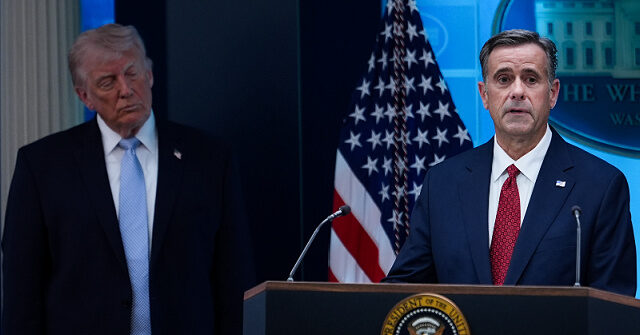
President Donald Trump and CIA Director John Ratcliffe on Monday detailed a high-risk rescue deep inside Iran in which U.S. forces — aided by a CIA-led “deception campaign” — raced “against the clock” to locate and recover a wounded airman concealed in a mountain crevice, “invisible to the enemy, but not to the CIA,” after his F-15E Strike Eagle was shot down, while evading capture for nearly two days behind enemy lines.
Speaking at a White House news conference following the successful rescue of both the F-15E pilot and his weapons systems officer (WSO), who ejected over Iran after their aircraft was downed Friday morning, Trump described the mission as “one of the most daring Search and Rescue Operations in U.S. history,” emphasizing that the operation’s success “involved a lot of subterfuge” as U.S. forces deliberately misled Iranian units searching for the wounded airman across mountainous terrain.
Trump said the deception effort included coordinated activity across multiple locations to confuse Iranian forces, explaining, “We had seven different locations where they thought he was, and they were very confused,” adding that planners intentionally created the impression the airman was elsewhere while the real recovery operation was underway.
He also pointed to the scale of the operation, describing a large, coordinated force involving scores of aircraft and special operations personnel operating across multiple axes to execute both the deception effort and the recovery missions.
Trump credited Director Ratcliffe and the CIA with playing a decisive role in locating the airman, describing the intelligence effort as central to the mission’s success.
Ratcliffe described the effort as a “race against the clock,” explaining that CIA officers were tasked with identifying a single individual across vast, hostile terrain based on limited and intermittent signals that initially raised concerns about possible enemy deception.
“It was comparable to hunting for a single grain of sand in the middle of a desert,” Ratcliffe said, detailing how analysts worked to authenticate transmissions while Iranian forces and civilians were actively closing in on the area.
He said the Agency leveraged what he described as “human assets and exquisite technologies that no other intelligence service in the world possesses” to verify the airman’s identity and ultimately pinpoint his location.
Ratcliffe added that the airman remained “concealed in a mountain crevice … invisible to the enemy, but not to the CIA,” underscoring the precision of the intelligence effort.
At the same time, he confirmed the CIA executed a deception campaign designed to misdirect Iranian search efforts — pushing false signals and narratives that diverted enemy forces away from the airman’s actual position as U.S. military planners prepared the extraction.
Once the location was confirmed, the operation rapidly transitioned into execution, with War Secretary Pete Hegseth describing the mission as a “high-risk, high-stakes” operation conducted “deep inside enemy territory in Iran.”
“These are not routine operations,” Hegseth said, describing how U.S. forces synchronized air, ground, and special operations capabilities while employing deception and conducting strikes to suppress Iranian threats converging on the area.
Hegseth highlighted the wounded WSO’s ability to survive and evade as critical to the mission, detailing how the airman relied on his training to move away from the crash site, gain elevation, and avoid capture for nearly 48 hours while “scaling rugged ridges” as enemy forces closed in.
Hegseth said the airman ultimately activated his emergency transponder and transmitted the message, “God is good,” which helped confirm he was alive — though officials initially worked to verify the signal’s authenticity given the risk of enemy interference.
He further detailed the intensity of the operation, noting that U.S. forces conducted extended-duration flights — including roughly seven-hour missions over Iranian territory — while maintaining continuous coordination from a secure command center for more than 45 hours as planners tracked and executed both recovery efforts.
Chairman of the Joint Chiefs of Staff Gen. Dan Caine, who also spoke at the briefing, described the effort as a “no-fail mission” from the outset, requiring uninterrupted coordination from the moment the aircraft was shot down.
Hegseth underscored that point, stating, “The call never dropped. The meeting never stopped. The planning never ceased,” describing the sustained command effort behind the operation.
The first recovery, of the F-15E pilot, was carried out within hours of the shootdown in what officials described as an audacious daylight operation, with U.S. aircraft operating over Iranian territory under fire to retrieve him.
The second recovery, involving the wounded WSO, proved significantly more complex as he moved to higher ground, concealed himself in mountainous terrain, and remained hidden while Iranian forces converged on his location.
Enabled in large part by CIA intelligence and deception efforts, U.S. special operations forces ultimately executed a nighttime extraction, inserting into the rugged terrain and recovering the airman before evacuating him from Iranian territory.
During the operation, U.S. forces established forward staging positions and deployed rotary-wing aircraft brought in for the mission, while strike and surveillance assets worked to secure the extraction corridor.
Despite complications during the final phase — including aircraft issues that required contingency procedures — all U.S. personnel were successfully recovered, and no American fatalities were reported.
Hegseth said the operation left Iran’s military “embarrassed and humiliated,” adding, “The Iranians are still asking themselves … how did the Americans do this?”
Trump echoed that assessment, saying the mission demonstrated that “we leave no American behind,” while noting the risks involved and the potential for significantly higher casualties without precise execution.
The rescue unfolded over the weekend as part of the broader U.S. campaign against Iran under Operation Epic Fury, which on Monday entered its 38th day.
Beyond the battlefield, the CIA’s central role in the operation reflects a broader shift under Ratcliffe’s leadership.
As Breitbart News reported in a January profile, Ratcliffe has emerged as President Trump’s “quiet hammer,” reshaping the Agency into a more aggressive, mission-focused organization aligned with the administration’s national security priorities.
“Under Director John Ratcliffe, CIA is back to focusing on mission and is executing on President Trump’s national security priorities,” CIA Director of Public Affairs Liz Lyons told Breitbart News at the time, describing an Agency “willing to take risks to give the United States a decisive advantage.”
That approach was on full display in the operation detailed Monday, where intelligence, deception, and military force were tightly integrated to locate, protect, and extract an American service member from deep inside hostile territory.
Trump framed the outcome as both a tactical success and a broader message, declaring that U.S. forces will “go anywhere, anytime” to protect American personnel and complete the mission.
Joshua Klein is a reporter for Breitbart News. Email him at jklein@breitbart.com. Follow him on Twitter @JoshuaKlein.