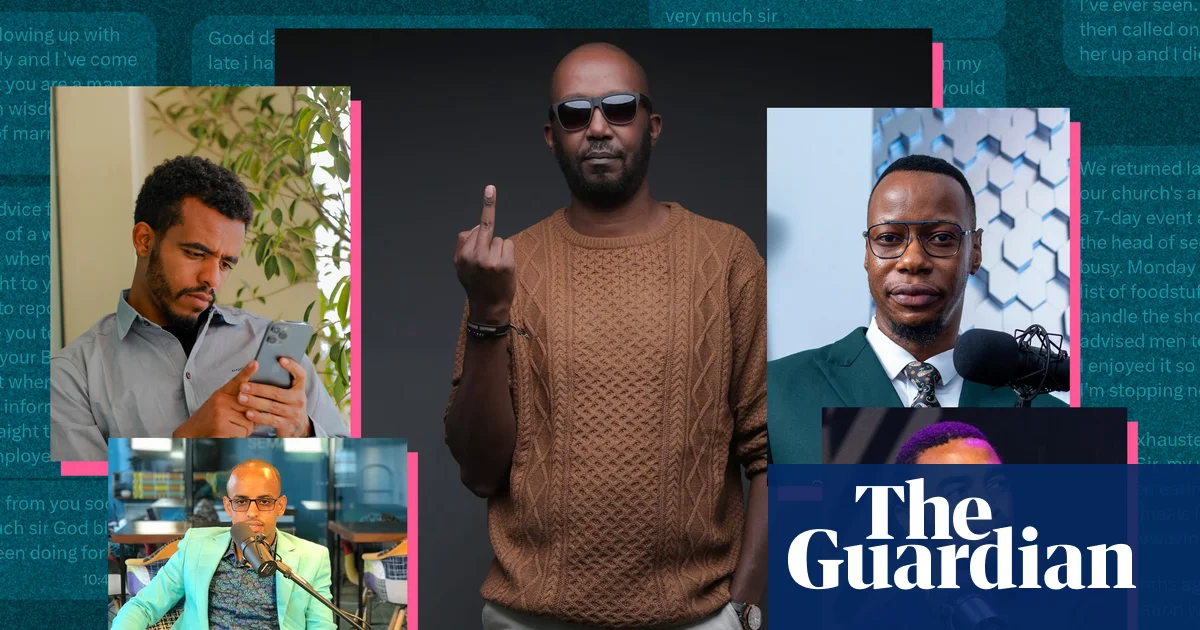
It is not just Europe and the US that are grappling with a growing landscape of misogynistic influencers online. While Andrew Tate, Myron Gaines, Sneako and other voices grow in toxicity in the manosphere of the west, across Africa – which has more than 400 million people aged between 15 and 35 – several individuals are gaining traction.
The manosphere is a loose network of communities that claim to address men’s struggles such as dating and fitness, but often promote harmful misogynistic attitudes. Sunita Caminha, who leads UN Women on ending violence against women and girls in east and southern Africa, first started noticing its presence in Africa about five years ago, and believes it is on the rise. “Research and data that keeps coming out is very consistent [in] showing this is an alarming issue in different countries and contexts across the continent.”
Awino Okech, a professor of feminist and security studies at Soas University of London, also started noticing harmful digital content expanding about five years ago, but says falsehoods peddled against women in Africa predate the proliferation now online. “The ideas that shape the manosphere are linked to those of men’s rights organisations like Maendeleo ya Wanaume. Its big argument was that men and boys were being left behind as a result of all of the investments that had been made around girls’ and women’s rights.”
This view – know as the red pill theory – has been amplified by the manosphere, framing men as the victims of a society distorted by feminism. The men who populate the manosphere have made it their mission to redress the balance – through domination and intimidation.
The result? Women who voice ideas or opinions are threatened, harassed and hounded offline, and online abuse of female politicians is on the rise globally. Experts say the atmosphere empowers some of the more extreme features of misogyny, including trafficking and sexual exploitation of girls and women, femicide, physical and verbal violence, stalking and domestic abuse.
Q&A
What is technology-facilitated gender based violence (TFGBV)?
Show
As the world becomes increasingly digital, the spaces and methods for perpetrating gender-based violence are expanding and proliferating at an alarming rate.
Technology-facilitated gender-based violence (TFGBV) is, as defined by the UN, any “act committed using information communication technologies or other digital tools, which results in physical, sexual, psychological, social, political or economic harm, or other infringements of rights and freedoms”. The consequences are severe, affecting many aspects of women and girls’ lives and often forcing them to self-censor or leave the online world altogether. The term reflects how technology can result in harm, both in the digital, and real, world.
Millions of women and girls are affected by TFGBV every year with research suggesting that up to 60% of women around the world have experienced this type of gendered abuse.
TFGBV takes many forms. For example, doxing is the act of sharing someone’s personal information online and can lead to stalking and physical violence in real life. Deepfake abuse, where manipulated images or videos are published online, can damage someone’s reputation and have a lasting impact on their life. Sexual harassment, intimidation and sextortion are also common forms of TFGBV.
It infiltrates homes, workplaces, schools and universities. It has no limits and can occur anywhere. It can start online and escalate into the offline world, or the other way around, culminating in the most extreme forms of violence, including femicide.
Certain groups are more at threat – young women and girls, who are more likely to use technology and are therefore more exposed; women with disabilities, women of colour and LGBTIQ+ people; and women in political and public life such as parliamentarians, activists and journalists.
There are huge gaps in data, policy and the law when it comes to TFGBV, and several international organisations have been working with governments and the tech industry to combat the issue.
“There is a straight line between blogs and YouTube channels denigrating women to physical violence, including femicide,” says Okech. “This is seen in the language used by men to ‘explain’ why they killed women.”
We looked at some of the manosphere figures gaining online momentum on the continent.
Amerix – Kenya
On his website, Eric Amunga, who goes by the name Amerix, calls himself a reproductive health specialist who promotes “a holistic approach to the wellness and welfare of men”.
“Through my unique wellness plans that promote men’s health, I have helped men regain their health, pride, self-esteem and a sense of masculinity,” he writes. His advice comes packaged with deeply misogynistic attitudes.
He has 2.3 million followers on X, his main platform, and 160,000 on Facebook, as well as 120,000 subscribers to his Telegram channel and 15,000 to his WhatsApp. He hosts a podcast and has online courses available through his website, where he writes blogposts, including one on how to detoxify from Covid-19 vaccines. He gains hundreds of thousands of followers a year.
Amerix spouts views that unmarried women over 30 are “red flags”, and tells men not to “sleep with sluts” or engage in oral sex to “protect their sexual energy from sex predators”. In recent posts on X, he says the “biggest lie” ever told is that “If you empower a woman, you empower a community.”
He adds: “It is only a man who can empower a community, and that begins when he is a FATHER and a LEADER of his family.”
He is disparaging of “fat” women and “simps” (a man showing deference to a woman). He recently resurfaced a post from 2022 telling men not to engage in “effeminate bullshit” and to “disengage” when their wife becomes pregnant. He is the main propagator of the hashtag #MasculinitySaturday, where he advises men on relationships and other aspects of life.
Andrew Kibe – Kenya
Andrew Kibe, a former radio host turned podcaster, had more than 420,000 YouTube subscribers before his account was terminated by Google in 2023 for violation of the platform’s terms of services.
In response he was key in setting up Yafreeka, which positioned itself as an African version of YouTube. He invited other influencers with more than 100,000 followers to use the platform. Its current status is unclear, and Guardian inquiries went unanswered. One Kenyan podcaster says it has “failed miserably”. Kibe also has a sizeable presence on X, as well as smaller followings on Instagram and TikTok, and his live streams have begun appearing on YouTube again.
In 2026, Kibe has been appearing at events he organises, and on several popular podcasts in Kenya, promoting his book, 28 Commandments: A Journey into Manhood. In it, he tells men to never share their problems with women, who see them as either “power or puny”. He is disparaging of modern day marriage and monogamy. He believes workplaces are “toxic” for men.
In January, there was a backlash across social media when he claimed that women’s sole purpose was to bear children.
Àgbà John Doe – Nigeria
The well-populated Nigerian manosphere is primarily on X, where key influencers, including the anonymous Àgbà John Doe, discuss relationships, masculinity, finances and traditional gender roles. Àgbà means “elder” in Yoruba, and in his bio he calls himself commander-in-chief of the Àgbàfians – his followers.
He has a brusque style, finishing posts on X with “End”. His views on women have been labelled misogynistic. In one post, he says: “You’ll hardly know a woman’s true character, until her hymen is broken.” In another, he writes: “One man can deflower 5-10 women in his lifetime. So there isn’t [sic] enough virgin women to go round. Men who did not deflower women, aren’t just “modest or saintly”. They didn’t have the courage or wit, or skill to do it.”
Ugochi Ihe, who works for TechHer, a Nigerian organisation that encourages women and girls to work with technology but is increasingly looking at online abuse, says Doe is one of three main influencers in the Nigerian manosphere on X. He and two others, Shola and Sir Dickson, have more than 1.6 million followers combined. Ihe says they position themselves as experts on relationships, encouraging people to send in questions, to which they respond. They also target feminists online, she adds.
Ihe believes their behaviour is increasingly linked to being able to make money. In 2023, X introduced Creator Revenue Sharing where users are financially rewarded for creating content and engagement on the site. “When you can post something [about “incel” (involuntarily celibate) culture] on X and make more money than a monthly salary, it’s the incentive they need,” she says.
Naty Mon – Ethiopia
With a TikTok following of almost half a million, Naty Mon is one of the most prominent voices in the Ethiopian manosphere. He is seen in the same digital circles as, and often collaborates with, Bella Axumawi, an influencer who covers his face and calls women derogatory terms, such as the Amharic equivalents of “slut” and “whore”.
Mon has become known for his TikTok live streams, which are republished on other social media sites such as Instagram and YouTube. He invites young women on, then talks about their bodies and asks them about sexual positions. He uses Telegram to circulate information and photos of women he is trying to shame. He employs a mix of humour, satire and Amharic slang to critique the behaviour of Ethiopian women, as well as to slam feminists.
Ethiopia is a predominantly Christian country, and Mon uses religion and quotes from the Bible to support his argument that women are not supposed to be equal to men. He has said women should not talk back to a man.
In the past, accusations of sexual harassment against him have aired on Facebook, according to a digital rights activist who requested anonymity. He has denied them all and no action was taken. She says: “For most women, Naty Mon is the most frustrating entity on TikTok because he’s almost beyond the law.”
Research by the Centre for Information Resilience has found that Ethiopian influencers and other content creators on podcasts, TikTok and YouTube spread misogynistic content and use offensive gendered slurs, often under the guise of comedy. The study also highlights a crisis in content moderation and regulatory enforcement in Ethiopia, with many people doubting platforms’ ability to tackle online abuse effectively.
Xaliye – Somalia
A former TV journalist turned influencer, Abdisamad Xaliye is based in Nairobi, Kenya. He is primarily known as Xaliye, which means “fixer” or “solver”, and hosts a podcast in Somali, Fikradaha Xaliye (Xaliye’s thoughts). His YouTube channel has 178,000 subscribers and he has almost 500,000 followers on TikTok.
Xaliye focuses on themes of masculinity and self-improvement. Some of his views have attracted controversy: he advises men to be cautious with women and never give money to girls they are dating, while calling women derogatory names and body shaming them for not exercising enough and not being in shape. He hosts live dating shows on TikTok where he berates and shames women who call in. He advocates for a return to traditional masculine and feminine roles and has been criticised for promoting submissiveness and condemning women for pursuing careers. He has drawn the ire of Somali female influencers such as Fathia Absie, a women’s rights activist based in the US, who have responded to his TikToks.
Shadaya Knight – Zimbabwe
With nearly 700 million followers on X, Shadaya Knight (real name Night Tawona Shadaya) is a prominent and prolific social media personality who has been referred to as Zimbabwe’s Andrew Tate. His banner picture on X includes images of Andrew Tate, Elon Musk and Donald Trump. He is a frequent guest on several popular podcasts, and also hosts his own, on which he interviews people.
Shadaya attracted international attention in 2023 when he posted on X about a Vogue cover showing Rihanna leading the way holding A$AP Rocky’s hand while he carries their baby. He wrote about the image: “The emasculation of men continues … you can already tell who the man in this relationship is … that dude about to be a proud mother of two.” The post went viral attracting more than 20 million views and various US celebrities responded, many deriding him.
This month he posted again about Rihanna referencing a photo of her with A$AP Rocky: “Men aren’t attracted to a woman’s achievements (her being a superstar billionaire) BUT are attracted to a woman’s femininity (youthfulness) Rihanna must understand, A$AP is still in his prime, meanwhile she’s washed up, she’s old and fat …”
He has made numerous other controversial and misogynist statements. In 2020, MailOnline reported on the backlash to his thread listing the “benefits” of dating a woman “aged 18-25”, including being with someone who is “less sexually experienced” and “more likely to submit”. He has expressed strong opinions on single mothers, masculinity, and relationships, often sparking heated discussions.
Penuel The Black Pen – South Africa
Penuel Mlotshwa, who goes by Penuel The Black Pen, is best known for hosting a podcast, The Penuel Show, on YouTube, where he has 133,000 subscribers and has amassed around 15 million views. He is also on X where he has 130,000 followers. He has built a following by taking an in-depth approach to politics, social issues, fatherhood, and the history of South Africa. He sometimes gives a platform to polarising figures, and in 2024 interviewed Siphesihle Nxokwana, an anti-feminist influencer.
Some of his comments and views have been labelled misogynistic. He has said, “Most women are confused, delusional and responsible for most broken families …” and told people to teach boys to “never to open up and be vulnerable to their partners. Most of them weaponise that vulnerability when they are angry”. He has implied women go after men for their money, posting on X, “If men went after women’s money, as much as women go after men’s money … more & more women would stop getting married.”
Unlike some other voices in the South African manosphere, Mlotshwa does not hide behind anonymity. Born and raised in Newcastle in Kwa Zulu Natal, he performed well at school before attending university and then working in banking. He quit and later grew a following on social media during the Covid pandemic. He has said he does not believe in marriage and that he has six children with different women.
Siddharth Venkataramakrishnan, an analyst at Institute for Strategic Dialogue who has been researching the South African manosphere, says it’s not necessarily the most extreme voices that get the most attention. He says, “Mlotshwa is successful at mixing somewhat questionable content with less controversial content. That speaks to why he gets [a bigger following] than somebody who’s just doing ‘women are all terrible’ content, which I think is not as powerful.”